Go watch this week's Sunday Funny first. See the four panels. A real business runs the same trade the strip draws, and it runs it on small children.
The recipe
Bloomberg looked inside this trade in late 2025. The reporters found a simple playbook. One creator, Monique Hinton, showed her million followers the recipe 1. She asks ChatGPT for "simple, repetitive" children's songs with "playful nonsense words like la la, na na or clap clap" 1. The words go into a video tool. Then the ad money rolls in 1. Hinton admits the machine does about 95 percent of the work 1. The channel stays faceless. A bot posts six or seven clips a day. One channel started in August 2025. By late January it had posted 7,770 videos, about one every half hour 2. Each view earns a sliver. The sum grows huge. Fairplay, a watchdog group, counts more than $4.25 million a year going to the top channels built for babies 3. Bloomberg puts the wider slop economy near $117 million and 221 million subscribers 1.
On TikTok the recipe sells as a dream. Young hustlers post how-to clips and promise easy money. The kids' niche earns a name as simple volume. A toddler replays a jingle forty times, and the watch time stacks up. The goal sits in plain sight: make the cheapest loop, aim it at the youngest eyes, and keep them watching. Deloitte named the risk in its 2026 predictions: "Generative video could empower independent creators and boost platforms' ad revenues, but it also risks overwhelming audiences, eroding authenticity, and fueling misinformation, likely intensifying regulatory scrutiny" 8.
Built to hold
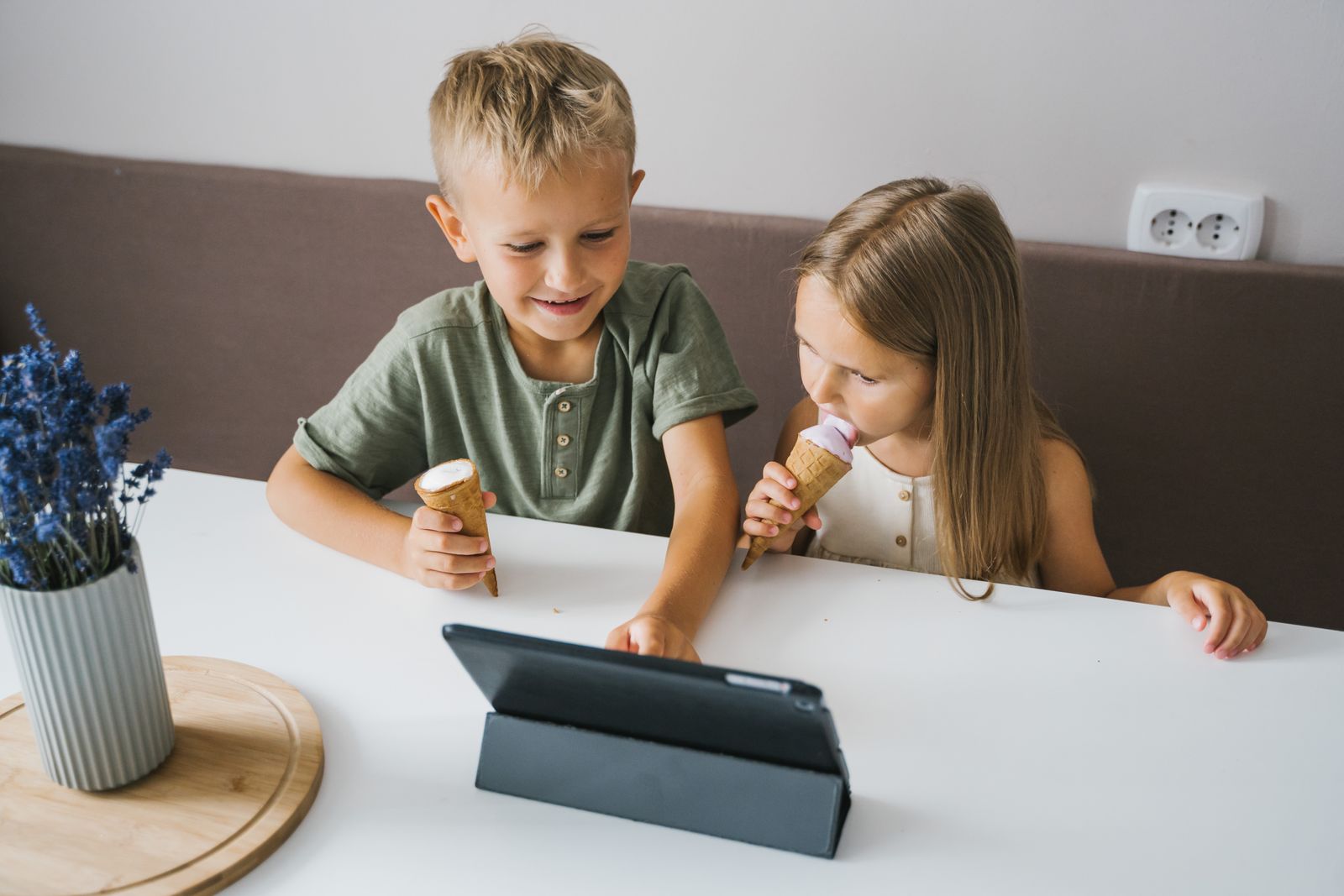
The videos hold attention, and that is the whole design. A New York Times investigation watched more than 1,000 shorts made for small kids. Reporter Arijeta Lajka summed up the finding: "The YouTube algorithm is pushing bizarre, often nonsensical A.I.-generated videos targeting children" 2. After one CoComelon video, about 40 percent of the next clips were machine-made 2. Many showed warped faces, spare limbs, and melted words. The tools are new and cheap. Sora, Veo, and Runway can spin a clip from one line of text 5. MIT Technology Review has tracked the same slop wave across every platform this year 5. An adult scrolls past it. A baby takes it as a lesson. Toddlers learn how the world works by watching it. A screen full of melted faces and broken words teaches the wrong things.
What play teaches
The strip makes the point better than a chart can. A child who solves a puzzle learns to wait. She hunts for the edge piece. Her hands feel the click when it fits. Solve the puzzle for her, and the lesson leaves with the fun. Growth runs on that effort. Common Sense Media counted the hours in 2025. Children under eight watch about two and a half hours of screens a day 6. Four in ten two-year-olds hold their own tablet 6. JAMA Pediatrics followed 7,100 one-year-olds. More screen time at age one linked to speech and problem-solving delays at ages two and four 7. Put the two facts together. The hours the feed takes are the hours a young brain would spend learning to think. Watch time climbs. The skill a puzzle builds falls away.
Pushback
Pressure is building on YouTube. Neal Mohan, the chief executive, called AI slop a priority in his January 2026 letter 4. A July 2025 rule now treats mass-produced, repeated uploads as "inauthentic content" 4. The platform wiped sixteen channels at once. Those accounts held about 35 million subscribers and 4.7 billion views 4. YouTube is testing a prompt that asks viewers to grade how much a clip feels like slop 4. Fairplay gathered more than 200 groups behind a letter to Mohan and Sundar Pichai 3. The letter asks for firmer limits around the youngest users 3. Deloitte expects Washington to move next 8. It forecasts fresh age checks, new fights over the 1996 liability shield, and labels on AI video 8.
By the numbers
- 40 percent of the shorts served to small kids after a nursery hit were machine-made 2.
- $4.25 million a year flows to the top AI channels made for children 3.
- 1,000 shorts fed to toddlers formed the sample for that count 2.
- Two and a half hours of screens a day is the average for kids under eight 6.
- 40 percent of two-year-olds own a tablet today 6.
- 7,100 one-year-olds in a JAMA study showed more screens tracking with delay 7.
- 16 channels, 35 million subscribers, and 4.7 billion views fell in one YouTube purge 4.
- 90 percent of web content could be machine-made by 2026, on one Europol estimate 9.
What comes next
The trend points one way. Europol has guessed that up to 90 percent of web content could be machine-made by 2026 9. The tools keep getting cheaper and faster. Deloitte expects fresh laws on age checks and content labels 8. Call 2027 and 2028 the sorting years. One road runs bright. Platforms label real human work, a paid tier of trusted kids' shows grows, and parents pay a little more for a show built by people who study how three-year-olds learn. The other road runs dark. A fully machine-made baby feed takes over, an endless scroll of cheap wonder tuned to hold a toddler's eyes, sold for a fraction of a cent 8. Kids raised on that road learn to expect the world to solve itself, the way the boy expected his robot to.
Here is the part the numbers miss. Fun is how a child practices being a person. The wait, a guess, one small win: each builds a mind. Trade all of it for a smooth feed, and the child grows used to ease and stays hungry for it.
What the boy wants back is the doing itself. He wants the waiting, the trying, and the win his own hands earn. A tool that skips the effort offers a smaller life dressed up as a gift. Our job is to guard the friction worth keeping. Hand a child a screen that asks something back. Give the fun back.
Sources
- Bloomberg, "YouTube Creators Find a New Consumer for AI Slop: Babies," Bloomberg, Dec. 3, 2025, https://www.bloomberg.com/news/articles/2025-12-03/ai-slop-youtube-videos-for-kids-pretend-to-be-educational
- Arijeta Lajka, "Investigation: YouTube Recommends AI Slop Videos to Toddlers and Preschoolers," The New York Times, 2026, https://www.nytimes.com
- Fairplay, "Open Letter to YouTube and Google on AI Slop Aimed at Children," Fairplay, March 2026, https://fairplayforkids.org/wp-content/uploads/2026/03/YouTube-Letter-AI-Slop.pdf
- Fortune, "200-Plus Organizations Urge YouTube and Google to Protect Kids," Fortune, April 1, 2026, https://www.fortune.com/2026/04/01/ai-slop-200-organizations-letter-youtube-google
- MIT Technology Review, "How I Learned to Stop Worrying and Love AI Slop," MIT Technology Review, Dec. 23, 2025, https://www.technologyreview.com/2025/12/23/1130396/how-i-learned-to-stop-worrying-and-love-ai-slop/
- Common Sense Media, "The 2025 Common Sense Census: Media Use by Kids Zero to Eight," Common Sense Media, 2025, https://www.commonsensemedia.org/research/the-2025-common-sense-census-media-use-by-kids-zero-to-eight
- JAMA Pediatrics, "Screen Time at Age 1 Year and Communication and Problem-Solving Developmental Delay at 2 and 4 Years," JAMA Pediatrics, 2023, https://jamanetwork.com/journals/jamapediatrics/fullarticle/2808593
- Deloitte, "Technology, Media & Telecommunications Predictions 2026," Deloitte, 2026, https://www.deloitte.com/us/en/insights/industry/technology/technology-media-and-telecom-predictions.html
- Europol, "Facing Reality? Law Enforcement and the Challenge of Deepfakes," Europol Innovation Lab, 2022, https://www.europol.europa.eu/publications-events/publications/facing-reality-law-enforcement-and-challenge-of-deepfakes