AI pulls a dead singer's voice off an old tape now. A film's background effects come from it too. So does a newsroom chatbot's answer to a reader's question. Music, film, books, news and visual art all use the tools now, on real projects, for real money.
The fight over who keeps that money plays out elsewhere. It runs through courtrooms and two union contracts signed in 2023. Settlement checks worth hundreds of millions of dollars changed hands too.
What AI Already Builds, Field by Field
Suno and Udio turn a text prompt into a finished song in under a minute1. Lionsgate signed a deal with the AI video company Runway in September 2024. The deal builds storyboards and background effects for its filmmakers2. Michael Burns, Lionsgate's vice chair, called Runway "a visionary, best-in-class partner who will help us utilize AI to develop cutting-edge, capital-efficient content creation opportunities."
Publishers use similar tools to draft jacket copy and translate backlists. Newsrooms route reader questions through chatbots trained partly on their own articles. The New York Times sued OpenAI and Microsoft over that practice in December 20233.
Image generators such as Midjourney and Stable Diffusion fill stock libraries and film previsualization decks. Software alone makes every picture inside them.
The Lawsuits Deciding Who Owns the Input
Four cases mark where this argument stands. The Times' suit over article training reached summary judgment motions by September 2026. Both sides asked a judge to settle fair use ahead of any trial. The Justice Department backed OpenAI's defense on Sept. 1, calling AI training "exceedingly transformative"3.
A group of authors reached a different outcome. Anthropic agreed in 2025 to pay roughly $1.5 billion to settle their class action. The payout works out to about $3,000 a book, for some 500,000 pirated books its models trained on45.
Mary Rasenberger, the Authors Guild's chief executive, called the deal "a vital step in acknowledging that AI companies cannot simply steal authors' creative work to build their AI just because they need books to develop quality LLMs."

Visual artists have won less so far. Britain's High Court ruled in November 2025 on Getty Images' case against Stability AI. Model weights sit outside the legal definition of a copy under UK law, the court found6. That finding rejected Getty's central claim, leaving only narrow trademark infringement standing.
Music labels keep returning to the same courtroom. Universal Music Group and Sony Music Entertainment sued Suno again in September 2026. This time the claim covers 60,202 recordings a judge had refused to fold into their first case1.
Warner Music Group was once a co-plaintiff in that fight. It settled with Suno in 2025 and now licenses its catalog to the platform instead.
AI's Arts Lawsuits Hit 5 Milestones in 33 Months
Dated filings, rulings and deadlines named in this piece, December 2023 to September 2026
Each pin marks one dated legal event; the cluster at the right shows how much landed in 2026 alone.
Sources: The Next Web [1]; openclassactions.com [3]; Authors Guild [4]; Mayer Brown [6]; Praxikon [12]. Chart by Ryan Elliott Dennis.
The numbers behind this chart
| Date | Event |
|---|---|
| Dec. 2023 | NYT sues OpenAI, MSFT |
| Sept. 2025 | Authors settle for $1.5B |
| Nov. 2025 | UK rules for Stability |
| Aug. 2026 | EU disclosure law begins |
| Sept. 2026 | Labels sue Suno again |
Court papers unsealed on Sept. 17, 2026 told a different story in private. Brent Hecht, Microsoft's director of applied science, wrote an internal memo about the same AI training. He called it "an astonishing theft of unprecedented proportions" and "the largest theft of labor in human history"7.
Microsoft's outside lawyers argue something else in court. There, the same training counts as fair use. Fair use is the legal term for copying that transforms an original enough to escape infringement claims.
What Two Union Contracts Already Changed
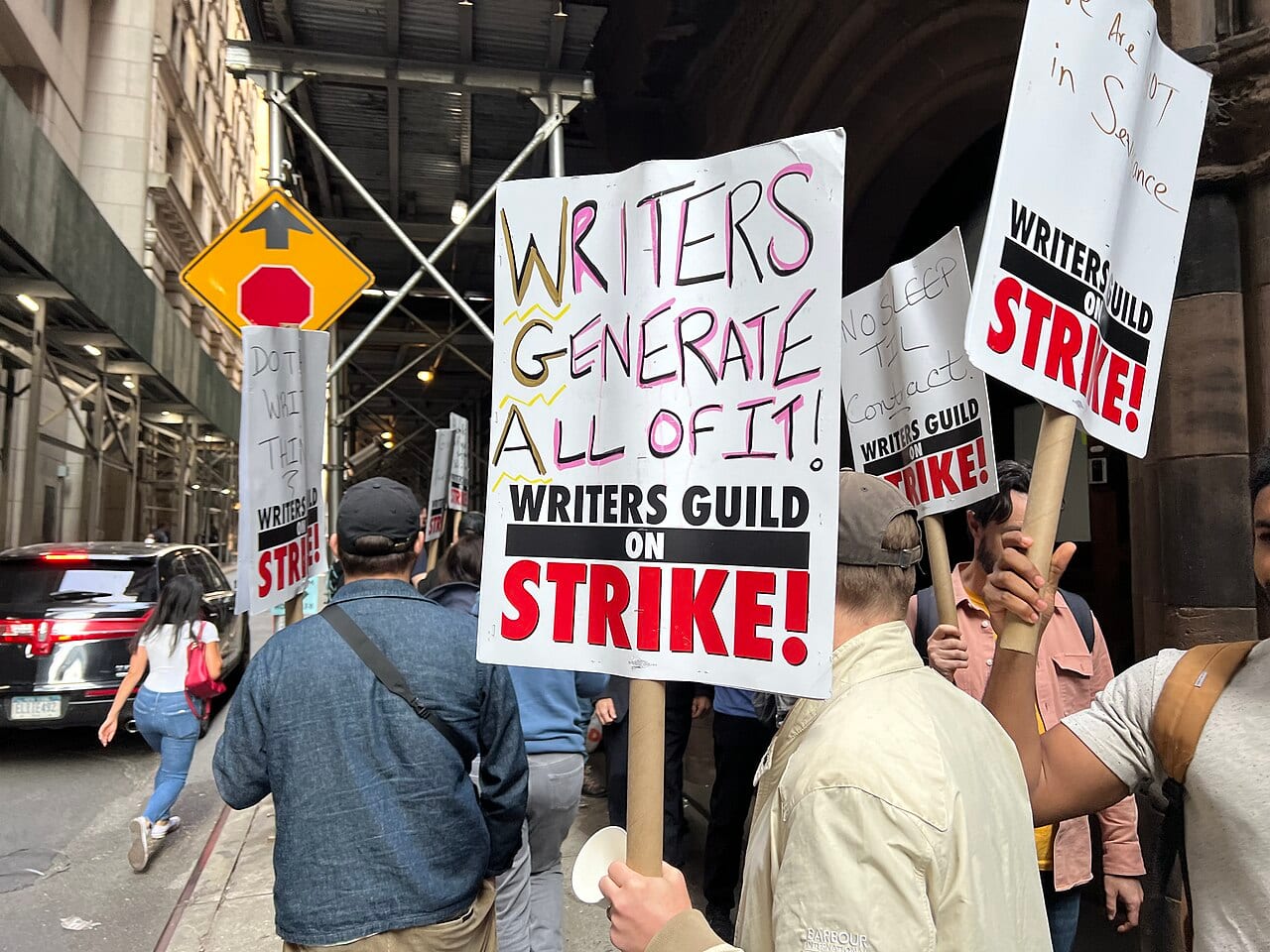
Two entertainment unions moved before any regulator did. The Writers Guild of America's 2023 contract covers a studio that hands a writer an AI-drafted screenplay. That studio has to pay the writer as the screenplay's first writer, the full fee a rewrite payment would skip8.
The same contract also bars forced AI use. It also requires disclosure of AI-generated material handed to a writer.
Ellen Stutzman@ellenstutzmanBut for the writers of everything they stole to build their AI? https://t.co/iRrf0QbNuq
SAG-AFTRA's 2023 television and theatrical contract works through consent instead of credit. A studio can build a digital replica, a computer-made stand-in for a performer's voice or face. It needs that performer's signed consent first, tied to pay for each use9. An independently created replica, built apart from any employment deal, needs the performer's consent or their estate's.
Goldman Sachs put a number on the stakes those contracts answer. The bank estimated this in March 2023. Generative AI could perform 26 percent of the tasks across arts, design, entertainment, sports and media jobs, it found10.
That number sits just above the 25 percent found across every industry. It sits well under the 46 percent found in office work.
Arts Jobs' AI Task Exposure Lands at 26%, Near the Economy's 25% Average
Share of industry task time Goldman Sachs estimates generative AI could perform, United States, 2023
Each bar is one industry Goldman Sachs measured; the arts bar sits just above the all-industries line and far under office work's share.
Goldman Sachs estimates the share of task time AI could perform, separate from jobs lost; most exposed workers keep their jobs, with AI handling part of the task load.
Source: Goldman Sachs Global Investment Research [10]. Chart by Ryan Elliott Dennis.
The numbers behind this chart
| Item | Value |
|---|---|
| Office and Administrative Support | 46% |
| Arts, entertainment & media | 26% |
| All Industries | 25% |
What Counts as Honest Now
A separate fight over honesty followed the consent rules into 2025. The AI talent studio Xicoia shopped an AI performer named Tilly Norwood to talent agencies that September. SAG-AFTRA answered within days, naming the problem directly: "It doesn't solve any 'problem' — it creates the problem of using stolen performances to put actors out of work, jeopardizing performer livelihoods and devaluing human artistry"11.
Lionsgate would answer that question differently. Its Runway deal keeps the tools under its own filmmakers' control, the studio says. The tools serve people who hold the job now2.
Regulators drew a line of their own too, when the European Union's AI Act took a new step on Aug. 2, 2026. From that date, anyone deploying such a system has to label the result as machine-made. The duty covers a deepfake image, sound or video, across all 27 member states12. An evidently fictional or satirical work keeps a lighter version of the same rule, one that leaves its enjoyment intact.
What to Do
Two guarantees sit inside these rules now. The WGA keeps AI use voluntary for a writer. SAG-AFTRA ties a digital replica to signed consent. Look for both in your own contract before signing anything new89.
Ask where your own work sits inside a settlement class. Authors covered by the Anthropic case can check a public works list for a payout. Musicians whose labels settled with Suno can ask the same question. Warner Music Group settled in 2025, and its artists can ask their rights society41.
Read a disclosure label when a platform offers one. A U.S. platform can add the same label on its own initiative, ahead of any mandate12.
By the Numbers
- 26 percent: AI's estimated reach into arts and media tasks, against 46 percent in office work, Goldman Sachs says10.
- $1.5 billion: what Anthropic agreed to pay roughly 500,000 authors for training on their pirated books, about $3,000 a title45.
- 60,202 recordings: Universal Music Group and Sony Music Entertainment say Suno trained on these outside any license, in a suit filed Sept. 12, 20261.
- Nov. 4, 2025: Britain's High Court rejected Getty Images' central copyright claim against Stability AI that day, the first such ruling in the UK6.
- Aug. 2, 2026: the EU's AI Act began requiring a visible label on a deepfake image, sound or video, across 27 member states12.
- Two contracts, one year: both the WGA and SAG-AFTRA wrote AI consent and pay rules into the same 2023 round of bargaining89.
What to Watch
Watch the briefing clock in the Times' case against OpenAI and Microsoft. Replies are due Nov. 20, 2026. Judge Sidney Stein could rule on fair use ahead of any trial date3.
Sony Music Entertainment keeps suing Suno directly, even as Warner signs licensing deals around it. Watch whether Sony reaches a license too. Its next move will show whether a license or a courtroom sets music's AI price1.
Sources
- The Next Web, "Universal and Sony sue Suno again, this time over 60,202 recordings," Sept. 18, 2026, https://thenextweb.com/news/universal-sony-second-lawsuit-suno-60202-recordings
- Lionsgate Studios, "Runway Partners with Lionsgate in First-of-its-Kind AI Collaboration," Sept. 18, 2024, https://investors.lionsgate.com/news-events/news/news-details/2024/Runway-Partners-with-Lionsgate-in-First-of-its-Kind-AI-Collaboration/default.aspx
- openclassactions.com, "New York Times vs. OpenAI and Microsoft: Where the Lawsuit Stands," Oct. 1, 2026, https://openclassactions.com/news/new-york-times-openai-microsoft-copyright-lawsuit.php
- Authors Guild, "Key Updates on the $1.5 Billion Anthropic Settlement," Sept. 25, 2025, https://authorsguild.org/news/anthropic-settlement-key-updates/
- PBS NewsHour, "Anthropic to pay authors $1.5B in landmark settlement over pirated chatbot training material," Sept. 5, 2025, https://www.pbs.org/newshour/nation/anthropic-to-pay-authors-1-5b-in-landmark-settlement-over-pirated-chatbot-training-material
- Mayer Brown, "Getty Images v Stability AI: What the High Court's Decision Means for Rights-Holders and AI Developers," Nov. 1, 2025, https://www.mayerbrown.com/en/insights/publications/2025/11/getty-images-v-stability-ai-what-the-high-courts-decision-means-for-rights-holders-and-ai-developers
- TechCrunch, "Microsoft exec called AI scraping 'the largest theft of labor in human history,' new unredacted filings reveal," Sept. 17, 2026, https://techcrunch.com/2026/09/17/microsoft-exec-called-ai-scraping-the-largest-theft-of-labor-in-human-history-new-unredacted-filings-reveal
- Writers Guild of America, "Artificial Intelligence," Sept. 27, 2023, https://www.wga.org/contracts/know-your-rights/artificial-intelligence
- Loeb & Loeb, "Artificial Intelligence Terms of SAG-AFTRA TV/Theatrical Contract," Nov. 1, 2023, https://www.loeb.com/en/insights/passle/2023/11/artificial-intelligence-terms-of-sagaftra-tv-theatrical-contract
- Joseph Briggs and Devesh Kodnani, "The Potentially Large Effects of Artificial Intelligence on Economic Growth (Briggs/Kodnani)," Goldman Sachs Global Investment Research, March 26, 2023, https://www.gspublishing.com/content/research/en/reports/2023/03/27/d64e052b-0f6e-45d7-967b-d7be35fabd16.pdf
- TechCrunch, "Hollywood is not taking kindly to the AI-generated actress Tilly Norwood," Oct. 1, 2025, https://techcrunch.com/2025/10/01/hollywood-is-not-taking-kindly-to-the-ai-generated-actress-tilly-norwood
- Praxikon, "Article 50 EU AI Act: official text, duties and deadlines," Aug. 2, 2026, https://www.praxikon.com/en/ai-act/artikel/50