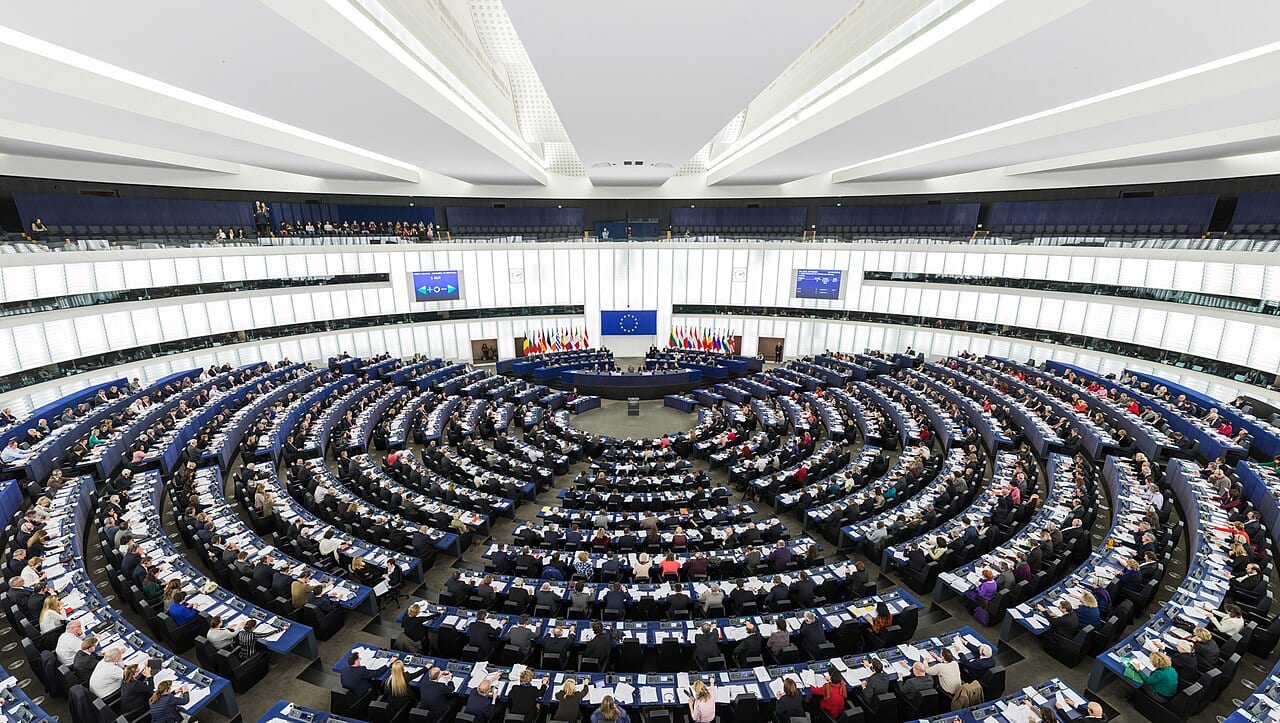
Europe's biggest artificial intelligence law has new deadlines. Lawmakers in the European Parliament voted 423 to 57 on June 16, and the Council gave its final approval on June 29. The two bodies signed Regulation (EU) 2026/1744 on July 8, and it entered into force on July 27, 202612. Commission officials first proposed the change on Nov. 19, 2025, part of a wider push to simplify digital rules across the bloc.

The law's toughest rules cover hiring tools, exam graders and police-risk scores. They now apply from December 2, 2027, instead of August 20262. A separate ban on photo-editing AI apps took effect the same week, with fines that can reach tens of millions of euros34.
Brussels took 8 months to rewrite the AI Act's deadlines
Digital Omnibus on AI, from the Commission's proposal to entering into force, Nov. 2025 to July 2026
Each pin is one step in the law's path; the rail stretches across the five months Parliament and Council spent negotiating before the June votes.
Sources: European Commission [1]; Official Journal of the European Union [2]; NicFab [3]; NicFab [8]. Chart by Ryan Elliott Dennis.
The numbers behind this chart
| Date | Event |
|---|---|
| Nov. 19, 2025 | Commission proposes |
| May 7, 2026 | Deal reached |
| June 16, 2026 | Parliament votes |
| June 29, 2026 | Council approves |
| July 8, 2026 | Law signed |
| July 24, 2026 | Published in OJ |
| July 27, 2026 | Takes effect |
What the New Deadlines Actually Cover
If your company builds or buys AI for hiring, school grading or policing, the deadline moved. Annex III of the AI Act lists these "high-risk" uses2. They include recruitment screening, exam scoring, credit checks, migration tools and predictive policing. Those systems now have until December 2, 2027, instead of August 2, 20261.
AI built into regulated products, like medical scanners or elevators, has until August 2, 20282. That date was August 2, 2027 before the delay7. Miss either deadline, and fines reach €15 million, or 3 percent of global turnover4. That tier runs lower than the nudifier ban's.
The EU's AI deadline moves 16 months for standalone systems, 12 for embedded ones
Added months before EU AI Act high-risk rules bind each class of system, after the July 2026 delay
Each column is one class of AI system; its height is how many months later the rules now apply than first planned.
Sources: European Commission [1]; Official Journal of the European Union [2]. Chart by Ryan Elliott Dennis.
The numbers behind this chart
| Item | Value |
|---|---|
| Standalone (III) | 16 mo. |
| Embedded (I) | 12 mo. |
A Ban That Started on Time
The same law added a ban of its own. Article 5 lists AI practices the Act bans outright. A new entry covers "nudifier" tools2. These apps edit clothing out of a real photo, or invent a nude body for a real face6.
Any system now needs the subject's freely given, specific and informed consent2. Only then can it create or alter images of their body this way. Child sexual abuse material falls under the same new rule. Breaking either part of the ban costs up to €35 million, or 7 percent of global revenue4.
When that ban starts is where the record splits. Several summaries list December 2, 2026, as the date these tools become illegal7. BEUC's own release on the final deal is one of them6.
The regulation's own recitals describe the ban's scope and its exemptions2. They leave timing to the law's general start date, July 27, 2026. A policy or legal team should read Article 113 directly, ahead of any summary.
Who Wanted More Time
Tech trade groups pushed hardest for the extra months. The Computer & Communications Industry Association's Europe office welcomed the new dates in March5. That was months before Parliament's final vote.
Boniface de Champris, the group's AI policy lead, framed the fight as a promise owed5. "The EU promised a simpler regulatory landscape. Now is the time to deliver on the AI Omnibus," de Champris said.
The European Commission backed the same timing1. Executive Vice-President Henna Virkkunen said the extra time lets standards arrive before the rules start. "Our businesses and citizens want two things from AI rules. They want to be able to innovate and feel safe," Virkkunen said the day negotiators struck the deal.

Who Says the Wait Costs Too Much
Consumer and digital-rights groups read the same delay as a cost paid by the public. The European Consumer Organisation, BEUC for short, called the deal a rollback of protections the AI Act had barely delivered6.
Agustín Reyna, BEUC's director general, pointed to systems already running in hiring and other high-stakes decisions6. "The AI Act was designed to establish a clear and harmonised baseline of protection for consumers. This AI omnibus rolls back key consumer protections which had barely been adopted a year ago," Reyna said the day the political deal closed.
In April, those same talks nearly collapsed. Green lawmaker Kim van Sparrentak warned the fight over embedded systems would leave cautious companies worse off than reckless ones9. "Big Tech is probably popping champagne. While European companies that care about safety and did their homework now face regulatory chaos," van Sparrentak told reporters.
A coalition published a joint analysis in June10. AlgorithmWatch, Access Now, ARTICLE19 and Amnesty International signed it. They argued the nudifier ban served as cover for the rest of the delay.
The Commission's answer to Reyna's complaint stays narrow1. Companies need a finished technical standard before they can build toward one. Standards take time either way.
What to Do
Check which of your AI tools fall under Annex III2. That list covers hiring, credit, education and policing tools. You now have until December 2, 2027, to finish conformity checks, instead of this past August.
If your product can edit a photo, check it against the nudifier ban today. Read Article 113 yourself, rather than trust a summary of its start date2.
By the Numbers
- Dec. 2, 2027: the new deadline for Annex III's "high-risk" systems, 16 months after the original Aug. 2, 2026, date2.
- Aug. 2, 2028: the new deadline for AI built into regulated products, 12 months later than planned2.
- A 423-57 vote: the European Parliament's margin approving the delay on June 16, 2026, with 174 abstentions3.
- €35 million: the top fine for breaking the nudifier ban, or 7 percent of a company's global revenue, whichever runs higher4.
- A lower tier: an ordinary high-risk miss costs up to €15 million, or 3 percent of global revenue4.
- Four months: the grace window for labeling AI-generated content, open to systems already selling before Aug. 2, 20268.
- Five months: how long it took the Commission's proposal, filed Nov. 19, 2025, to become a political deal on May 7, 20261.
What to Watch
Watch whether the Commission's technical standards and AI Office guidance land before December 20271. That timing is the industry's whole argument for the extra months5. Watch, too, for a clear start date on the nudifier ban2. BEUC, law firms and the regulation's own recitals currently point in different directions67.
Sources
- European Commission, "EU agrees to simplify AI rules to boost innovation and ban 'nudification' apps to protect citizens," May 7, 2026, https://ec.europa.eu/commission/presscorner/detail/en/ip_26_1024
- European Parliament and Council of the EU, "Regulation (EU) 2026/1744 of 8 July 2026 (Digital Omnibus on AI)," Official Journal of the European Union, July 24, 2026, https://eur-lex.europa.eu/eli/reg/2026/1744/oj/eng
- NicFab, "Digital Omnibus on AI: the European Parliament Approves the Agreed Text," June 16, 2026, https://www.nicfab.eu/en/posts/digital-omnibus-ai-final-approval/
- European Commission, "Article 99: Penalties," AI Act Service Desk, Aug. 1, 2026, https://ai-act-service-desk.ec.europa.eu/en/ai-act/article-99
- Boniface de Champris, "AI Omnibus: Swift Agreement Needed to Deliver on Simplification Promises After Parliament Adopts Negotiating Position," CCIA Europe, March 18, 2026, https://ccianet.org/news/2026/03/ai-omnibus-swift-agreement-needed-to-deliver-on-simplification-promises-after-parliament-adopts-negotiating-position/
- BEUC, "AI Omnibus risks creating dangerous regulatory loopholes and weakening consumer protection," May 7, 2026, https://www.beuc.eu/press-releases/ai-omnibus-risks-creating-dangerous-regulatory-loopholes-and-weakening-consumer
- Gibson Dunn, "EU AI Act Omnibus Agreement — Postponed High-Risk Deadlines and Other Key Changes," July 10, 2026, https://www.gibsondunn.com/eu-ai-act-omnibus-agreement-postponed-high-risk-deadlines-and-other-key-changes/
- NicFab, "Digital Omnibus on AI: Regulation (EU) 2026/1744 Is Published in the Official Journal," July 24, 2026, https://www.nicfab.eu/en/posts/digital-omnibus-ai-official-journal/
- IAPP, "EU AI Act reform talks stall as key compliance deadline looms," April 29, 2026, https://iapp.org/news/a/eu-ai-act-reform-talks-stall-as-key-compliance-deadline-looms
- AlgorithmWatch, "The AI Omnibus: a rollback of AI safeguards before they even apply," June 18, 2026, https://algorithmwatch.org/en/the-ai-omnibus-a-rollback-of-ai-safeguards-before-they-even-apply/