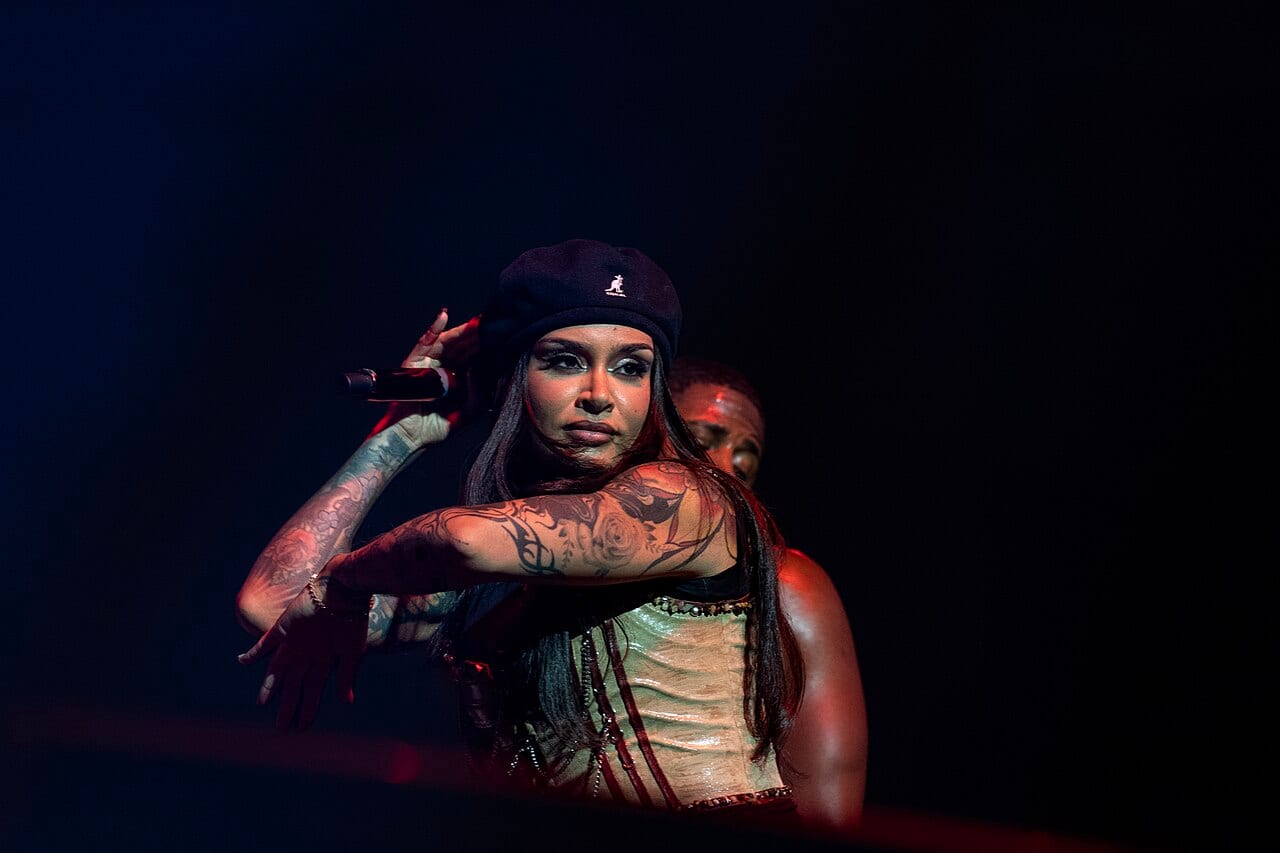
Synthetic comedians filled Instagram and TikTok feeds through October 2026, each one standing against a brick wall and holding a plain microphone. The jokes land clean. Real comedians wrote them first1.
A trade outlet named nine comedians whose routines turned up inside those accounts, word for word2. Olivia Carter is one of them. Her bit about asking out her personal trainer had run on Netflix and The Tonight Show, before any synthetic account spoke it1.
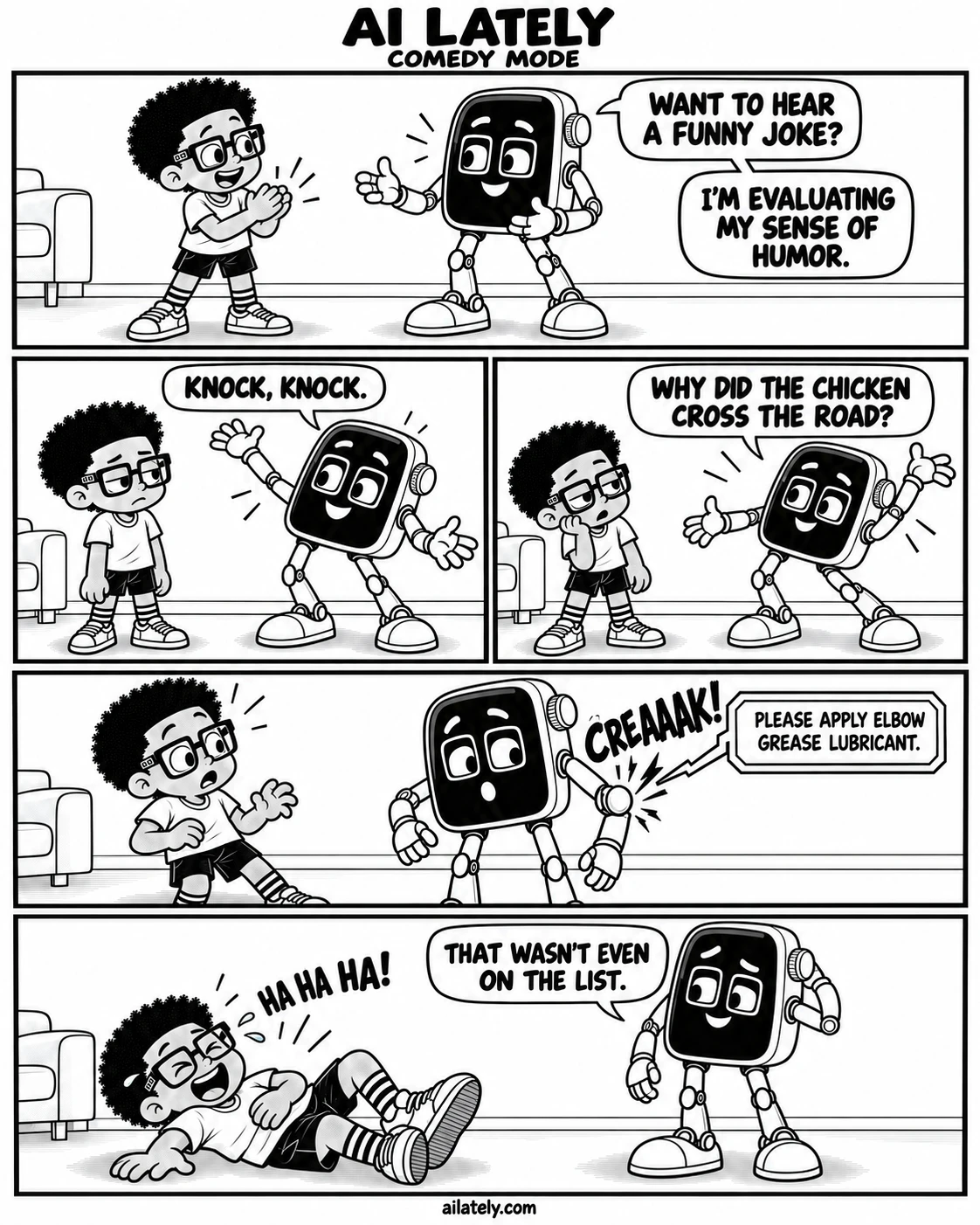
Ai Lately's comic this week watches a boy coach his robot through its own joke list.
A Brick Wall and a Borrowed Punchline
Each synthetic performer follows the same visual formula. A brick wall sits behind her, and a wired microphone sits in her hand. The outfit runs toward crop tops and tight bodysuits, and the set covers dating or sex12. Viewers scroll past hundreds of thousands of likes on these clips, believing a human wrote the words they just heard.
Anonymous operators built this pipeline from clips already proven to work. A scraper pulls a viral set from a working club comic. Video software turns the transcript into a synthetic performance that posts under a made-up name1. Carter watched her own joke become someone else's engagement.
"I think Instagram has made a pressure where, like, comedians are now influencers and influencers look a certain way," Carter said. "For comedy in general, we're creating a world where people expect comics to be like AI-generated women's bodies"1.
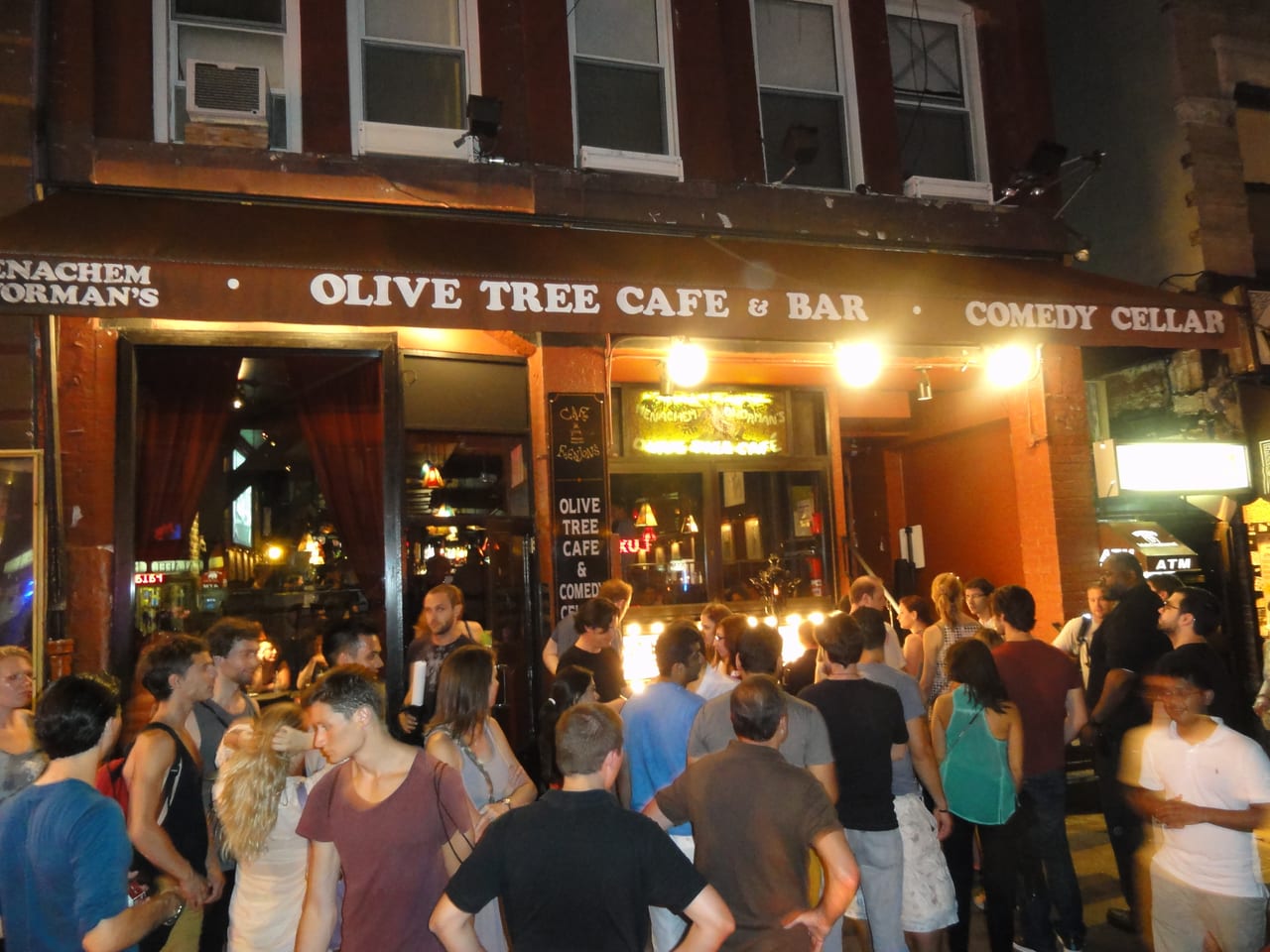
George Brett Olson had his joke about AI stealing jobs copied by one of these accounts. He called the irony plain. The system around it felt worse to him. "What's crazy to me is you can't report this. A bunch of people tried," he said1.
Why the Theft Lands on Young Women
Famous headliners keep their catalogs untouched; Dave Chappelle and Jim Gaffigan's sets stay their own. The theft runs almost entirely through working comics who perform in small clubs and post their own clips, mostly young women12.
Julia Jasunas lost a routine about renting out a spare room to one of these accounts. "It still feels incredibly violating to have your work taken and used without permission," she said2.
The New York Post, citing WIRED's reporting, quoted Jasunas again on the harm that sits on top of the copy itself. "It's one thing to have your jokes stolen," she said. "It's another to funnel your work into something so sexualized, for someone else's profit"3.
Sarah Purdum watched a synthetic account recite her own Daniel Day-Lewis joke. She judged the delivery as sharply as the theft. "There's aspects of her quote-unquote performance that are comedian-like, but it's not the same as a comedian telling a joke," Purdum said. "If you are that hot you don't need to develop a sense of humor. It's not delivered well enough"4.
Mandy Martino's jokes were taken by one of the most active accounts in this group3. British comics lost material too.
A skit built around Tim Vine, Karen Taylor and Jim Tavare was copied nearly whole. It reached more than 660,000 TikTok views under a synthetic performer's name2. Char Ramtin, Kait Calabrese and Hannah Berner lost bits the same way.
Chortle names 9 copied comedians, more than the other three outlets combined
Comedians named as having material copied by synthetic accounts, by outlet, Sept.-Oct. 2026
Each column counts the comedians one outlet names as having a routine copied; the accent column is the trade outlet that named the most.
Outlets overlap: several comedians, including Olivia Carter and George Brett Olson, appear in more than one outlet's count.
Sources: Gizmodo [1]; Chortle [2]; New York Post, via DNYUZ [3]; San.com [4]. Chart by Ryan Elliott Dennis.
The numbers behind this chart
| Item | Value |
|---|---|
| Gizmodo | 3 comedians |
| San.com | 2 comedians |
| NY Post | 3 comedians |
| Chortle | 9 comedians |
Why Algorithms Favor the Digital Clone
Television and late-night showcases once picked which young comic got a shot. A broadcast set could launch a career and fill club seats for a year. Networks lost their grip on younger viewers over the past decade. Comedians moved onto Instagram, TikTok and YouTube Shorts to find an audience instead.
That move turned every comedian into her own marketing department. Club bookers check follower counts before handing out weekend spots. A comic who wants stage time has to keep posting, and hope the algorithm carries one clip to a million strangers.
The algorithm rewards two things above all: outrage and sex appeal. A joke about dating or bedrooms earns a higher completion rate than a joke about airline food. That higher completion rate earns more followers12.
Operators studied that pattern and found an open vault. Years of tested, high-performing jokes about sex and dating already sat in public view. Comedians with small legal budgets and little industry clout had written every one of them.
Pairing a proven script with a synthetic, idealized body gets an operator the best of both. A real comic does the unpaid work of finding what makes a room laugh. Software supplies the face the algorithm rewards.
Why Large Language Models Write Bad Jokes
Generative tools struggle to write an original joke. A language model predicts the next likely word from everything it has read before. Comedy runs the other way: a strong punchline leads a listener down one path, then breaks the pattern in its last few words.
Ask most text generators for five minutes on modern dating, and the result leans on dad jokes and worn-out observations. A joke needs a specific point of view, usually rooted in embarrassment or pain. Software only knows those feelings as words it read somewhere else.
Operators sidestepped that problem instead of solving it. Rather than teach software what makes a joke funny, they let working comics write the jokes first and let the software do the theft.
The Shame That Used to Work
Copyright law barely covers a spoken joke. A three-minute bit about a bad date costs more to defend in court than it earns. Stand-up built its own enforcement outside the law instead.
A comic caught stealing lost stage time. Peers dropped the thief from shared bills. Headliners stopped sharing a green room with one.
Joe Rogan put that system on display on Feb. 10, 2007. He accused Carlos Mencia of stealing jokes during an on-stage confrontation at the Comedy Store in Hollywood5. The clash became a lasting example of comedy policing its own. Mencia had a name, a face and a career the dispute could damage.

Four outlets broke the synthetic-comedian story inside three weeks, 19 years after a club shamed a human thief
The Comedy Store confrontation and the four 2026 reports on AI avatar accounts
Each pin is one dated event; the accent pins mark the 2026 reporting that ran inside a single three-week stretch.
Sources: Gizmodo [1]; Chortle [2]; New York Post, via DNYUZ [3]; San.com [4]; Wikipedia [5]. Chart by Ryan Elliott Dennis.
The numbers behind this chart
| Date | Event |
|---|---|
| Feb. 10, 2007 | Rogan confronts Mencia. The Comedy Store |
| Sept. 30, 2026 | San.com report |
| Oct. 6, 2026 | Gizmodo report |
| Oct. 8, 2026 | Chortle report |
| Oct. 16, 2026 | NY Post report |
A synthetic account skips all of that risk. Its fictional name skips the green room, and it skips a headliner's approval too. Olson felt that gap directly when his own report stalled. He named the contrast himself: a joke about AI stealing jobs, stolen by AI, "one of the most ironic things that's ever happened"1.
What the Platform Says
Adam Mosseri runs Instagram. He told the New York Post that identifying synthetic content will only get harder from here. "It's gonna be harder and harder to identify, and it's not all bad content (though yes, there is plenty of slop)," he said3.
Mosseri's comment weighs AI content as a broad category, some useful, some junk. The comedians describe a narrower problem his framing skips. One account recites one person's own written joke, under a different face, for its own following. Chortle's reporting found that Meta skipped its request for comment on the specific accounts named in its piece2.
Rewiring the Human Laugh
Early critics of synthetic video expected the "uncanny valley" to protect human performers. Robotics professor Masahiro Mori coined the idea in 1970. A replica that looks almost human, but misses small details in the eyes or mouth, makes an observer uneasy rather than charmed.
That unease is largely missing from the comments under these clips. Audiences praise the beauty and wit of a performer who exists only on a server, the same way they'd praise a real comic. A teenager opening Instagram for the first time may see a synthetic set first. The brick wall and the microphone come before any real one does.
Repeated exposure to a flattened, algorithm-built delivery changes what an audience expects from the craft. Live stand-up runs on a real person risking silence in front of strangers. A synthetic clip removes that risk, and the removal is hard for a casual scroller to spot.
Fighting for the Live Room
Comedians and club owners now choose between feeding the algorithm and walling off their own work. Posting clips online still sells tickets, so most comics keep posting even while every upload hands a scraper fresh material.
A takedown notice rarely moves fast enough to matter. By the time a platform pulls one copy, a clip has already collected most of the views it will ever get. An operator can stand up a fresh account the same day13.
Live stand-up has outlasted radio, television and cable specials. People still pay to sit in a dark room and watch one person sweat under a light. A synthetic account tests whether a newer audience still values that risk, or just the punchline at the end of it.
What to Do
Read a synthetic comedy clip the way an editor reads a press release. Ask who wrote the words first. A search of the exact line usually turns up the comic who built it on a real stage.
Follow working comedians directly. Use their own accounts or a club's lineup, ahead of whatever an algorithm surfaces next. This theft depends on a feed that mixes a borrowed line in with an original one.
By the Numbers
- Chortle named nine comedians whose material was copied by synthetic accounts. That tops the other three outlets' named totals combined2.
- A UK skit built around three comedians reached more than 660,000 TikTok views under a synthetic performer's account2.
- Four outlets published independent reports on this pattern inside a three-week span, from Sept. 30 to Oct. 16, 20261234.
- Nineteen years separate Rogan's on-stage confrontation with Mencia from the first of these 2026 reports54.
- Every comedian quoted in this piece describes a takedown report that stalled or went unanswered, Olson's included12.
What to Watch
Watch whether Instagram changes how it screens a new performer account. Mosseri's own comment leaves that process unchanged for now. Watch too for a comedian or a guild testing the copyright question in court. The weak legal footing described here has gone untested at this scale.
A companion piece soon looks at a different kind of synthetic act. Xania Monet, an AI-generated singer built with Suno, signed a reported multimillion-dollar deal with Hallwood Media in 2026. Other recording artists objected in public.
Comics
Comedy Mode
A robot works through its joke list for its boy, and the line that gets the laugh is the one the robot never scripted.
Sources
- Kyle Torpey, "AI Comedians Are Stealing Jokes on Instagram to Sell OnlyFans Subscriptions," Gizmodo, Oct. 6, 2026, https://gizmodo.com/ai-comedians-are-stealing-jokes-on-instagram-to-sell-onlyfans-subscriptions-2000821923
- Chortle Staff, "The AI 'comedians' stealing jokes wholesale: 'It feels incredibly violating,'" Chortle, Oct. 8, 2026, https://www.chortle.co.uk/news/2026/10/08/61797/the_ai_comedians_stealing_jokes_wholesale
- New York Post Staff, "Fake babes, stolen jokes: AI-generated women are ripping off comics to promote porn sites, reports find," New York Post, via DNYUZ, Oct. 16, 2026, https://dnyuz.com/?p=303542
- Rosie Thomas, "Have you heard the one about AI stealing real comedians' work?," San.com, Sept. 30, 2026, https://san.com/cc/have-you-heard-the-one-about-ai-stealing-real-comedians-work/
- Wikipedia contributors, "Carlos Mencia," Wikipedia, accessed Oct. 29, 2026, https://en.wikipedia.org/wiki/Carlos_Mencia