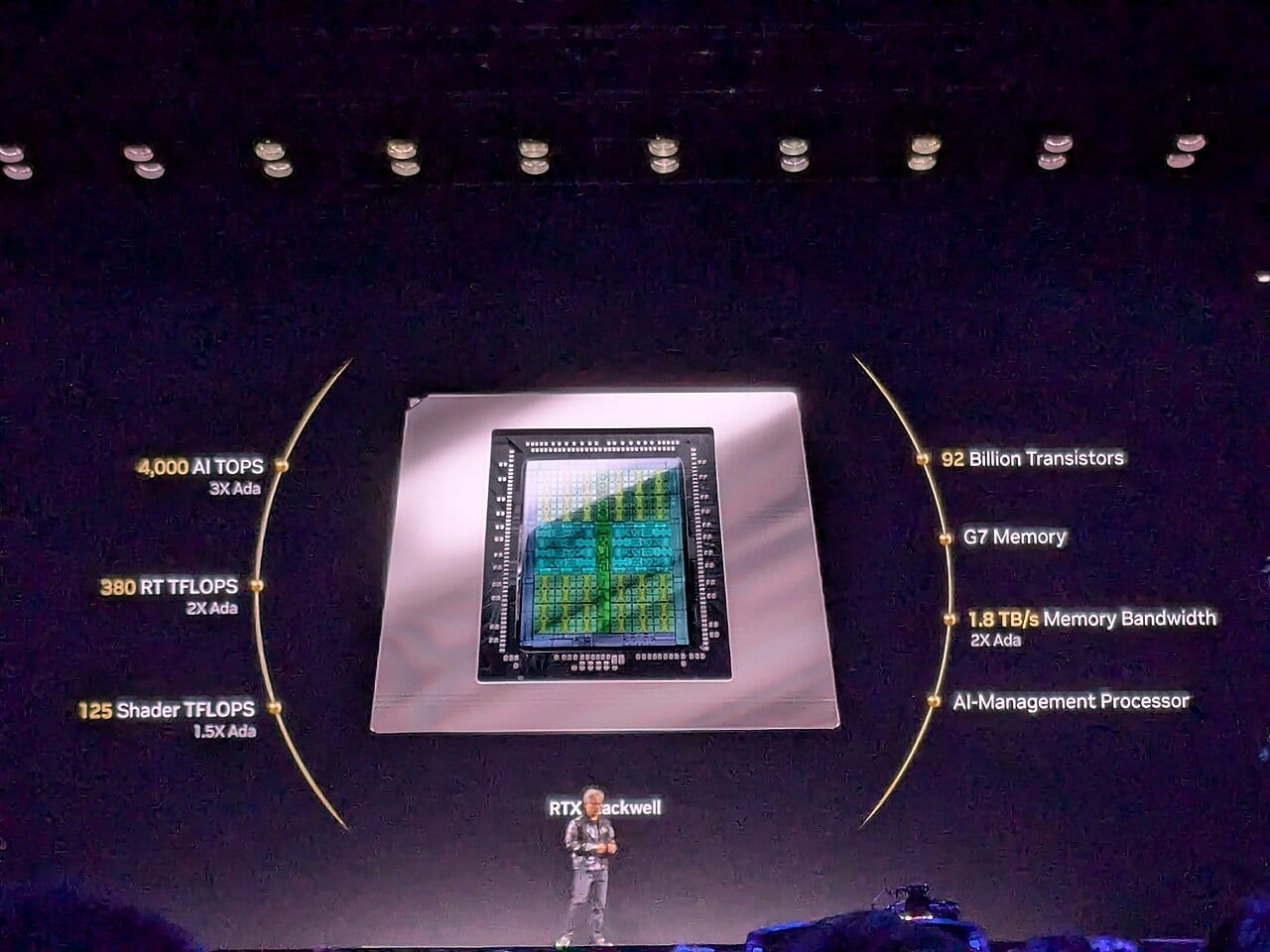
Will DePue posted a claim on X on Nov. 12. "I've found conclusive forensic evidence that the top 4 Chinese AI labs—DeepSeek, Moonshot, MiniMax and Ant Group—have built their newest models on NVIDIA's most advanced Blackwell chips, which are barred from export to China," he wrote2.
DePue runs the research group Unemployment Labs. He published a full report the same day, naming six models across the four labs1.
will depue@willdepueI have a major result to share.
I’ve found conclusive forensic evidence that the top 4 Chinese AI labs—DeepSeek, Moonshot, MiniMax and Ant Group—have built their newest models on NVIDIA’s most advanced Blackwell chips, which are barred from export to China.
This sounds insane,… pic.twitter.com/qlttvJsXG7

How a Chip Leaves Its Signature
Inspectors walk into data centers in the United States. China keeps its own centers off-limits to them. DePue's method reads a data center's own paperwork instead. That paperwork is the model weights every lab publishes to show off its work1.
A model's first weights start as random numbers. Before training begins, a chip generates them with a formula Nvidia calls Philox1.
That formula spreads its numbers across threads. The thread count depends on the chip: Hopper chips run 270,336 threads, and Blackwell chips run 303,104 or 311,296, depending on the part1.
Training changes almost every weight. A few values survive untouched, and DePue reads those survivors for the chip's thread count1.
"The seed must generate the right numbers, and the thread count must put them in the right places," DePue wrote in his report1.
Six Models, Four Labs, One Signature
DePue tried six trillion seed-and-layout pairs1. Pure chance alone tops out around 8 sigma, a way to measure how sure a match is.
His six real matches ranged far past that line, from 20 to 1,385 sigma. DeepSeek-V4-Flash scored strongest, matching Blackwell's B200 or B300 chip1.
Four models matched a bigger Blackwell chip, the Grace Blackwell GB200 or GB300: DeepSeek-V4-Pro, Kimi K3, Kimi K3.1-Pro and Ling-3.1-flash1.
DeepSeek's own history shows the switch. Its December 2024 model, DeepSeek-V3, reads as Hopper, while the April 2026 follow-up, DeepSeek-V4-Flash, reads as Blackwell1.
4 of 9 Top Chinese AI Labs' Newest Models Fingerprint as Blackwell
Newest readable open-weight models from nine Chinese AI labs, by chip fingerprint, Unemployment Labs' analysis published Nov. 12, 2026
Each cube is one lab. Magenta cubes are labs whose newest readable model fingerprints as Nvidia's export-banned Blackwell chip; gray cubes are labs whose newest model still fingerprints as the legal Hopper chip.
Source: Unemployment Labs [1]. Chart by Ryan Elliott Dennis.
The numbers behind this chart
| Item | Value |
|---|---|
| Fingerprints as Blackwell | 4 |
| Still fingerprints as Hopper | 5 |
| Whole | 9 |
Physical hardware backed the numbers. A rented Blackwell B300 copied 445 of DeepSeek-V4-Flash's untouched starting values, bit for bit. The same test on a Hopper H100 produced an unrelated pattern across every preserved row12.
Nine Chinese labs have released models recent enough for DePue's method to read. Five still carry a Hopper signature: Alibaba, Zhipu, Tencent, Xiaomi and StepFun1.
DePue sounded certain. "I am highly confident in this result, and it has been independently verified by senior researchers at OpenAI and Anthropic," he wrote on X2. OpenAI and Anthropic stayed silent on that claim in public, and DePue's own written report skips naming any reviewer15.
The claim traveled fast. Hacker News readers argued over the numbers for hours, and the thread passed 200 points the same day3.
What the Signature Leaves Open
DePue's own report draws a limit. A signature marks which chip set a model's starting numbers, a narrower claim than naming the chip that finished training1.
Blackwell systems rent outside China too. A lab could set initial values on one machine, then move the model to another for the full run1.
The report answers part of that gap. DePue ruled out AMD's rival chip for the clearest case. On a physical MI300X, only Nvidia's math matched DeepSeek-V4-Flash's untouched weights, in 363 of 377 disputed values1. He also checked his method against 24 models whose makers already named their hardware, and it matched every public claim.
Some Chinese labs skip the question entirely. Meituan says its LongCat-2.0 model trained entirely on domestic chips, and DePue's method found only an unrelated pattern in its weights1.
The scale still carries weight. DePue's revised estimate puts the five training runs at 12,000 Blackwell GPUs combined1. Kimi K3 alone needed an estimated 4,500, the most of the five. DeepSeek-V4-Pro took about 3,000, and DeepSeek-V4-Flash, MiniMax-M3 and Ling-3.1-flash each used about 1,500.
Kimi K3's Training Run Needed an Estimated 4,500 Banned Blackwell Chips, the Most of Five
DePue's revised best estimate of Blackwell GPUs used in each model's final training run, Unemployment Labs, Nov. 12, 2026
Each bar is one model's best estimate of the Blackwell GPUs its training run needed. DePue's own ranges are wide; the bar shows his single best estimate for each.
DePue's own ranges are wide: his report puts Kimi K3 anywhere from 1,000 to 9,500 Blackwell GPUs, so read each bar as a single best estimate.
Source: Unemployment Labs [1]. Chart by Ryan Elliott Dennis.
The numbers behind this chart
| Item | Value |
|---|---|
| Kimi K3 | 4,500 GPUs |
| DeepSeek-V4-Pro | 3,000 GPUs |
| DeepSeek-V4-Flash | 1,500 GPUs |
| MiniMax-M3 | 1,500 GPUs |
| Ling-3.1-flash | 1,500 GPUs |
The Case That the Chip Ban Already Leaked
Ritwik Gupta studies export policy at the University of California, Berkeley. His view is that hardware rules already carry less force than Washington assumes4.
"Advances in machine learning have eroded the moat that the United States initially built to limit access to the latest GPUs via its existing export controls," Gupta wrote with two co-authors in a 2024 paper4.
His point predates DePue's finding by two years. Chinese labs reached strong results on chips still legal to buy, Gupta's paper found. They did it through software choices that get more work from each chip, using Tencent as the example4.
Jensen Huang spent his final months at Nvidia defending open-weight models. He signed a July letter, with 25 other companies, arguing that free AI weights help security and "sovereignty"6. Huang resigned Nov. 12, after a probe into his personal life. Ai Lately covered his exit and Nvidia's reply in a separate piece.
Clément Delangue, Hugging Face's chief executive, called Huang's exit "a really sad day" for open AI. He promised his company would keep going anyway. "We'll keep fighting for open-source AI, harder than ever. This is too important to slow down now," Delangue said6.
What Each Side Needs to Be True
DePue's case holds if his physical tests apply beyond the one clearest example. He matched real hardware for one model directly, and his method agreed with 24 known cases first1.
Gupta's case holds regardless of whether China's labs ever touched a Blackwell chip. In his reading of the record, legal chips alone already carried China's labs to frontier results4.
Both points can be true together. DePue describes new chips that still reached China. Gupta describes older, legal chips that already closed China's gap with American labs. Together the two findings raise one question: what is the export ban still achieving?
What to do
Check your own vendors' hardware claims before you repeat them. Ask the vendor directly, the same way DePue checked public claims against his own method1.
If your company buys models or API access from a Chinese AI lab, ask which chips trained the model you use. A straight answer, or a dodge, both tell you something.
By the numbers
- 1,385 sigma: DePue's strongest chip match, for DeepSeek-V4-Flash against Blackwell's B200 or B3001.
- Weakest of six: 20 sigma, still far past what chance alone could produce1.
- Chance's ceiling: 8 sigma is the strongest match pure chance alone could produce, DePue says1.
- 6 trillion: seed-and-layout pairs DePue's search tried1.
- Combined estimate: 12,000 Blackwell GPUs across all five training runs, DePue's revised figures say1.
- Kimi K3 alone: an estimated 4,500 Blackwell GPUs, the most of the five runs1.
- $70,000: DePue's estimated cost per Blackwell GPU, based on a reported price for a separate shipment1.
- 24 known models: each one DePue's method matched to its maker's own hardware claim1.
What to watch
DePue plans to publish his code and a full paper soon2. That would let outside researchers test his method on their own. Nvidia, DeepSeek, Moonshot AI, MiniMax and Ant Group stayed silent once the report ran, Glitchwire reported5.
Watch whether the Commerce Department's Bureau of Industry and Security opens its own inquiry. DePue's report settles a technical question. The enforcement question still belongs to regulators1.
Sources
- Will DePue, "Top Chinese Frontier AI Models Carry the Fingerprint of Export-Controlled NVIDIA Blackwell GPUs," Unemployment Labs, Nov. 12, 2026, https://unemploymentlabs.com/checkpoint-forensics
- Will DePue, post on X, Nov. 12, 2026, https://x.com/willdepue/status/2120992457630326841
- "Chinese frontier AI models carry the fingerprint of export-controlled GPUs," Hacker News, Nov. 12, 2026, https://news.ycombinator.com/item?id=50474883
- Ritwik Gupta, Leah Walker and Andrew W. Reddie, "Whack-a-Chip: The Futility of Hardware-Centric Export Controls," arXiv, Nov. 21, 2024, https://arxiv.org/abs/2411.14425
- "OpenAI Researcher Claims GPU Fingerprints Prove Chinese Labs Trained on Export-Banned Blackwell Chips," Glitchwire, Nov. 12, 2026, https://glitchwire.com/news/openai-researcher-claims-gpu-fingerprints-prove-chinese-labs-trained-on-export-b/
- "Hugging Face CEO vows to keep fighting for open source AI after Jensen Huang's exit," TechCrunch, Nov. 12, 2026, https://techcrunch.com/2026/11/12/hugging-face-ceo-vows-to-keep-fighting-for-open-source-ai-after-jensen-huangs-exit/