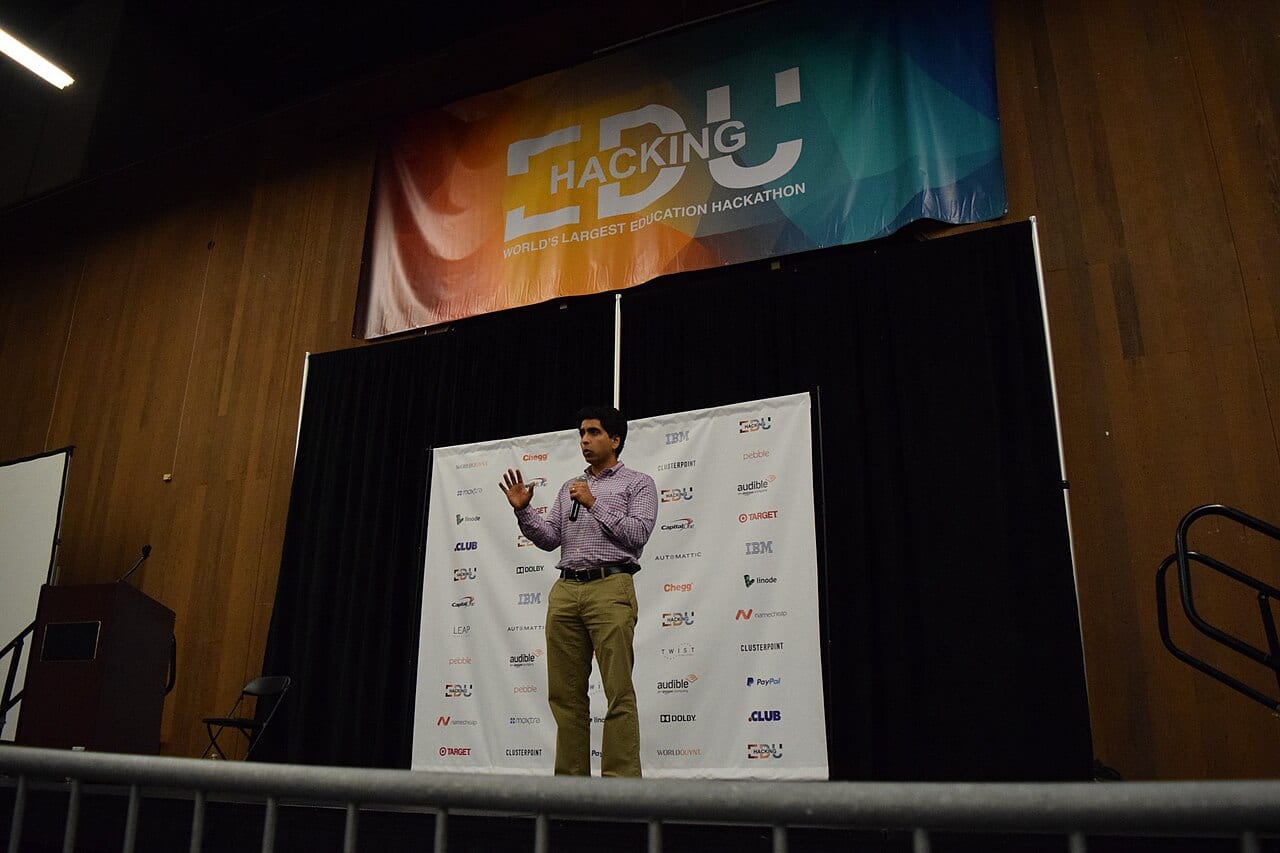
Khan Academy's AI tutor now reaches 770,000 students in American classrooms7. The biggest study built to test it found the typical student barely spoke to it.
Researchers at the University of Toronto spent two years running the trial inside 18 Tennessee middle schools. They published the results on Aug. 25, 202613. Math scores moved. They moved by less than a point.
A two-year trial, and a small number
The study split 53 grade-level groups across the 18 schools. One set of 28 used Khan Academy with its AI tutor, Khanmigo, during their regular remedial math period1. The other 25 kept doing what the district already ran.
That is a cluster randomized trial. Drugmakers use the same design to test a pill: some clinics get it, and the rest serve as the comparison.
Being assigned to the AI tutor raised scores by 1.3 national percentile ranks a term1. Researchers measure that as 0.06 to 0.08 standard deviations, or SD, a year. It is a small slice of the gap between an average student and a struggling one. Over a full year of steady use, the effect reached about 0.14 SD for below-grade-level students4.
Harvard's required AI tutor gained 0.63 standard deviations, nine times Tennessee's 0.07
Effect size in standard deviations, three randomized controlled trials of AI tutoring
Each column is one trial's effect size in standard deviations; the note under it names the study and how many students or clusters it measured.
Each bar comes from a separate trial with its own students, subject and years, so compare the size of the gap, since the exact decimal differs by design.
Sources: National Bureau of Economic Research [1]; Scientific Reports [2]. Chart by Ryan Elliott Dennis.
The numbers behind this chart
| Item | Value | Note |
|---|---|---|
| Harvard, required | 0.63 | 194 undergraduates, Fall 2023 |
| Tenn., sustained | 0.14 | below-grade-level students with full-year use |
| Tenn., all | 0.07 | 28 of 53 clusters, 18 schools, calc: midpoint of 0.06 to 0.08 |
Why the number stayed small
Khanmigo is built to coach first. It asks a struggling student a guiding question before it hands over a solution1.
Almost every student tried it. The researchers found 96 percent opened Khanmigo at least once1. After that, most stopped.
The median student messaged it on about a third of the days they practiced. On the moments they got a problem wrong, that share fell to 17 percent.
Philip Oreopoulos, the study's lead author at the University of Toronto, put the pattern plainly to Chalkbeat. "If a keen, engaged student wants to use the technology as a good tutor, it's ready to go. The issue is that most students don't use it that way," he said3. He added a second line that cuts closer to the design problem: "The same technology that can be used as a good tutor, can also be used to make your life easier. But making your life easier equals less learning".
Sal Khan, the company's founder, told Chalkbeat the result matched what most teachers already see in a classroom. "What this has put in huge spotlight, not that it's a shock to educators, is how much motivation matters," he said3.
A tutor that worked when it was required
One Harvard study shows what happens when every student must take part. Researchers ran a randomized, crossover trial inside an introductory physics course in the fall of 20232.

All 194 students used a custom-built AI tutor for part of the course. They used an active-learning classroom for the rest, switching between the two across two weeks2. Attendance was built into the lesson plan, since the AI tutor was that day's lesson.
The researchers found a 0.63 SD gain for the AI-tutored sessions over the classroom sessions. Harvard's gap ran nine times the size of Tennessee's headline number. Students also finished the AI-tutored lessons faster, 49 minutes against 60.
Harvard's course taught college physics, to a group a tenth the size of Tennessee's, over weeks instead of years. It built one tutor for one course, instead of opening a general-purpose coach to a whole district. The gap between the two trials says less about Khanmigo's code. It says more about what happens to any AI tutor once attendance is optional.
Aakash Gupta@aakashguptaSal Khan’s “life’s work” just had its best year ever. The numbers say the opposite of what this tweet assumes.
Khanmigo, Khan Academy’s AI tutor, grew 731% year over year. 2 million students, educators, and parents used it in the 2024-25 school year. 770,000 students are now in… https://t.co/cyjmfZXaNT pic.twitter.com/y4gTOmOGIa

The case for buying it anyway
Khan Academy's growth ran well ahead of the trial. Sign-ups for Khanmigo climbed 731 percent in a single year7. The company's Districts Partnerships program grew too, adding 218 U.S. school communities to reach 795.
Kristen DiCerbo, Khan Academy's chief learning officer, told K-12 Dive the jump from 40,000 users to 700,000 "was the biggest one-year jump that I have seen in terms of adoption of an education technology"6. She also pointed to a quieter problem in the transcripts: many students just typed "idk" and moved on.
Khan Academy added 218 partner districts to reach 795 in a year
U.S. school communities in Khan Academy's Districts Partnerships program, SY23-24 to SY24-25, one cube per 25 districts
Each cube is 25 districts; the accent cubes are districts that joined in the latest year, and the gray cubes were already partners.
Source: Khan Academy [7]. Chart by Ryan Elliott Dennis.
The numbers behind this chart
| Item | Value |
|---|---|
| Already partners | 577 |
| Joined this year | 218 |
| Whole | 795, each cube 25 |
Sal Khan reads the sustained-use subgroup result as the more important number. On his own blog, he framed it this way: "A rigorous RCT showing a 0.14 SD effect for students who are below grade level and who got sustained access, measured against what the district was already running rather than against nothing, in a population that's historically hard to move, is a genuinely strong result," he wrote4.
His point rests on the comparison group. Hamilton County's control classrooms already ran a remedial math block. The study measured Khan Academy against an existing program, a higher bar than an untreated group would set.
Susanna Loeb, who runs Stanford's National Student Support Accelerator and studies tutoring programs for a living, reads the same evidence more cautiously. "We don't have solid research showing that AI tutoring can work in the U.S. at scale," she told The 74 Million5. She pointed to the same finding Oreopoulos did: "Biggest finding is that the take-up is very low," she said, and added a line aimed straight at buyers: "If you choose a tool that has some evidence or that you think could be effective, you have to figure out how to actually get kids to use it".
Both sides accept the same numbers. The disagreement is about what one subgroup result, from one state, should tell a district. Hundreds of them now pay for the tool.
What to do
Ask a vendor for its usage rate before its adoption total. A tool with 770,000 licensed students and a 17 percent engagement rate is one purchase. Fifty thousand students who open a tool daily is a different one entirely.
Pilot an AI tutor inside required class time first, the way Harvard did, before rolling it out as an optional extra. The Tennessee and Harvard trials point at the same lever: a tutor only teaches the student who opens it.
Ask the researcher, as well as the company, which comparison group the result came from. Khan's 0.14 SD figure and the trial's 0.06 to 0.08 SD headline are both real. They answer different questions.
By the numbers
- 1.3 national percentile ranks: the gain from being assigned Khan Academy with Khanmigo, per term, in the Tennessee trial1.
- 96 percent: students in the trial who opened Khanmigo at least once1.
- Just 17 percent: the share of wrong-answer moments where the median student actually messaged Khanmigo1.
- 0.63 SD: the learning gain in Harvard's mandatory-use AI tutor trial, against 194 students2.
- 731 percent: Khanmigo's sign-up growth in a single year, as Khan Academy reports it7.
- 795: U.S. school communities in Khan Academy's Districts Partnerships program, up from 577 a year earlier7.
What to watch
Khan Academy redesigned Khanmigo in 2026 to turn itself on during practice, instead of waiting for a student to ask7. A new trial on that version would show whether automatic coaching lifts the engagement numbers Oreopoulos measured. It would also show whether students find a new way to route around it.
Sources
- Philip Oreopoulos and Nina Low, "One Click Away: AI Tutoring with Khanmigo in a Two-Year School Experiment," National Bureau of Economic Research, Aug. 2026, https://www.nber.org/papers/w35620
- Greg Kestin, Kelly Miller, Anna Klales, Timothy Milbourne and Gregorio Ponti, "AI tutoring outperforms in-class active learning: an RCT introducing a novel research-based design in an authentic educational setting," Scientific Reports, June 3, 2025, https://www.nature.com/articles/s41598-025-97652-6
- Matt Barnum, "Students rarely engaged with Khan Academy's AI-powered tutor Khanmigo, study finds," Chalkbeat, Aug. 25, 2026, https://www.chalkbeat.org/2026/08/25/ai-tutoring-students-khanmigo-khan-academy-engagement-study/
- Sal Khan, "What I found compelling in a new randomized trial of Khan Academy in math intervention," Khan Academy Blog, Aug. 24, 2026, https://blog.khanacademy.org/what-i-found-compelling-in-a-new-randomized-trial-of-khan-academy-in-math-intervention/
- Linda Jacobson, "AI Tutors Not Yet a Replacement for Humans, Research Says," The 74 Million, Sept. 1, 2026, https://www.the74million.org/article/ai-tutors-not-yet-a-replacement-for-humans-research-says/
- Anna Merod, "3 questions for K-12 leaders to consider amid the AI tutoring boom," K-12 Dive, Aug. 25, 2025, https://www.k12dive.com/news/3-questions-for-k-12-leaders-to-consider-amid-the-ai-tutoring-boom/757314/
- Khan Academy, "SY24-25 Annual Report: Districts Partnerships Program," Khan Academy, 2026, https://www.annualreport.khanacademy.org/districts-partnerships-program