The Wesleyan Media Project tracks every AI-made political ad it can find. By Oct. 15, the count reached 220 ads worth more than $137 million1. Only 27 percent carried a label saying AI made them.
Two weeks earlier, three political scientists had counted $80 million spread across almost 170 ads2. The total kept climbing as campaigns kept buying airtime.
A law requiring the label barely moved how often one showed up. Ads carried one 29 percent of the time in states with a rule. States that skipped the rule posted a label 32 percent of the time2.
Any campaign or company running a political ad touched by AI this fall should check its own state's rule before Election Day.
The Tracker Keeps Growing, the Label Rate Barely Moves
Erika Franklin Fowler helps run the count at Wesleyan University. "AI is making its way into the 2026 midterms in a big way this year," she said, comparing it with the last cycle1. "For comparison, we identified less than $50,000 in spending on AI-generated ads in the 2024 cycle," Fowler said.
Republican campaigns and groups bought most of the ads. They sponsored 81 percent of the 220 spots and 88 percent of the spending2. Two weeks earlier, Republicans held smaller shares: 80 percent of ads and 83 percent of spending1. Democratic campaigns bought a small share of the rest.
AI ad labels show up 3 points less often in states with a law
Share of AI-generated political ads carrying a disclosure label, by whether the ad's state requires one, 2026 cycle
Each column is one group of ads: the left bar is ads that ran in a state with an AI disclosure law, the right bar is ads in a state that skips one.
The project's later count, through Oct. 15, covers 220 ads and a 27 percent overall label rate, kept apart from the state-law breakdown.
Source: The Conversation [1]. Chart by Ryan Elliott Dennis.
The numbers behind this chart
| Item | Value |
|---|---|
| States with a law | 29% |
| Unregulated states | 32% |
Most State Laws Hold, Two Sit Blocked
States wrote 31 election deepfake laws by June, the National Conference of State Legislatures found3. Twenty-eight require a label on a deceptive AI ad. Three, Maryland, Minnesota and Texas, ban certain deepfakes outright regardless of any label.
Courts have blocked two of those 31 laws from enforcement. A federal judge permanently struck down California's version in 2025. Hawaii's law fell the same way. That leaves 29 of the 31 laws actually in effect this fall3.
28 of 31 state AI election laws require a label over a ban
How each of the 31 state election deepfake laws NCSL counted by June 2026 treats an AI ad, one cube per state
Each cube is one state's law: magenta cubes require a disclosure label, gray cubes ban certain deepfakes outright regardless of a label.
Two of the 31, California and Hawaii, sit under a permanent court injunction that leaves each one unenforced this fall.
Source: National Conference of State Legislatures [3]. Chart by Ryan Elliott Dennis.
The numbers behind this chart
| Item | Value |
|---|---|
| Requires a disclosure label | 28 |
| Bans certain deepfakes outright | 3 |
| Whole | 31 |
California Assemblymember Gail Pellerin wrote the blocked law, AB 2839, after two decades running elections as Santa Cruz County's clerk. "AI itself is not the problem," Pellerin said. "The problem is when these tools are used to create something materially false that looks real"3.
U.S. District Judge John A. Mendez disagreed with how far her law reached. He ruled that AB 2839 "acts as a hammer instead of a scalpel, serving as a blunt tool that hinders humorous expression and unconstitutionally stifles the free and unfettered exchange of ideas which is so vital to American democratic debate"6. His injunction still stands.
A Senate Ad Tests the Watermark
Texas produced the clearest test case. The National Republican Senatorial Committee posted an 85-second video of Senate candidate James Talarico on March 1178. It showed a synthetic version of him reading his own old social media posts aloud.
Senate Republicans@NRSCJames Talarico, in his own words: pic.twitter.com/lDlUoqBbP7
The clip carried a label. "AI GENERATED" sat in a small, translucent corner mark through most of the runtime7. Robert Weissman, co-president of the watchdog group Public Citizen, called the label an afterthought. "This deepfake has an 'AI-generated' watermark, but it's all but invisible–sort of like an admission of wrongdoing, more than an effort at transparency," Weissman said.
Hany Farid, a digital forensics professor at the University of California, Berkeley, studied the clip's craft as closely as its label. "The face and voice are very good," Farid said. "There is a slight misalignment between audio and video, but otherwise this is hyper-realistic and I don't think that most people would immediately know it is fake"8.
New York and Oregon Show the Rule in Court
State law in New York requires any political ad with "materially deceptive media" to say the image "has been manipulated"5. A candidate the ad targets can ask a court for a fast injunction when a campaign skips that line. Democratic Committee Chair Jay Jacobs filed a complaint on Aug. 10, accusing Nassau County Executive Bruce Blakeman of skipping it across at least 22 AI-made ads attacking Gov. Kathy Hochul since April.
Blakeman defended the ads as old-fashioned campaigning dressed in new tools. "I use every tool available," he told a local TV station. "AI is very good at producing things that people want to watch"5.
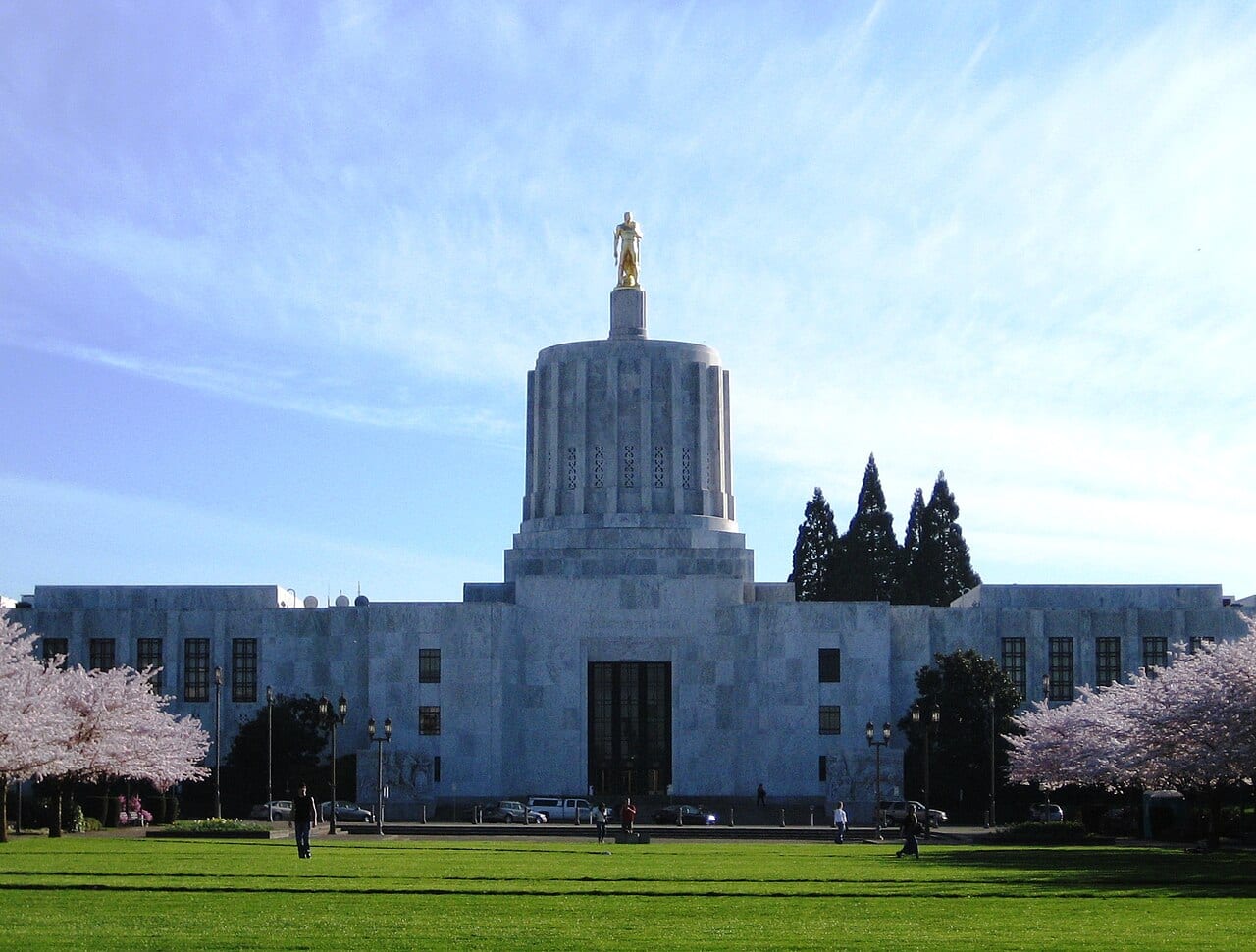
Oregon's own disclosure law, Senate Bill 1571, passed with bipartisan support in 2024 and drew its own fight this year. Jonathan Lockwood, a former legislative aide, posted AI videos of Rep. Janelle Bynum and Gov. Tina Kotek during his primary run, and the Secretary of State's office opened a review after a rival candidate complained4.
Lockwood called the law itself the problem. "This is a frivolous censorship complaint filed by another congressional candidate in an effort to weaponize Oregon's unconstitutional synthetic media law," he said4.
What to Do
Check your state's rule before any AI-touched political ad runs this fall. Twenty-eight states demand a label; three ban certain deepfakes regardless of one3.
A small corner watermark gives weak cover alone. Weissman's complaint about the Talarico ad targeted legibility over legality. A label a viewer can miss invites the same backlash a missing label does7.
Hold a legal review before copying California's or Hawaii's playbook. Courts blocked both laws, so a company that copies either state's language is following an enjoined rule6.
By the Numbers
- $137 million: total spending the Wesleyan Media Project had tracked on AI-generated political ads through Oct. 15, across 220 ads2.
- 27 percent: the share of those 220 ads carrying any AI disclosure label2.
- 29 vs. 32 percent: the label rate in states with an AI ad law against states that skip one, in the project's Oct. 5 count1.
- 31: the number of states that had passed an election deepfake law by June, per the National Conference of State Legislatures3.
- 2: California and Hawaii, whose deepfake laws sit under a permanent court injunction3.
- 88 percent: Republican campaigns' share of AI ad spending by Oct. 15, up from 83 percent two weeks earlier12.
- 22 ads: the AI-made spots New York Democrats say Bruce Blakeman's campaign ran missing the state's required label5.
What to Watch
Watch the Wesleyan Media Project's weekly releases through Election Day2. The spending total and the label rate have both moved every two weeks so far. Oregon's inquiry into Lockwood and New York's complaint against Blakeman should produce the first rulings45. Both will show how these laws actually apply to a sitting campaign.
Sources
- Travis N. Ridout, Erika Franklin Fowler and Michael Franz, "We've tracked $80M of spending on almost 170 AI-generated political ads this year. It's weird.," The Conversation, Oct. 5, 2026, https://theconversation.com/weve-tracked-80m-of-spending-on-almost-170-ai-generated-political-ads-this-year-its-weird-292105
- Wesleyan Media Project, "GOP Lead in Senate Spending Narrows; Dems Catch Up in Senate Broadcast Airings," Oct. 15, 2026, https://mediaproject.wesleyan.edu/releases-101526/
- National Conference of State Legislatures, "When AI Campaign Ads Fake Reality," Oct. 21, 2026, https://www.ncsl.org/state-legislatures-news/details/when-ai-campaign-ads-fake-reality
- Dirk VanderHart, "Over-the-top AI campaign ads will test Oregon disclosure law," Oregon Public Broadcasting, July 9, 2026, https://www.opb.org/article/2026/07/09/artificial-intelligence-ai-generated-political-advertisements-oregon/
- Tom Gambardella, "State Democrats File Complaint Over Blakeman's AI Ads, Accuse County Exec Of Flouting Election Law," Patch, Aug. 11, 2026, https://patch.com/new-york/longisland/state-democrats-file-complaint-over-blakeman-s-ai-ads-accuse-county-exec
- The Associated Press, "Judge blocks new Calif. law cracking down on election deepfakes," MTSU Free Speech Center, Oct. 11, 2024, https://firstamendment.mtsu.edu/post/judge-blocks-new-calif-law-cracking-down-on-election-deepfakes/
- Stephen Prager, "'This Should Be Illegal': Senate GOP Uses AI Deepfake to Attack Talarico," Common Dreams, March 12, 2026, https://www.commondreams.org/news/gop-talarico-deepfake
- International Business Times UK Staff, "Republicans Release AI Deepfake of James Talarico — Is Voter Manipulation Crossing the Line?," International Business Times UK, March 16, 2026, https://www.ibtimes.co.uk/ai-deepfake-ad-texas-senate-candidate-controversy-1785781