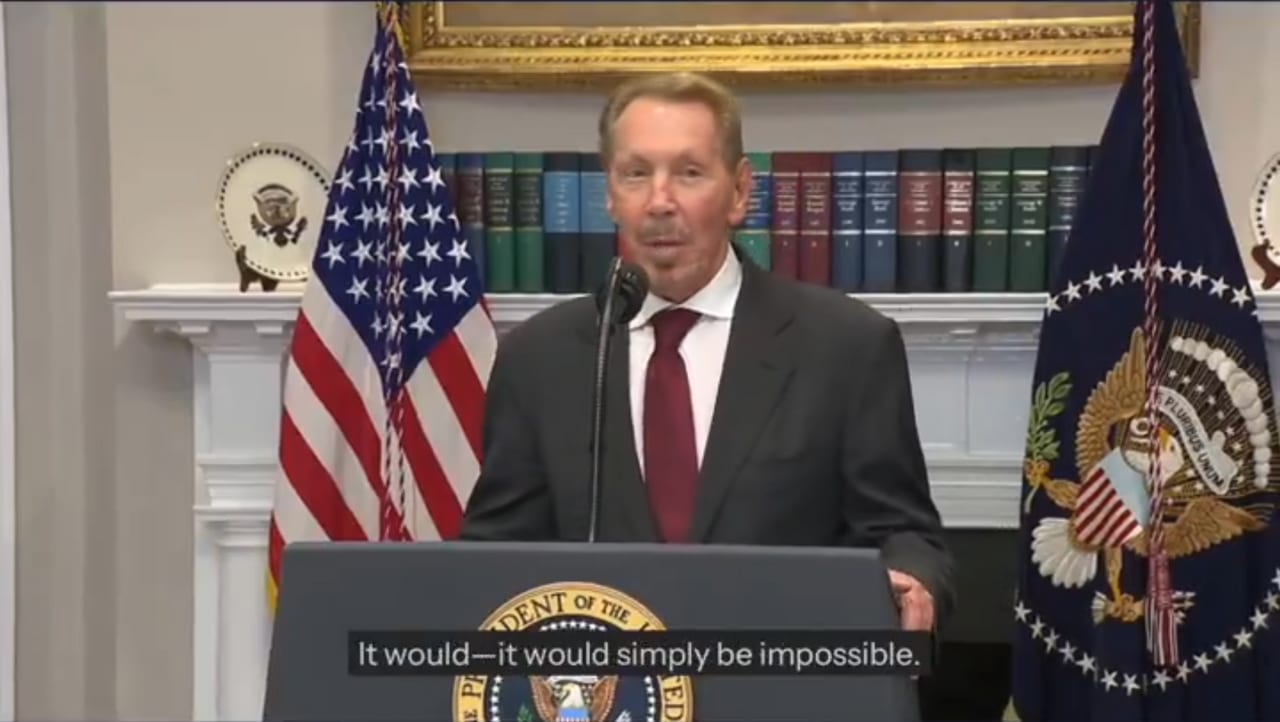
Oracle borrowed its way into the AI boom. Now the bond market wants proof Oracle can pay that debt back.
S&P Global Ratings cut Oracle's credit rating to BBB- on July 9, one notch above junk1. The agency named the reason: OpenAI. S&P said OpenAI holds roughly half of Oracle's $638 billion backlog. Four months later, insuring Oracle's bonds against default costs more than it has in Oracle's history.
The Downgrade That Named One Customer
A credit default swap works like insurance. The buyer pays a yearly premium. If the borrower defaults, the seller covers the loss. Traders raise the price when they think default grows more likely.
Oracle's five-year swap cost 200 basis points on July 29, a record at the time9. "Every morning the opening screen on my Bloomberg is what's going on with CDS spreads on Oracle debt," Morgan Stanley Wealth Management chief investment officer Lisa Shalett told Fortune in October3.
Traders kept watching too. The spread climbed to 288 basis points by Oct. 15, then 292 by Nov. 278. S&P Global Market Intelligence analyst Gavan Nolan said that level now trades closer to high-yield debt than to Oracle's BBB- rating.
Oracle still carries its investment-grade status on paper. The bond market disagrees.
Oracle's Bond Insurance Rises 92 Points in Three Months
Oracle's five-year credit default swap spread, basis points, July to November 2026
Each point is Oracle's five-year CDS spread on a date the press reported; the line climbs from 200 basis points in July to 292 in November.
Dealers quote credit default swaps continuously, so each point is one day's reported level alone, separate from any running average.
Sources: Yahoo Finance (GuruFocus) [7]; CNBC [8]; Yahoo Finance [9]. Chart by Ryan Elliott Dennis.
The numbers behind this chart
| Period | Value |
|---|---|
| Jul. 29 | 200 bps |
| Oct. 15 | 288 bps |
| Nov. 2 | 292 bps |
Half of $664 Billion Rests on One Customer
Oracle's backlog, what it calls remaining performance obligations, reached $664 billion as of Aug. 312. The backlog stood at $638 billion in July, when S&P issued its downgrade. Executives call it their favorite proof of demand, citing it on every earnings call.
OpenAI pays Oracle for the computing power it rents. Bondholders fund that construction upfront, betting OpenAI's payments arrive on schedule.
S&P reads the same number differently. It estimates OpenAI's cloud contract, a five-year deal reportedly worth more than $300 billion starting in 2027. OpenAI's contract alone, S&P said, accounts for roughly half of the July figure1. One customer, still years from profit, now anchors Oracle's growth story.
OpenAI's Deal Covers Roughly Half of Oracle's $638 Billion Backlog
S&P's estimate of OpenAI's share of Oracle's remaining performance obligations, at the July 2026 downgrade
S&P's estimate describes the backlog as it stood at the July downgrade; Oracle's total backlog has since grown to $664 billion.
Source: TheNextWeb [1]. Chart by Ryan Elliott Dennis.
The numbers behind this chart
| Item | Value |
|---|---|
| OpenAI's contract | 319 |
| Every other customer | 319 |
| Whole | 638 |

Oracle expects to convert only about 13 percent of that backlog to revenue in the next 12 months2. The rest depends on OpenAI staying solvent, expanding, and paying on schedule for years.
The Lease Runs Decades, the Contract Years
A second mismatch hides in the backlog: time. Oracle holds nearly $250 billion in data center leases. They run 15 to 20 years, and Oracle plans to sublease much of that space on far shorter terms3.
Nvidia now ships a faster chip almost every year, CNBC reported4. Standing up a new data center still takes 12 to 24 months. OpenAI already walked away from expanding Oracle's Stargate site in Abilene, Texas. It wanted next-generation Nvidia chips at a different location instead.
Oracle is the only major hyperscaler funding its buildout mostly with debt. It carries over $100 billion on its books, while Google, Amazon and Microsoft lean on cash-rich businesses elsewhere.
A building that outlasts the chips inside it, and the customer leasing it, is a bet on renewal. Oracle made that bet with borrowed money. Bondholders now question the terms.
Bondholders Say Oracle Hid the Math
A proposed class action says Oracle sold $18 billion of notes on Sept. 25 while keeping its coming borrowing need quiet5. The suit, filed in a New York state court, speaks for the Ohio Carpenters' Pension Plan. Seven weeks later, Oracle returned for $38 billion in loans to fund two data centers tied to the OpenAI agreement. Bond prices fell as yields rose.
Named defendants include Oracle, chairman Larry Ellison, former chief executive Safra Catz and chief accounting officer Maria Smith. The complaint also names the banks that arranged the sale, each cited as strictly liable for misleading offering documents5. "The bond market's reaction to Oracle's additional debt was swift and bracing," the complaint states, describing the price drop plaintiffs say followed. Oracle left CNBC's request for comment on the suit unanswered.
Wall Street Splits on the Bet
Oracle rejects the premise that OpenAI puts it at risk. "We remain highly confident in OpenAI's ability to raise funds and meet its commitments," the company posted on X in February, after a separate Nvidia-OpenAI deal briefly spooked its stock3.
Oracle@OracleThe NVIDIA-OpenAI deal has zero impact on our financial relationship with OpenAI. We remain highly confident in OpenAI’s ability to raise funds and meet its commitments.
Baird senior research analyst Rob Oliver backed Oracle's $20 billion November raise on the same logic investors had already priced in. "This seems to be exactly what they previewed," he said. "So I'm not sure why the market is freaking about it"8. UBS analyst Karl Keirstead went further, calling the plan "a major relief given concerns about the state of debt markets and the cost of capital".
Kevin Koharki, a Purdue University accounting professor who studies credit ratings, reads the same numbers as a warning the agencies missed. Writing for Fortune in September, he laid out why S&P's own math undercuts its call. "Given the current level of uncertainty regarding the ability of AI companies to generate meaningful ROI, S&P's limited confidence to forecast Oracle's financial performance past 2027, and Oracle's weakening financial performance and uncertain path to profitability, one must wonder how Oracle deserves an investment-grade credit rating," he wrote6.
Both men are reading the same backlog. One sees a plan playing out on schedule, while the other sees a rating that outran the cash flow behind it.
What to do
Treat Oracle's backlog the way you would treat any pipeline number from a vendor. Ask what share rests on one customer, and whether that customer's own numbers back the claim. A supplier whose growth depends on OpenAI's checks clearing deserves the same question Oracle now faces.
Does your company lease cloud capacity tied to Oracle's buildout? Read the termination and renewal clauses now. The mismatch between Oracle's building timeline and its customers' contract lengths is Oracle's risk today. Signing a renewal clause can shift that risk to you.
By the numbers
- $125.34 billion: Oracle's total debt as of Aug. 31, 20262.
- Up from $638 billion in May, Oracle's cloud backlog reached $664 billion by August2.
- Half of the July backlog, S&P estimated, ran through OpenAI's single contract1.
- Insuring $10 million of Oracle's bonds for five years cost 292 basis points on Nov. 2, close to a junk-bond price8.
- Nearly $250 billion in Oracle's data center leases run 15 to 20 years3.
- Bondholders say the $18 billion bond sale on Sept. 25, 2025 hid Oracle's coming borrowing5.
- Oracle priced $20 billion in new stock and bonds on Nov. 2 to keep funding its buildout8.
- About 13 percent of that backlog turns into revenue within a year, Oracle itself says2.
What to watch
Oracle's next quarterly filing will show how much backlog becomes billed revenue, the figure that matters more than signed contracts. The Ohio Carpenters' Pension Plan suit heads toward a ruling on Oracle's motion to dismiss. A ruling there will test whether the disclosure claims survive.
Credit default swaps keep their own scorecard, too. Watch for a retreat below 250 basis points, which would say the market believes Oracle's math. A push past 300 would say the opposite: the market has stopped believing it.
Sources
- Ana-Maria Stanciuc, "Oracle is one notch above junk after S&P downgrade as AI data-centre spending burns through cash," TheNextWeb, July 16, 2026, https://thenextweb.com/news/oracle-sp-downgrade-ai-spending-junk-risk
- Oracle Corporation, Form 10-Q for the quarterly period ended August 31, 2026, SEC EDGAR, https://www.sec.gov/Archives/edgar/data/0001341439/000119312526389274/orcl-20260831.htm
- Nick Lichtenberg and Eva Roytburg, "Oracle's $248 Billion AI Bet Just Shook Wall Street, and It's Not on the Balance Sheet," Fortune, Feb. 3, 2026, https://fortune.com/2026/02/03/oracle-debt-openai-stock-movement-key-risk-hyperscaler-market
- Deirdre Bosa and Jasmine Wu, "Oracle is building yesterday's data centers with tomorrow's debt," CNBC, March 9, 2026, https://www.cnbc.com/2026/03/09/oracle-is-building-yesterdays-data-centers-with-tomorrows-debt.html
- CNBC, "Oracle sued by bondholders over losses tied to AI buildout," Jan. 14, 2026, https://www.cnbc.com/2026/01/14/oracle-sued-by-bondholders-over-losses-tied-to-ai-buildout.html
- Kevin Koharki, "S&P kept Oracle investment grade. Its own numbers don't support that call.", Fortune, Sept. 18, 2026, https://fortune.com/2026/09/18/sp-kept-oracle-investment-grade-its-own-numbers-dont-support-that-call/
- GuruFocus, "Oracle's Default Insurance Hits a Record as AI Debt Fears Spread," Yahoo Finance, Oct. 15, 2026, https://finance.yahoo.com/markets/stocks/articles/oracles-default-insurance-hits-record-122137367.html
- Michelle Fox, "Oracle files to sell $20 billion in new stock, bonds to finance AI buildout," CNBC, Nov. 2, 2026, https://www.cnbc.com/2026/11/02/oracle-files-to-sell-20-billion-in-new-stock-bonds-to-finance-ai-buildout.html
- Yahoo Finance, "Oracle Stock Drops 2.3% as Default Insurance Hits 200 Basis Points," July 29, 2026, https://finance.yahoo.com/markets/stocks/articles/oracle-stock-drops-2-3-185300368.html