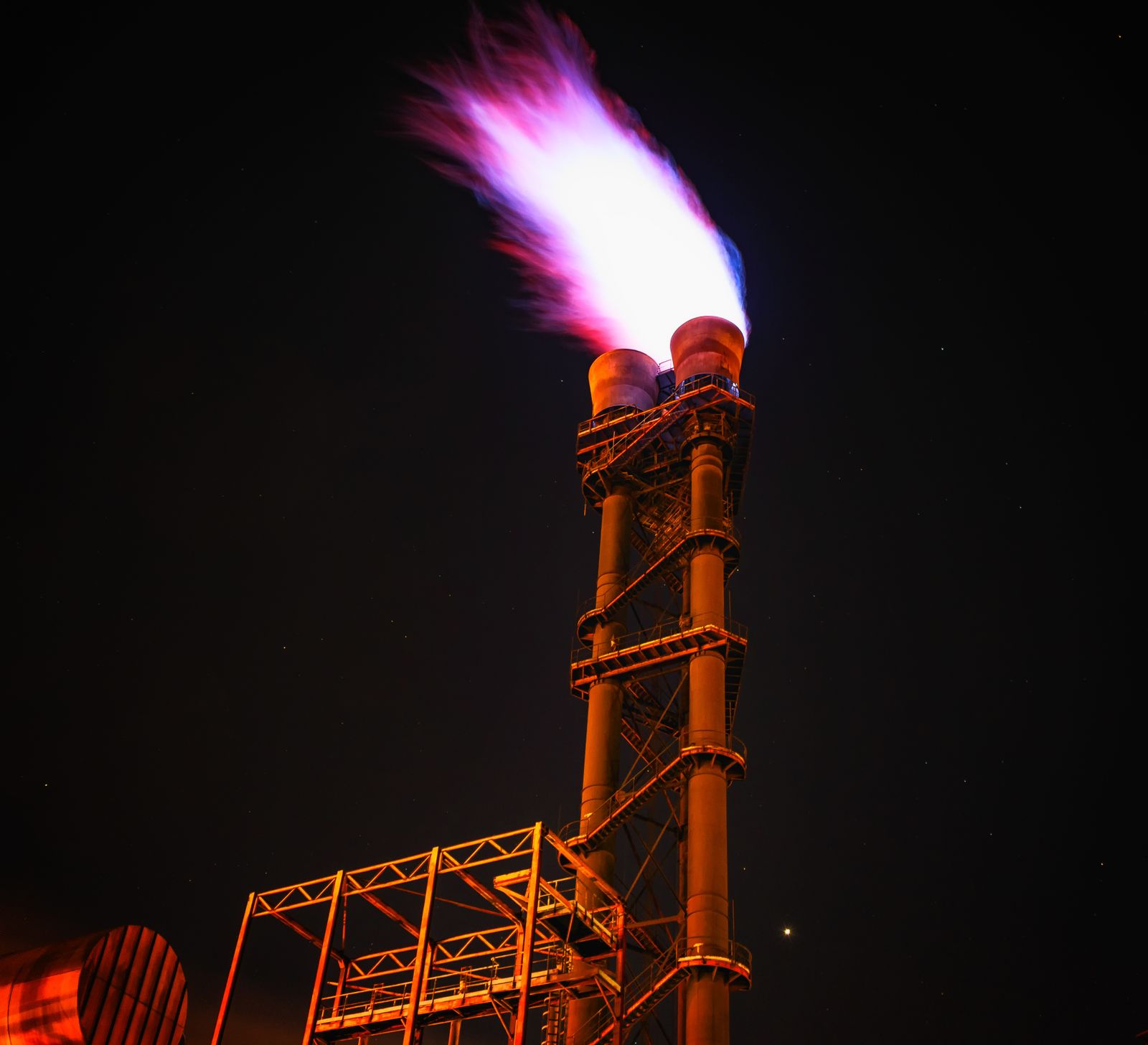
BloombergNEF says data centers built to run artificial intelligence will draw an extra 15 billion cubic feet of natural gas out of American ground every day by 2035. That volume would make the industry the world's fifth-largest gas consumer, trailing only China, Russia, Iran and the United States itself1. Henry Eaton, the firm's gas market analyst, published the estimate in mid-September. It doubles BloombergNEF's own forecast from December1. Fifteen billion cubic feet turns a year of talk about mature, slow-growing shale into a rounding error.
Every gas conference this autumn will read that number the same way. The shale patch found a customer bigger than any liquefied natural gas terminal, one that runs at every hour and rarely negotiates on price. Appalachia and the Permian Basin can keep drilling, goes the theory, because a data center campus in Ohio or West Texas will burn whatever comes out of the ground. That theory describes appetite. It says little about who signs the contract, who owns the pipe, and who remains solvent if the appetite arrives two years late.
Toby Rice, chief executive of EQT Corporation, the country's second-largest gas producer, has staked its growth on that appetite showing up on schedule. On an earnings call this spring, Rice told analysts, "These are big plans that are being put out in this area, so we're really excited about how Appalachia is positioned to be the home for a lot of these projects"2. In August, EQT quietly opened bidding on a new pipeline called POWER, a 50-mile line that would carry a billion cubic feet of gas a day from Greene County, Pennsylvania, to a hub in Ohio. Several firms there plan the data centers that would burn it3. EQT has told prospective shippers the line could enter service in January 2030.
That gap between drilling and delivery is the detail the demand forecast leaves out. GE Vernova, Siemens Energy and Mitsubishi Heavy Industries build nearly every heavy-duty gas turbine sold in the country. Their combined order books already run past 20304. Exelon's chief financial officer, Jeanne Jones, told investors that her utility now signs power deals only with data center customers who document real commitments, because so many earlier announcements chasing that gas were speculative4. A well drilled in the Marcellus Shale this year will reach a turbine still on an assembly line, feeding a data center that has yet to break ground, for a company that has yet to sign a rate contract.
David Braziel, chief executive of the energy consultancy RBN Energy, has watched this pattern before. He said so directly to an industry room this autumn. Gas, he warned, has "a tendency to be exuberant about a particular thing, overbuild the heck out of it and then crush whatever margins that might have existed," and he counted the AI buildout among the candidates5. Braziel's caution carries weight because his firm sells forecasts to the same producers rushing to drill for that fifteen billion cubic feet.
The forecast settles the easy question. Shale can produce fifteen billion more cubic feet of gas. The industry has answered versions of that question for fifteen years running. A harder question is who owns the asset if the spending behind this forecast slows first. Gartner already expects more than 40 percent of the agentic AI projects driving today's data center pipeline to be canceled by the end of 20276.
Jeremy Fisher, a principal advisor for the Sierra Club, named his analysis of the buildout after Sir Martin Frobisher. Frobisher was the English explorer who filled his ships in 1577 with what looked like gold. It turned out to be pyrite embedded in shale, the mineral known ever since as fools gold7. Fisher's essay argues regulators let utilities chase data center customers ahead of signed contracts. He points to Kentucky utility KU/LG&E's pursuit of nearly two gigawatts of new gas capacity, a $3 billion wager on demand still unconfirmed7.
Rice and Braziel chose to make that wager. The Ohio household covering a stranded gas plant after a canceled AI contract inherited a bill someone else wrote.
Patience beats conviction here. Fifteen billion cubic feet of new demand is real, and Rice holds real gas to sell into a meaningful share of it. Braziel's warning carries equal weight. Frobisher's crew filled their holds with the shale ore in 1577. They learned the difference between gold and pyrite only after the assay came back in England.
Gas coming out of Appalachia and the Permian Basin this year will find a buyer eventually. This forecast leaves one question open. The pyrite could belong to Rice, to Braziel, or to the ratepayer footing an idle gas plant when the assay comes back on this one. Readers who want that assay tracked in real time, contract by contract and turbine order by turbine order, can find it every morning in The Signal, AI Lately's daily email brief. Subscribe, and watch which one this turns out to be.
Sources
- Julian Hast, "US Data Centers Set to Burn More Natural Gas Than Most Nations," Insurance Journal (Bloomberg News), Sept. 15, 2026, https://www.insurancejournal.com/news/national/2026/09/15/885009.htm
- Yahoo Finance Staff, "EQT Poised to Capture More Data Center Power Demand in Its Backyard," Yahoo Finance, April 24, 2026, https://finance.yahoo.com/sectors/energy/articles/eqt-poised-capture-more-data-162659420.html
- Reuters, "EQT Sees Higher 2026 US Natgas Output on Lower Spending, CEO Says," BOE Report, Sept. 22, 2026, https://boereport.com/2026/09/22/eqt-sees-higher-2026-us-natgas-output-on-lower-spending-ceo-says/
- Michael Kern, "The Gas Turbine Shortage Just Became AI's Biggest Constraint," OilPrice.com, Aug. 22, 2026, https://oilprice.com/Energy/Energy-General/The-Gas-Turbine-Shortage-Just-Became-AIs-Biggest-Constraint.html
- Natural Gas Intelligence Staff, "Is Data Center Natural Gas Demand a Bubble? Difficulties Seen in Sizing Up Consumption," Natural Gas Intelligence, Nov. 23, 2025, https://naturalgasintel.com/news/is-data-center-natural-gas-demand-a-bubble-difficulties-seen-in-sizing-up-consumption/
- Gartner Newsroom, "Gartner Predicts Over 40% of Agentic AI Projects Will Be Canceled by End of 2027," Gartner, June 25, 2025, https://www.gartner.com/en/newsroom/press-releases/2025-06-25-gartner-predicts-over-40-percent-of-agentic-ai-projects-will-be-canceled-by-end-of-2027
- Jeremy Fisher, "Fools Gold: When 700 Gigawatts of Data Centers Come Knocking," Sierra Club, Aug. 8, 2025, https://www.sierraclub.org/articles/2025/08/fools-gold-when-700-gigawatts-data-centers-come-knocking