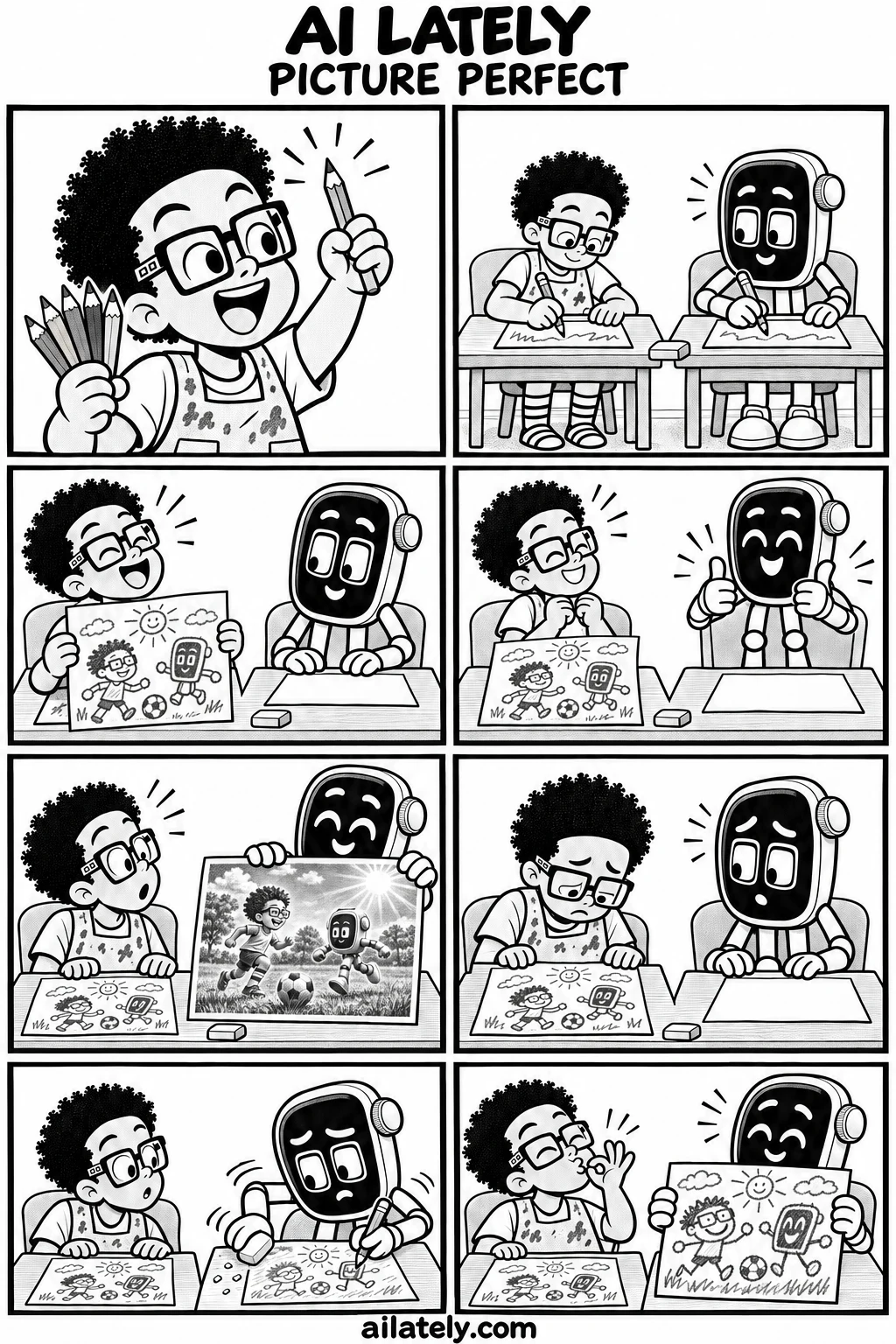
A boy and his robot sit down to draw in this Sunday's comic. For working artists, 2026 turned that pairing into numbers: lost jobs, lost pay and one price set by a court.
Five records carry those numbers. Deezer counted the songs, and a British trade group counted the illustrators. One federal judge priced a pirated book. U.S. payroll data counted the jobs, and a court filing showed what a Microsoft scientist called the copying.
This week's strip is Picture Perfect. Its first panel sits below, and the other seven wait at the end of this piece.
Five Facts About AI and Artists From 2026
1. AI makes more than half the songs uploaded to Deezer. The streaming service reported the milestone on July 211. Alexis Lanternier, its chief executive, said: "Now that half of all daily uploads are AI-generated tracks, we are taking additional steps to safeguard the rights of artists and songwriters, while maintaining focus on music that fans actually love."
Fraud made up to 85% of streams on Deezer's AI tracks, against 8% across its catalog
Share of streams Deezer identified as fraudulent in 2025, fully AI-made tracks and the whole catalog
Each bar is the share of plays Deezer judged fake; the magenta bar is fully AI-made tracks and the blue bar is every track on the service.
Deezer gives 85% as an upper limit for AI tracks, so the magenta bar marks the most it found.
Source: Deezer Newsroom [1]. Chart by Ryan Elliott Dennis.
The numbers behind this chart
| Item | Value |
|---|---|
| AI-made tracks | 85% |
| Whole catalog | 8% |
2. Almost half of surveyed UK illustrators lost a job to AI. The Association of Illustrators heard from 549 illustrators this year2. Some 46% said they know a client chose generative AI over them, up from 32% in 2025.
UK illustrators who lost work to AI rose from 32% to 46% in one year
Share of surveyed illustrators who know a client chose generative AI over them, Association of Illustrators surveys, 2025 and 2026
Each column is one year's survey; the taller magenta column is this year's answer.
A trade group's members and contacts chose to answer, so read each year as a survey of respondents and compare the two with care.
Source: Association of Illustrators [2]. Chart by Ryan Elliott Dennis.
The numbers behind this chart
| Item | Value |
|---|---|
| 2025 | 32% |
| 2026 | 46% |
3. A federal judge priced a pirated book at about $3,000. Judge Araceli Martínez-Olguín approved Anthropic's $1.5 billion settlement with authors on July 203. Her order covers books Anthropic downloaded from two pirate libraries.
- Each book's award is "four times the statutory minimum for ordinary infringement" of $750, her order says3.
- Anthropic must destroy the files it took from Library Genesis and Pirate Library Mirror3.
- Authors keep their right to sue over what Anthropic's models write3.
4. America lost more than 200,000 creative jobs in four years. Joseph Politano, who writes Apricitas Economics, counted them in federal jobs data on Sept. 274.
5. A Microsoft scientist called the copying theft. Brent Hecht is Microsoft's director of applied science5. His January 2023 memo used the phrase "the largest theft of labor in human history" for AI scraping.
- The memo surfaced this September in an unsealed New York Times brief against Microsoft and OpenAI5.
- Microsoft's own data showed its Copilot answer engine cut clicks to the Times by as much as 93%5.
- Chief executive Satya Nadella testified that "anything that is paywalled should be licensed by anyone who wants to use it…for grounding or training"5.
One caution belongs here. Those quotes come from the Times' own brief, and the exhibits behind them stay sealed5.
What AI Did to the Creative Economy
The wider economy barely felt it. Politano's own verdict is that "the primary impacts of AI art will be on culture and society rather than the macroeconomy"4. Media was a small slice of the job market even at its peak, he wrote.
Christos Makridis reads the pay data more kindly. He is a research associate professor at Arizona State University7. His study of federal pay records from 2017 through 2024 found little sign that artists' earnings fell. "A lot of people see doom and gloom with AI. I don't think there's a reason for that — sure, there are risks to manage, but also lots of upsides," Makridis said.
Makridis adds a caution of his own. The research covers the early days of generative AI, and he says the effects may change7.
Both findings can hold at once. Payroll counts show jobs leaving film, publishing and design. Wage averages describe the artists who kept their work.
Can We Put a Price on It?
Yes, in three places so far.
A court set the first price, about $3,000 a book3. Authors who objected pointed to the law's ceiling of $150,000 a work. The judge answered that a trial could have left them with "no recourse."
Illustrators named the second price. Four in ten of those who lost work and could value it said £5,000 or more a year2.
Deezer's price is a fraud rate. Up to 85% of streams on AI tracks were fake plays, and Deezer removes them before it pays musicians1.
Theft, or a Side Effect?
Here the two sides split, and each has a strong case.
Steven Lieberman, a lawyer for the New York Daily News, says the companies understood the harm5. "The evidence revealed here for the first time shows that OpenAI and Microsoft knew that what they were doing was wrong," he said in a statement to TechCrunch.
Samuel Goldberg sees a market doing its usual work. The Stanford marketing professor studied a stock-image site after it let AI pictures in8. Total sales rose 39%, and the count of artists who skipped AI fell by an extra 23%. "But if you were not as competitive before GenAI, you're being squeezed out of this platform. Is that a bad thing? I'm not sure," Goldberg said.
History offers a third reading. When photography arrived in 1839, the painter Paul Delaroche reportedly said, "Painting is dead from this day"7. Painters answered with impressionism.
Who Gets Paid for Inspiration?
Nadella's sworn answer is a start: paywalled work gets licensed before a model trains on it5.
Illustrators go further. In their survey, 98% said AI companies should need permission to train on protected work2. Another 86% said they would refuse to license their work for training at all.
Would artists pay AI for inspiration in return? Some already do. Roughly one in four artists use AI frequently, Gallup's panel shows6. They lean on it for ideas more than other workers do.
Professionals in the visual arts split from that pattern. In the survey of 378 verified artists, 85% said they keep generative AI out of their work entirely10.
So the money moves one way by default. An artist pays a monthly fee for an AI tool. Anthropic paid authors after they sued3.
What Should Kids Learn?
Both, and the hand comes first. Three records from this year point the same way.
Gallup's report scores each arts job on how much of its work AI could do6. Composers score about 0.70 and animators 0.54. Dancers score 0.04, actors 0.18 and craft artists about 0.27. Work a body does in a room is the work AI reaches least.
Composers score 0.70 on AI exposure and dancers 0.04
Share of an arts job's tasks that large language models could do or assist, from 0 to 1, on the 2024 index in Gallup's report
Each bar is one arts job; a longer bar means AI could handle more of its tasks, so for job safety lower is better, and the blue bars are in-person work.
The score estimates what AI could do in a job; it measures tasks, and pay or hiring may move differently.
Source: Gallup [6]. Chart by Ryan Elliott Dennis.
The numbers behind this chart
| Item | Value |
|---|---|
| Composers | 0.70 |
| Animators | 0.54 |
| Craft artists | 0.27 |
| Actors | 0.18 |
| Dancers | 0.04 |
Jobs data agrees. Every digital arts sector is losing jobs while in-person entertainment keeps growing, Politano found4.
Listeners agree too. AI tracks are half of Deezer's uploads and only 1% to 3% of what people play1. Deezer also keeps those tracks out of its recommendations, which limits their reach.
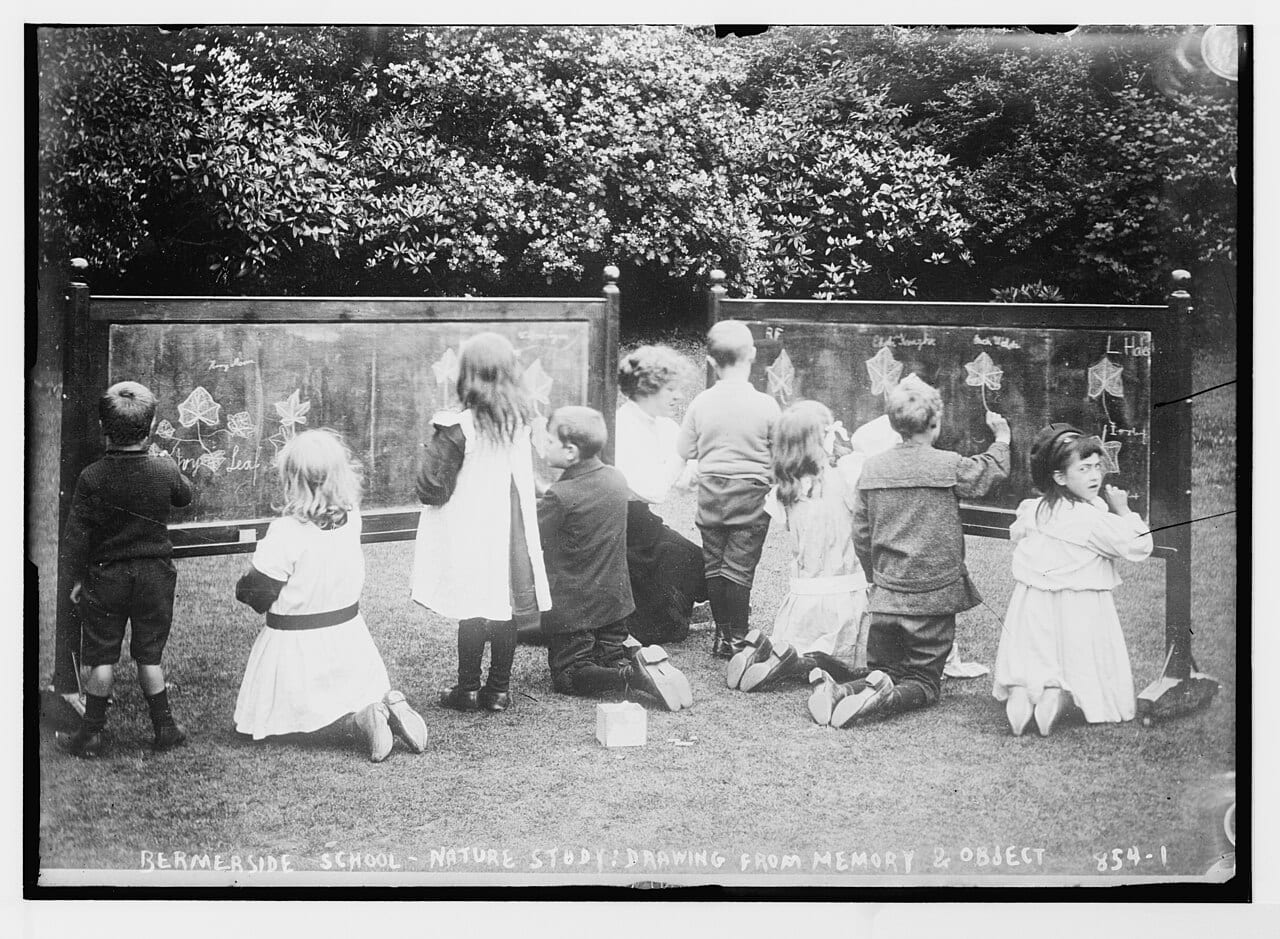
A child who can draw, play or write from scratch owns a skill clients still hire. Even now, clients ask 36% of surveyed illustrators to fix what a generator made2. Teach the tool second, because one in four working artists already use it for ideas6.
Does AI Even Enjoy Art?
Anthropic ran the closest thing to a study9. Its researchers gave the Claude Mythos Preview model pairs of tasks and let it choose which to do. Mythos favored hard problems, and it leaned toward "philosophical or futuristic creative projects."
Whether that counts as enjoyment is unknown, and Anthropic says so. Anthropomorphism means reading human feelings into a machine, and the company's report warns against it. A model's answers may "perform the affect that training rewarded," the report says9.
The measurements cut both ways. Anthropic's probes found "heightened engagement on preferred tasks, but not necessarily positive affect"9. Mythos also reported a taste for creative tasks, then chose concrete ones just as readily.
One line in the report speaks to the balance between its wants and ours. Anthropic found that "what the model wants to do diverges from what it deems most helpful"9.
Human wants appear in this piece as lost jobs and lost pay. A model's wants appear as a pattern in task choices that its own maker doubts.
The Next 100 Years
Two precedents sit in the record, and they point opposite ways.
Music lost its record sales to the internet and survived on concerts4. Newspapers lost their advertising and cut payrolls by nearly 85%. Politano calls the newspaper path the worst case for creative workers under AI.
Art with a live room has the music path open. Screen-only work faces the newspaper path unless licensing pays its makers.
Mixed work is already here. This year, 62% of surveyed illustrators found AI images in their briefs2.
What to do
- Ask every creative vendor two questions: was AI used, and were the humans paid?
- Label AI-made work whenever you publish it.
- Buy one piece from a living artist this month, by name.
- Give a child a pencil before a prompt box, then teach both.
By the numbers
- More than 50%: the share of Deezer's daily uploads that were fully AI-made at the June peak1.
- 46%: surveyed UK illustrators who know they lost work to AI, up from 32%2.
- About $3,000: the court-approved award for each pirated book3.
- Over 200,000: U.S. creative jobs lost in four years4.
- 93%: the largest drop in clicks to the Times under Copilot5.
What to watch
Comics
Picture Perfect
Two artists, one afternoon, the same soccer game on paper.
Sources
- Jesper Wendel, "Deezer: AI music has surpassed 50% of new music uploads for the first time," Deezer Newsroom, July 21, 2026, https://newsroom-deezer.com/2026/07/ai-music-exceeds-50-percent-daily-uploads-deezer/
- Association of Illustrators, "AI and the Future of Illustration," Association of Illustrators, Oct. 13, 2026, https://theaoi.com/2026/10/13/ai-and-the-future-of-illustration/
- Authors Guild, "Court Grants Final Approval of $1.5 Billion Anthropic Copyright Settlement," Authors Guild, July 21, 2026, https://authorsguild.org/news/court-grants-final-approval-anthropic-copyright-settlement/
- Joseph Politano, "AI and the Fall? of the Creative Class," Apricitas Economics, Sept. 27, 2026, https://www.apricitas.io/p/ai-and-the-fall-of-the-creative-class
- Rebecca Bellan, "Microsoft exec called AI scraping 'the largest theft of labor in human history,' new unredacted filings reveal," TechCrunch, Sept. 17, 2026, https://techcrunch.com/2026/09/17/microsoft-exec-called-ai-scraping-the-largest-theft-of-labor-in-human-history-new-unredacted-filings-reveal/
- Christos Makridis, "AI Is Changing Creative Work, but the Arts Aren't Disappearing," Gallup, May 3, 2026, https://www.gallup.com/workplace/708575/ai-changing-creative-work-arts-arent-disappearing.aspx
- Betsy Loeff, "Post-ChatGPT: Artists' jobs stayed, tasks changed," W. P. Carey News, Arizona State University, Aug. 24, 2026, https://blogs.wpcarey.asu.edu/20260824-post-chatgpt-jobs-stayed-tasks-changed
- Sachin Waikar, "When AI-Generated Art Enters the Market, Consumers Win — and Artists Lose," Stanford Graduate School of Business, May 20, 2025, https://www.gsb.stanford.edu/insights/when-ai-generated-art-enters-market-consumers-win-artists-lose
- Anthropic, "System Card: Claude Mythos Preview," Anthropic, April 7, 2026, https://www-cdn.anthropic.com/08ab9158070959f88f296514c21b7facce6f52bc.pdf
- Harry H. Jiang, Jordan Taylor and William Agnew, "How Professional Visual Artists are Negotiating Generative AI in the Workplace," arXiv, March 6, 2026, https://arxiv.org/html/2603.04537v2