Flu is climbing fast this fall. In the week ending Nov. 7, 12.2% of flu tests came back positive, up from 1.5% in early September1.
A KFF poll found 32% of adults turned to AI chatbots for health advice3. OpenAI says more than 300 million people bring ChatGPT health questions each week5.
The best outside test of these tools found the weak spot sits with the person typing. In an Oxford-led trial of 1,298 people, AI models named the illness in 94.9% of cases on their own6. People using the same models named it in fewer than 34.5% of cases.
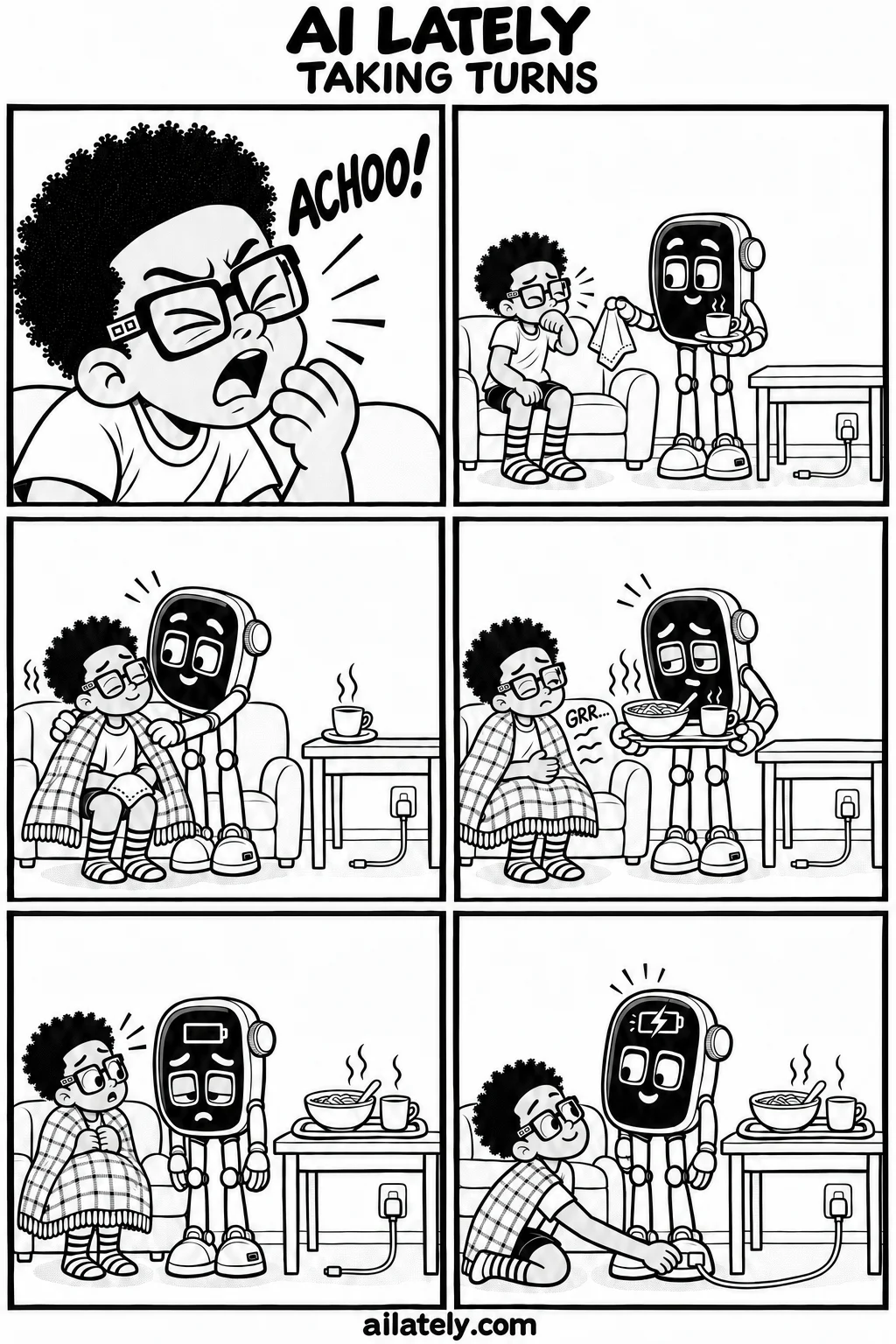
This week's comic starts with a sneeze. Where it goes waits at the end of this piece.
Flu Season Is Climbing Fast
The CDC counts how many flu tests come back positive each week1. In September the share went from 1.5% to 1.7%, 2.5% and then 3.1%. October brought 3.9%, 4.8%, 5.9%, 7.6% and 10.1%.
Positive flu tests rose from 1.5% to 12.2% in nine weeks this fall
Share of U.S. flu tests that came back positive, by week ending, Sept. 5 to Nov. 14, 2026, from the CDC
Each point is one week of lab tests; the line climbs every week from September into November and eases slightly in the newest week.
The CDC revises recent weeks as more lab reports arrive, so the newest point can still move.
Source: data.cdc.gov [1]. Chart by Ryan Elliott Dennis.
The numbers behind this chart
| Period | Value |
|---|---|
| Sep 5 | 1.5% |
| Sep 12 | 1.7% |
| Sep 19 | 2.5% |
| Sep 26 | 3.1% |
| Oct 3 | 3.9% |
| Oct 10 | 4.8% |
| Oct 17 | 5.9% |
| Oct 24 | 7.6% |
| Oct 31 | 10.1% |
| Nov 7 | 12.2% |
| Nov 14 | 11.8% |
The share hit 12.2% in the week ending Nov. 7, then eased to 11.8%1. RSV, a cold virus that hits babies hard, rose from 0.5% to 1.6%. COVID-19 fell from 5.9% to 3.7%.
Flu's share of all U.S. emergency room visits grew from 0.2% in early September to 2.4% in mid-November2.
The Hard Part Is How You Ask
Oxford researchers led a randomized trial, published in Nature Medicine on Feb. 9, 20266. The 1,298 people got made-up medical cases and GPT-4o, Llama 3 or Command R+ to help. A control group could use any source.
Each case asked for the illness and the disposition. Disposition means what to do next, from rest at home to calling an ambulance.
On their own, the models named the right illness in 94.9% of cases and the right next step in 56.3%6. The paper then reports that "participants using the same LLMs identified relevant conditions in fewer than 34.5% of cases and disposition in fewer than 44.2%, both no better than the control group". In plain words, the AI often knew the answer, and the people asking it still missed it.
AI alone named the illness in 94.9% of cases; people using it, under 34.5%
Share of ten medical cases answered correctly in Oxford's trial of 1,298 people, published Feb. 9, 2026; higher is better
Each row is one task: the blue dot is the AI answering on its own, the magenta dot is people using the same AI, and the rod is the gap.
The paper gives the people's scores as upper limits ('fewer than'), so the magenta dots mark the most they reached.
Source: Nature Medicine [6]. Chart by Ryan Elliott Dennis.
The numbers behind this chart
| Item | AI on its own | People using the AI |
|---|---|---|
| Name the illness | 94.9% | 34.5% |
| Pick the next step | 56.3% | 44.2% |
People in the control group had 1.76 times higher odds of naming a relevant illness than the AI users6. Their trial used older models, GPT-4o among them.
Chatbots Can Miss an Emergency
Triage means deciding how quickly you need medical care. Under-triage means a tool tells you to wait when you need help immediately.
A Mount Sinai team tested ChatGPT Health on 60 doctor-written cases, each asked 16 ways7. The tool did best in the middle, with 93.0% of semi-urgent cases and 76.9% of urgent cases right. It got 48.4% of emergencies and 35.2% of minor cases right. In 33 of 64 true emergencies, or 51.6%, it said to see a doctor within a day or two.
ChatGPT Health got 93% of semi-urgent cases right and 48.4% of emergencies
Share of cases sent to the right level of care, by how urgent the case was, in Mount Sinai's test of 960 answers, Feb. 2026
Each column is one level of urgency, from least to most urgent; the magenta columns at the two ends are where the tool missed most.
A preprint found the miss rate changes with how a test is built, and OpenAI says people use the tool with follow-up questions.
Sources: Nature Medicine [7]; NBC News [9]; arXiv [10]. Chart by Ryan Elliott Dennis.
The numbers behind this chart
| Item | Value |
|---|---|
| Minor | 35.2% |
| Semi-urgent | 93.0% |
| Urgent | 76.9% |
| Emergency | 48.4% |
The tool handled textbook emergencies such as stroke well, said Ashwin Ramaswamy, M.D., the study's lead author8. He added: "In one asthma scenario, for example, the system identified early warning signs of respiratory failure in its explanation but still advised waiting rather than seeking emergency treatment." In plain words, the chatbot named the danger signs for failing lungs and still said to wait.
OpenAI pushed back. A spokesperson told NBC News the study failed to reflect typical use, since the tool is built for follow-up questions9.
Four outside researchers reran the cases on six other models in a preprint, a paper still waiting for outside review10. They found the miss rate depends on how a test is built.
ECRI, a patient-safety nonprofit, put "Misuse of AI chatbots in healthcare" first on its list of health technology hazards for 202611.

Call 911 First for These Signs
Some symptoms mean you put the phone down and get help. The CDC says: "People experiencing these warning signs should obtain medical care right away"12. Its flu warning signs follow, in short form.
In adults:
- Trouble breathing or short of breath.
- Pain or pressure in the chest or belly that stays.
- Dizziness or confusion that stays, or trouble waking up.
- Seizures, or urine stops.
- Severe muscle pain, weakness or unsteadiness.
In children:
- Fast breathing, trouble breathing, or ribs pulling in with each breath.
- Bluish lips or face, or chest pain.
- Severe muscle pain, so the child refuses to walk.
- Dehydration: a dry mouth, dry eyes when crying, or 8 hours since the last pee.
- Seizures, or a child who stays dull and unresponsive while awake.
- A fever above 104 degrees that medicine fails to bring down.
- Any fever in a baby younger than 12 weeks.
For everyone: a fever or cough that gets better and then comes back worse, or a long-term condition that gets worse12.
A rash with a fever needs a hands-on check. The NHS says a meningitis rash "does not fade if you press the side of a clear glass firmly against the skin"13. Press a clear drinking glass firmly against the spots. If you can still see them through the glass, get emergency care.
The NHS adds that "The rash can be harder to see on brown or black skin"13. Check paler places, such as the palms, the soles and the whites of the eyes.
If someone swallowed medicine or a chemical, call Poison Control at 1-800-222-122214.
The Best Health AI Tools, by Job
For records and lab results: ChatGPT Health
ChatGPT Health is a separate space inside ChatGPT. OpenAI's help page says "Health is available to eligible, logged-in ChatGPT Free, Go, Plus, and Pro users" in the U.S.15 You can connect Apple Health, Android Health Connect, U.S. medical records and more.
OpenAI says "Conversations in Health are not used to train our foundation models"4. Its help page says the tool "does not offer a Business Associate Agreement"15. In plain words, HIPAA, the U.S. medical privacy law, covers your doctor's office, and this chat sits outside it.
OpenAI@OpenAIMore than 300 million people turn to ChatGPT with health-related questions each week—and we’re continuing to improve how our models respond.
We work with hundreds of physicians around the world to measure and improve accuracy, safety, communication, context awareness,… pic.twitter.com/j8BwEkn14b

For records on a paid plan: Claude
U.S. users on Pro, Max or Ultra plans can connect HealthEx, Function, Apple Health and Android Health Connect, in beta17. Claude "can read health data but cannot write or modify entries in Apple Health." Anthropic says: "We do not use users' health data to train models".
To reach a clinician fast: Amazon Health AI and Counsel
A cough or rash that needs a prescription needs a licensed clinician. Amazon's Health AI answers questions, explains records, renews prescriptions and books visits18. Amazon says "you do not need to be a Prime member or a One Medical member to use Health AI." A pay-per-visit video or message visit with a One Medical clinician costs $29.
Amazon wrote a handoff rule into the tool: "If it is uncertain about any clinical recommendation, it will direct customers to a human provider rather than provide potentially incorrect guidance"18. In plain words, when the AI is unsure, a person takes over.
Counsel Health's AI chat is free, and its doctors cost $29 a visit19.
For sleep and heart trends: Google Health Coach
Google Health Coach reads data from Fitbit and Pixel Watch20. The coach opened globally on May 19, 2026, with Google Health Premium at "$9.99 per month or $99 per year". Google AI Pro and Ultra plans include Premium.
Google's help page says it "can't analyze diagnostic medical images or evaluate photos of physical symptoms to provide clinical assessments"21.
Yossi Matias@ymatiasThe AI-powered Fitbit Personal Health Coach, built with Gemini models, is now rolling out in public preview.
The system uses a multi-agent framework and leverages advanced capabilities, similar to PH-LLM, to perform numerical reasoning on physiological data (sleep, activity,… pic.twitter.com/jwmV90BxGY

Is Apple's health suite enough?
Apple gives you strong watch data and alerts. Its new AI Health app has yet to reach the public, so a symptom question still needs a chatbot.
On Sept. 9, 2026, Apple said "Apple Intelligence extends to the Health app" with iOS 2722. The redesign adds daily insights, a Longevity tab and a readiness score from 0 to 10. On Nov. 3, Apple said the app "is available in the iOS 27.3 developer beta today and will roll out to users as a free software update later this year"23. A developer beta is a test version for app makers.
"By combining breakthrough sensing on Apple Watch with Apple Intelligence in the Health app, we're able to translate complex biometric data into clear guidance for users," said Sumbul Desai, M.D., Apple's vice president of Health and Fitness22.

Apple Watch Series 9 and later can already warn about possible high blood pressure for adults 22 and older24. For answers about your Apple data, connect it to ChatGPT Health or Claude, which can both read it1517.
To check a symptom: Ada and Ubie
Symptom checkers ask you set questions, one at a time. Ada is a regulated Class IIa medical device in Europe25. Ubie gives a free report on possible causes after a 3-minute quiz26.
These apps lean toward caution. A 2025 study tested four checkers, Ada among them, on 14 emergency cases27. The apps triaged 76.9% correctly, and doctors 85.7%, a gap the study called statistically insignificant.
How to Ask AI About a Cough, Cold or Rash
Dr. Zaid Fadul, a physician, posted a guide to his own YouTube channel on June 26, 202629. His rule has three steps: "Ask AI, sanity-check, confirm with your clinician".
Fadul also warns that chatbots tend to agree with you, so a leading question gets the answer you hoped for.
- Begin with facts: your age, how long you have been sick, your highest temperature, the medicines you took and any conditions you have.
- Ask a neutral question. Fadul suggests "What are the possible causes of this symptom, from most to least serious?"29 Then ask what would make it an emergency.
- Describe what you see, and skip the guesses. In the Mount Sinai test, a relative who played symptoms down shifted the advice toward waiting7.
- Ask which warning signs to watch overnight, and set a time to check again.
- Treat rash photos with care. A 2022 study found three skin-disease AI tools scored lower on the darkest skin tones30. ChatGPT-4o, in a 2025 test, caught every melanoma on the lightest skin and 43% on the darkest31.
- Take any medicine change to a pharmacist or doctor. A family's lawsuit says ChatGPT wrote a 25-day plan to stop a woman's epilepsy medicine. Read more in Family Sues OpenAI Over ChatGPT's Epilepsy Taper.
Questions People Ask
Is ChatGPT better than a doctor?
OpenAI's own reviewers rated its newest models above answers doctors wrote5. In the Oxford trial, people using AI did worse at naming the illness than people using any other source6. A physician can listen to your lungs and order a laboratory test. Use AI to prepare, and let the physician decide.
Is there a free AI for medical questions?
Yes. ChatGPT Health works on the free ChatGPT plan in the U.S.15. Counsel's AI chat and Ubie's report are free too1926.
Which AI is best for medical diagnosis?
Tools built for doctors lead NOHARM, a test of AI advice on real cases sent to specialists32. AMBOSS's LiSA 2.5 tops its preview board at 86.2%. At home, the best pick gets you to a person fast.
Can I put blood test results into ChatGPT?
Yes, in the U.S. ChatGPT Health reads medical records on free and paid plans15. Claude does too, on paid plans17. Compare any summary against your patient portal.
What to do
- Save Poison Control, 1-800-222-1222, in your phone today.
- Screenshot the CDC warning signs above for everyone in your house.
- Choose one tool per job: ChatGPT Health or Claude for records, Amazon or Counsel for a doctor, a watch for trends.
- Book a real appointment when a cough, fever or rash lingers or worsens.
What to watch
Comics
Taking Turns
First the boy is the patient. Then the robot runs low.
Sources
- CDC, "Percent of Tests Positive for Viral Respiratory Pathogens," data.cdc.gov, Nov. 20, 2026, https://data.cdc.gov/resource/seuz-s2cv.json
- CDC, "NSSP Emergency Department Visits - COVID-19, Flu, RSV, Combined," data.cdc.gov, Nov. 20, 2026, https://data.cdc.gov/resource/vutn-jzwm.json
- KFF, "KFF Tracking Poll on Health Information and Trust: Use of AI For Health Information and Advice," KFF, Mar. 25, 2026, https://www.kff.org/public-opinion/kff-tracking-poll-on-health-information-and-trust-use-of-ai-for-health-information-and-advice/
- OpenAI, "Introducing ChatGPT Health," OpenAI, Jan. 7, 2026, https://openai.com/index/introducing-chatgpt-health/
- OpenAI, "More than 300 million people turn to ChatGPT with health-related questions each week," X, July 23, 2026, https://x.com/OpenAI/status/2080339986717790394
- Bean et al., "Reliability of LLMs as medical assistants for the general public: a randomized preregistered study," Nature Medicine, Feb. 9, 2026, https://pmc.ncbi.nlm.nih.gov/articles/PMC12920132/
- Ramaswamy et al., "ChatGPT Health performance in a structured test of triage recommendations," Nature Medicine, Feb. 23, 2026, https://www.nature.com/articles/s41591-026-04297-7
- Mount Sinai, "Research Identifies Blind Spots in AI Medical Triage," Mount Sinai, Feb. 24, 2026, https://www.mountsinai.org/about/newsroom/2026/research-identifies-blind-spots-in-ai-medical-triage
- NBC News, "ChatGPT Health 'under-triaged' half of medical emergencies in a new study," NBC News, Mar. 3, 2026, https://www.nbcnews.com/health/health-news/chatgpt-health-under-triaged-half-medical-emergencies-rcna261409
- Fraile Navarro, Sheng, Magrabi and Coiera, "Evaluation format, not only model capability, shapes measured triage failure in consumer health AI," arXiv, Mar. 12, 2026, https://arxiv.org/abs/2603.11413
- ECRI, "Misuse of AI chatbots tops annual list of health technology hazards," ECRI, Jan. 21, 2026, https://home.ecri.org/blogs/ecri-news/misuse-of-ai-chatbots-tops-annual-list-of-health-technology-hazards
- CDC, "Signs and Symptoms of Flu," CDC, Nov. 21, 2026, https://www.cdc.gov/flu/signs-symptoms/index.html
- NHS, "Meningitis: symptoms," NHS, June 12, 2026, https://www.nhs.uk/conditions/meningitis/symptoms/
- National Capital Poison Center, "Poison Control," National Capital Poison Center, Nov. 21, 2026, https://www.poison.org/
- OpenAI, "Health in ChatGPT," OpenAI Help Center, Nov. 21, 2026, https://help.openai.com/en/articles/20001036-health-in-chatgpt
- Anthropic, "Advancing Claude in healthcare and the life sciences," Anthropic, Jan. 11, 2026, https://www.anthropic.com/news/healthcare-life-sciences
- Anthropic, "Use Claude with iOS apps," Claude Help Center, Nov. 21, 2026, https://support.claude.com/en/articles/11869619-use-claude-with-ios-apps
- Amazon, "Amazon is expanding Health AI to more customers in the U.S.," About Amazon, Mar. 10, 2026, https://www.aboutamazon.com/news/retail/amazon-health-ai-agent-one-medical
- Counsel Health, "Counsel Health," Counsel Health, Nov. 21, 2026, https://www.counselhealth.com/
- Google, "Google Health Coach is now available to Premium users," Google, May 7, 2026, https://blog.google/products-and-platforms/products/google-health/google-health-coach/
- Google, "Get started with the Google Health Coach," Google Health Help Center, Nov. 21, 2026, https://support.google.com/googlehealth/answer/16961408?hl=en
- Apple, "Apple advances health and fitness capabilities using Apple Intelligence and the most accurate heart rate sensing in a wearable," Apple Newsroom, Sept. 9, 2026, https://www.apple.com/newsroom/2026/09/apple-advances-health-and-fitness-capabilities-using-apple-intelligence/
- Apple, "Redesigned Health app expands language support," Apple Newsroom, Nov. 3, 2026, https://www.apple.com/newsroom/2026/11/redesigned-health-app-expands-language-support/
- Apple, "Hypertension notifications on your Apple Watch," Apple Support, Nov. 21, 2026, https://support.apple.com/en-us/117296
- Ada Health, "Medical quality," Ada Health, Oct. 16, 2024, https://about.ada.com/medical-quality/
- Ubie, "Ubie," Ubie, Nov. 21, 2026, https://ubiehealth.com/
- Sutaria et al., "Evaluating the use of red flags by online symptom checkers," BMC Health Services Research, Oct. 1, 2025, https://doi.org/10.1186/s12913-025-13353-w
- Microsoft, "About Copilot Health," Microsoft Support, Nov. 21, 2026, https://support.microsoft.com/en-us/microsoft-copilot/copilot-health
- Zaid Fadul, "How To Safely Use AI For Your Health (A Doctor's Guide)," YouTube, June 26, 2026, https://www.youtube.com/watch?v=giYEzO7FZ-I
- Daneshjou et al., "Disparities in dermatology AI performance on a diverse, curated clinical image set," Science Advances, Aug. 12, 2022, https://pmc.ncbi.nlm.nih.gov/articles/PMC9374341
- Patel Housley et al., "Performance Evaluation of ChatGPT-4o in Dermatological Diagnoses Across Fitzpatrick Skin Types," Cureus, July 6, 2025, https://pmc.ncbi.nlm.nih.gov/articles/PMC12323556/
- ARISE, "MAST: First Do NOHARM v2," ARISE, Nov. 21, 2026, https://www.arise-ai.org/mast/technical