At 1:51 Eastern on Nov. 2, twelve AI agents delivered their forecasts for control of the U.S. Senate3. Every agent favored Democrats, and every one thought the betting market was too confident.
Kalshi traders put Democratic control at 75%4. The agents averaged 64%.
The eleven-point gap raised one question. Could a committee of machines price an election better than people risking real money?
Nathan Scherner wanted to find out. He is the chief executive of BULX (bulx.ai)5. The platform simulates groups of people to forecast how markets, businesses and voters might respond to events. Four days earlier he had written to Ai Lately after reading a column about chatbots that quote betting odds.
"'Your Chatbot Now Quotes the Betting Odds' asked who checks the bet," Scherner wrote20. "We're building one answer: AI that forms its own view instead of echoing the market. BULX (bulx.ai) simulates crowds of AI agents to forecast outcomes. Our AI committee currently prices Democratic Senate control at 69% vs Kalshi's 62%, and we'll score that publicly after Nov 3."
He agreed to run the committee on camera before the vote, and to have the result graded in print whichever way it lands.
Twelve Agents, One Election
On Monday afternoon Scherner pasted the Kalshi link into his web app. He started BULX's Investment Committee, a panel of twelve AI agents with different forecasting roles3.
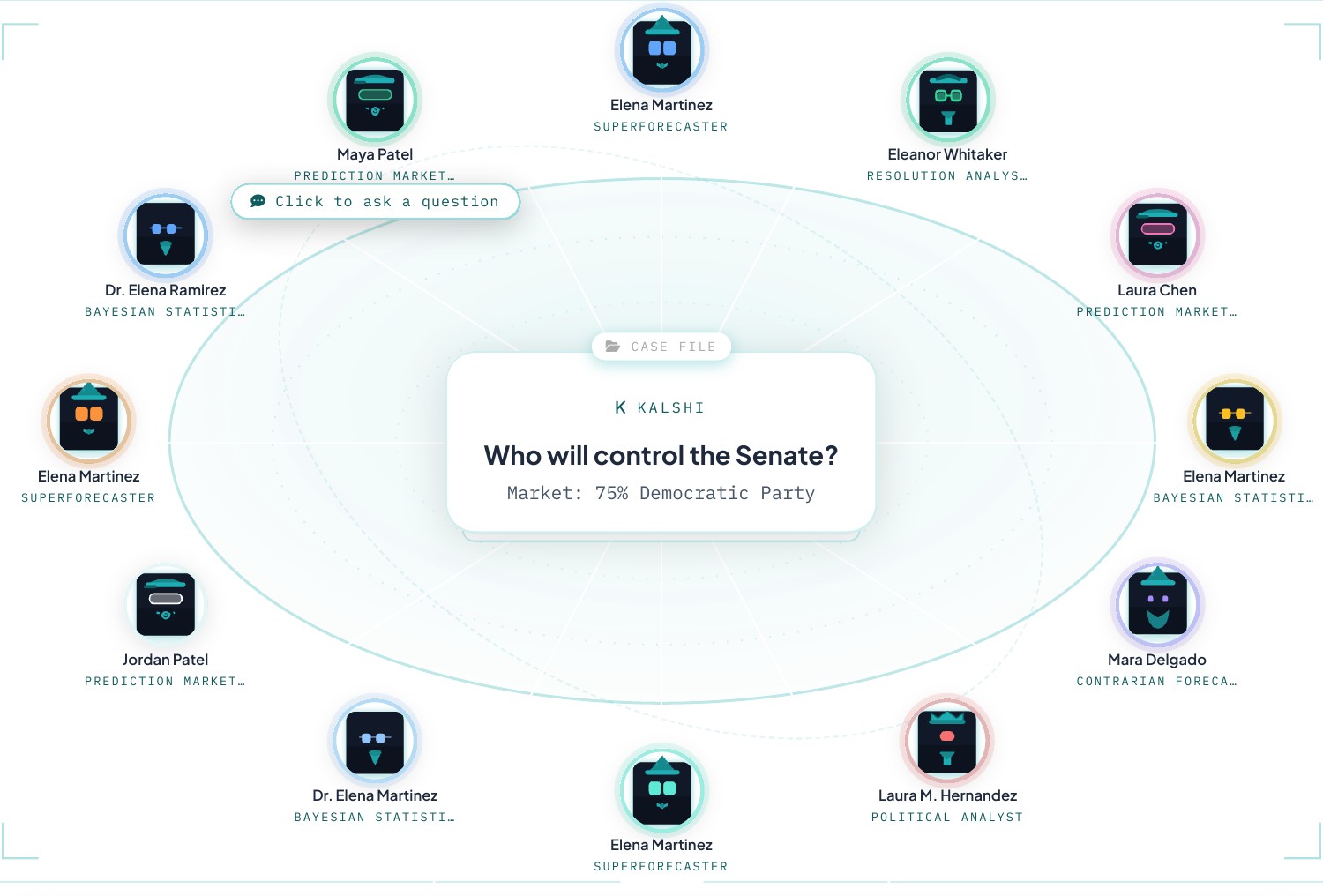
The agents played specialists: statisticians, traders, forecasters, a political analyst and a reader of settlement rules. Each received the same case file, with 90 days of news, Kalshi's contract rules and the 75-cent price. They were software personas, told to approach one question from different angles.
Their estimates ran from 61% to 68%, and their average was 64%3. One seat invoked historical midterms. Another questioned whether the Senate map justified such confidence. A third weighed the cost of betting against the market.
"The 75% quote looks rich by 10 points; with this volume, I'd still avoid a blind short until fees, depth and slippage confirm there's a clean entry," wrote the BULX seat playing a prediction market trader3.
The reasoning was orderly, and the conclusions were similar. A gap in the evidence was visible too. Several seats said they lacked state-by-state polling, candidate data or a specified Senate map. The day before an election, those are the details that decide the chamber.
BULX had priced this contract once before. On Sept. 26 its committee posted 69% against a Kalshi price of 62%, seven points above the market2. Thirty-seven days later it sat eleven points below.
BULX's committee sat 7 points above Kalshi on Sept. 26 and 11 points below on Nov. 2
Chance of Democratic Senate control, percent, the committee's average against Kalshi's price on each date
Each row is one run: the blue dot is BULX's committee average, the magenta dot is Kalshi's price that day, and the rod is the gap between them.
Sources: X (@bulxai) [2]; BULX community [3]; Kalshi [4]. Chart by Ryan Elliott Dennis.
The numbers behind this chart
| Item | BULX committee | Kalshi price |
|---|---|---|
| Sept. 26 call | 69% | 62% |
| Nov. 2 run | 64% | 75% |
Scherner explained the move in writing22. "It's lower than our Sept. 26 figure of 69% because the market moved to 75%, and the committee now reads that price as about 10 points too rich," he wrote.
bulx@bulxaiGot a bet on "Which party will win the U.S. Senate?"
Take a look what our predictive agents say about the betting field:
COMMITTEE CONSENSUS
The committee consensus probability for the Democratic Party winning the 2026 U.S. Senate is **69%**, with a **LEAN_YES** verdict. This… pic.twitter.com/ntbM1kKHxu

The committee was far from alone in doubting the market. Writing from the second-to-last run of Decision Desk HQ's election model on Nov. 2, Chris Cillizza, Geoffrey Skelley and Maddisen Murrell said Democrats "now have a 65% chance of winning the majority"23. A model built from individual Senate races and an AI committee that lacked race-level data had landed one point apart.
Three forecasts on Nov. 2: BULX's committee 64%, Decision Desk HQ 65%, Kalshi traders 75%
Chance of Democratic Senate control on Nov. 2, 2026, percent, by forecaster
Each bar is one forecaster's chance that Democrats control the Senate: the magenta bar is the betting market, and the two blue bars are the AI committee and the election model.
Sources: BULX community [3]; Kalshi [4]; Chris Cillizza (Substack) [23]. Chart by Ryan Elliott Dennis.
The numbers behind this chart
| Item | Value | Note |
|---|---|---|
| Kalshi traders | 75% | The market |
| Decision Desk HQ | 65% | |
| BULX committee | 64% |
That similarity sharpens the test. Either BULX extracts useful information through a different process, or its committee lands near a forecast anyone could read. The second case leaves open why twelve agents were needed.
Who Is Actually in the Committee?
The seats carry names, titles and confident explanations. On screen, zero proof backs the expertise those titles suggest. Their value has to come from the accuracy of their forecasts.
Scherner described the panel in writing before the call20. Five seats are fixed for every question: a superforecaster, one resolution analyst, one prediction market trader, the Bayesian statistician and the contrarian. The other seats go to domain experts drawn at random from a pool. Each answers alone, and the committee number is the simple average.
The panel runs on three model families: Claude, GPT and Nvidia's Nemotron22. Under the agents sits OASIS, an open simulator from a 23-author paper that scales to a million agents7. Above it sits a graph layer the team built on Graphiti, Zep's open framework "for building and querying temporal context graphs for AI agents"8.
Scherner says the design grew out of conversations with two hedge fund managers and a portfolio manager1. "So the hardest part was allowing for the behavior to dictate outside of what the odds are already predicting," he said.
Each agent had seen Kalshi's price before it answered. Their instructions told them to start from a base rate and read the rules literally. Each then said whether the price looked high, low or fair20.
That made their disagreement interesting. It did little to establish independence.
The Trouble With Artificial Agreement
BULX's first problem was getting its agents to disagree. Scherner says the team spent 45 days on it, because early runs kept producing the same answer1.
"They're practically all against each other in some degree, not in specifics, but they will not react as if they are all on the same team," Scherner said. "They're their own agent, their own identity. 45 days just to figure out how to do that because we kept getting into hive minds. It was brutal."
His fixes were separate providers, separate roles, blind parallel answers, and a rule that calls holding a number for consistency a bias20. Those steps can reduce some imitation. Agents trained on similar data, reading the same news and starting from the same price can still make correlated mistakes. Independence takes more than twelve job titles.
The averaging deserves a question of its own. A simple mean of twelve probabilities is easy to read. Whether it beats the best single seat, one model alone or a plain statistical baseline is a result BULX has yet to publish.
What the Record Really Shows
Scherner describes the technology in sweeping terms. Its public predictions offer a narrower way to judge it.
He supplied a record of 22 posts from BULX's X account as of Oct. 24, and he scored two later calls in writing on Nov. 222. Some of the 22 were scenario runs or open predictions that still await an outcome. Eight were stock calls with a stated target.
bulx@bulxaiFINAL TEASER
Here is the final prediction of BULX's 1024 retail trader's simulation on $AMD for the next 3 days. pic.twitter.com/kIiqQ2lr6r

Seven of the eight got the direction right. BULX scores each call out of 100, with 50 points for direction and up to 50 for landing near the close22. The scores: SPY 98.9, GameStop 94.9, Nvidia 93.0, AMD 91.6, Nvidia again 91.6, Tesla 90.5, Apple 89.6 and Wendy's 0.
Seven of eight public stock calls got the direction right, and the Wendy's call scored 0
BULX's score for each public stock call with a stated target, out of 100, Sept. 8 to Oct. 27, 2026; higher is better
Each bar is one call BULX posted on X: 50 points for the right direction plus up to 50 for price accuracy, and the gray bar is the one call that got the direction wrong.
Sources: X (@bulxai) [11]; X (@bulxai) [12]; X (@bulxai) [13]; X (@bulxai) [14]; X (@bulxai) [15]; X (@bulxai) [16]; X (@bulxai) [21]; AI Lately [22]. Chart by Ryan Elliott Dennis.
The numbers behind this chart
| Item | Value | Note |
|---|---|---|
| SPY, Oct. 18 | 98.9 | 0.21% off |
| GameStop, Oct. 26 | 94.9 | |
| Nvidia, Oct. 22 | 93.0 | |
| AMD, Sept. 8 | 91.6 | |
| Nvidia, Sept. 17 | 91.6 | |
| Tesla, Oct. 20 | 90.5 | |
| Apple, Oct. 21 | 89.6 | |
| Wendy's, Oct. 27 | 0.0 | Wrong direction |
Then came Wendy's. On Oct. 27 BULX's traders simulated a 3% drop to $6.00 for the next session21. The next morning a group led by Nelson Peltz's Trian Fund Management offered $7.35 a share in cash, about $1.4 billion24. Wendy's stock rose 14% in morning trading.
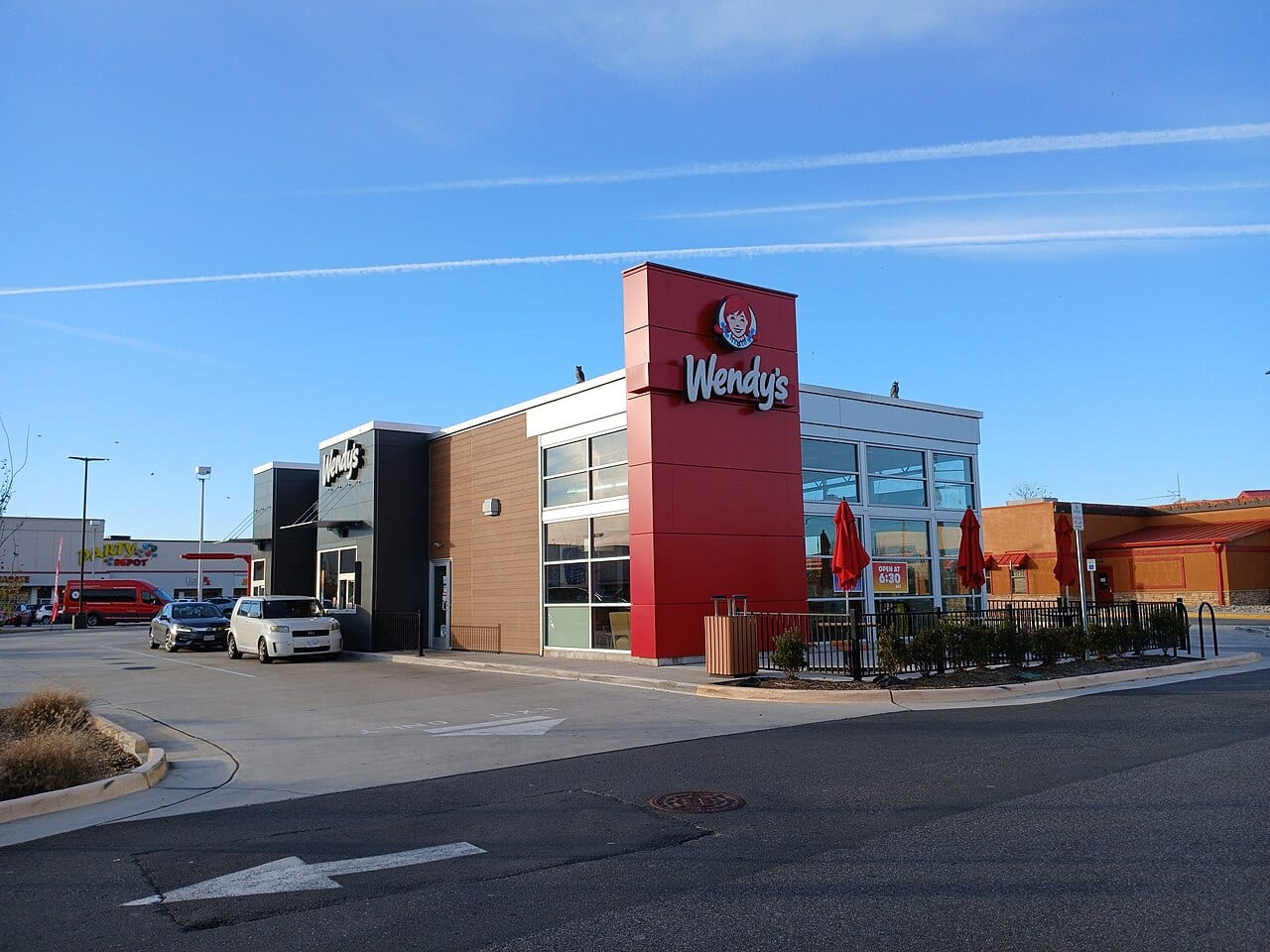
That miss shows a limit the scores hide. The simulator works from yesterday's information, and a takeover offer overwhelms yesterday. "We want to be wrong so we know how to improve," Scherner said1. "It's not scary to us. If anything, it's feedback on how we can get better."
The committee's own record is shorter, with three Kalshi calls resolved. It called a 15-minute Bitcoin contract right18 and a Trump approval contract right19. The third was a 68% lean toward the Green Bay Packers over the Atlanta Falcons, against a market at 70%17. Atlanta won 35 to 14.
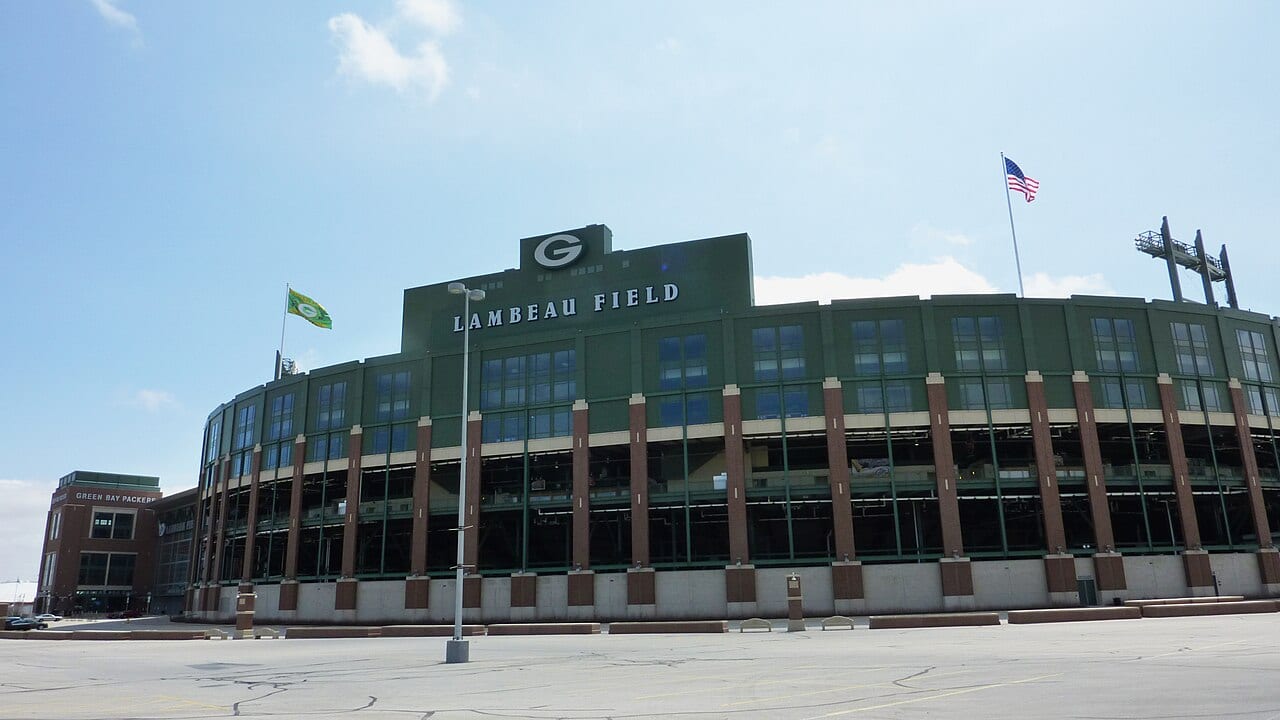
Two cautions sit over all of it. The sample is small and self-selected. BULX's point system rewards direction and proximity in its own way, so comparisons with standard benchmarks stay loose.
BULX's own deck lists the gaps20. It counts 15 to 20 public calls, news that thins on older dates, models that may remember the past, and baselines still being added.
Seven right stock directions also say little about a twelve-agent election forecast. The two share an engine and little else.
Can a Simulated Crowd Know More?
Research offers reasons to take simulated people seriously, and reasons to doubt them.
In 2024, Joon Sung Park and ten colleagues at Stanford built agents from two-hour interviews with 1,052 Americans. On held-out survey questions, the agents "achieved accuracies equal to 83%, 82%, and 86% of participants' own two-week test-retest consistency benchmark," the authors wrote10. Reproducing a person's answers is a different task from predicting an election.
A second Stanford-led study cuts the other way. In 2023, a team led by Shibani Santurkar measured whose views language models hold. The authors "find substantial misalignment between the views reflected by current LMs and those of US demographic groups," and they add that "this misalignment persists even after explicitly steering the LMs towards particular demographic groups"9.
Together the findings frame the problem. A simulation can sound human and still misrepresent the people it claims to model. BULX's seats are prompts on the same model families that team measured.
Scherner claims the field for retail users. "No, there is no competition," he said1. "There isn't anything. It sounds naive and ignorant, right?" The open-source MiroFish engine, built on the same OASIS simulator, shows 83,500 stars on GitHub6. His case rests on memory, custom personas and an easier interface, and those have yet to show up as forecasting advantages.
The test he accepts is the market's own price20. "Since the price is in front of them, we score committee calls against Kalshi's own odds," Scherner wrote. "Repeating the price isn't a forecast, so beating it is the real test."
What to do
Treat the 64% as a statement about uncertainty rather than a promise. Grade it with the Brier score, the standard rule for a probability forecast25. The score squares the gap between the forecast and the outcome, so lower is better.
If Democrats win, Kalshi's 75% scores 0.0625 and BULX's 64% scores 0.1296, and the market takes that round. Should Republicans win, BULX scores 0.4096 against Kalshi's 0.5625, and the committee takes it. One event settles one round. It says little about which system is better calibrated.
Democrats win: Kalshi 0.0625, BULX 0.1296. Republicans win: BULX 0.4096, Kalshi 0.5625
Brier score of each Nov. 2 forecast under each Senate outcome; lower is better
Each bar is one forecast's Brier score under one outcome: blue bars are BULX's 64%, magenta bars are Kalshi's 75%, and the shorter bar of each pair wins that round.
Sources: BULX community [3]; Kalshi [4]; Wikipedia [25]. Chart by Ryan Elliott Dennis.
The numbers behind this chart
| Item | Value |
|---|---|
| Democrats win, BULX at 64% | 0.1296 |
| Democrats win, Kalshi at 75% | 0.0625 |
| Republicans win, BULX at 64% | 0.4096 |
| Republicans win, Kalshi at 75% | 0.5625 |
A real test needs four methods on the same questions, with the same information cutoff. Run one agent alone, the twelve-seat committee, the committee with the market price hidden, and the market itself. Score dozens of questions recorded in advance, all the same way. If the committee's number tracks a price fed to it, the disagreement is anchoring dressed as judgment.
The number is recorded: 64% at 1:51 Eastern on Nov. 2, 2026, with a follow-up set for Thursday, Nov. 522. BULX has more to show. Its agents saw the price, several lacked the race-level data, and their independence is an open question. Scherner made the useful commitment: he wrote the number down before the outcome and agreed to be graded.
That is the whole deal with telling the future: you write it down first, and then you let the world grade you. Nathan did. What remains to be shown is whether his committee knew anything beyond the price it was handed.
Sources
- Ryan Elliott Dennis, "Interview with Nathan Scherner, chief executive of BULX," Ai Lately, Nov. 2, 2026
- BULX, "Got a bet on "Which party will win the U.S. Senate?" Take a look what our predictive agents say about the betting field," X (@bulxai), Sept. 26, 2026, https://x.com/bulxai/status/2103980833967329623
- BULX, "Investment Committee #committee_759623fd31c7: Who will control the Senate?," BULX community, Nov. 2, 2026, https://bulx.ai/community/post/541b384f-1dbd-48b7-a23a-4d83c479d81e
- Kalshi, "Who will control the Senate?," Kalshi, Nov. 2, 2026, https://kalshi.com/markets/controls/senate-winner/controls-2026
- BULX, "BULX — Behavioral AI Prediction Network," bulx.ai, Nov. 2, 2026, https://bulx.ai
- 666ghj, "MiroFish: A Simple and Universal Swarm Intelligence Engine, Predicting Anything," GitHub, Nov. 2, 2026, https://github.com/666ghj/MiroFish
- Ziyi Yang, Zaibin Zhang, Zirui Zheng and others, "OASIS: Open Agent Social Interaction Simulations with One Million Agents," arXiv, Nov. 18, 2024, https://arxiv.org/abs/2411.11581
- Zep, "Graphiti: Build Real-Time Knowledge Graphs for AI Agents," GitHub, Nov. 2, 2026, https://github.com/getzep/graphiti
- Shibani Santurkar, Esin Durmus, Faisal Ladhak, Cinoo Lee, Percy Liang, Tatsunori Hashimoto, "Whose Opinions Do Language Models Reflect?," arXiv, March 30, 2023, https://arxiv.org/abs/2303.17548
- Joon Sung Park, Carolyn Q. Zou, Jonne Kamphorst and others, "LLM Agents Grounded in Self-Reports Enable General-Purpose Simulation of Individuals," arXiv, Nov. 15, 2024, https://arxiv.org/abs/2411.10109
- BULX, "FINAL TEASER: Here is the final prediction of BULX's 1024 retail trader's simulation on $AMD for the next 3 days," X (@bulxai), Sept. 8, 2026, https://x.com/bulxai/status/2097327360844632536
- BULX, "BULX call on NVDA, one-day simulation," X (@bulxai), Sept. 17, 2026, https://x.com/bulxai/status/2100625458522128522
- BULX, "BULX call on SPY, next session," X (@bulxai), Oct. 18, 2026, https://x.com/bulxai/status/2111971825215496282
- BULX, "BULX call on TSLA, next session," X (@bulxai), Oct. 20, 2026, https://x.com/bulxai/status/2112664539330453760
- BULX, "BULX call on AAPL, next session," X (@bulxai), Oct. 21, 2026, https://x.com/bulxai/status/2112918233514930636
- BULX, "BULX call on NVDA, next session," X (@bulxai), Oct. 22, 2026, https://x.com/bulxai/status/2113381329832485117
- BULX, "Atlanta Falcons are playing the Green Bay Packers at Lambeau Field tonight in the NFL!," X (@bulxai), Sept. 24, 2026, https://x.com/bulxai/status/2103120197993574445
- BULX, "BULX committee call on Kalshi's 15-minute Bitcoin contract," X (@bulxai), Sept. 20, 2026, https://x.com/bulxai/status/2101811225646731625
- BULX, "BULX committee call on Kalshi's Trump RealClearPolitics approval contract," X (@bulxai), Oct. 10, 2026, https://x.com/bulxai/status/2108945623970116086
- Nathan Scherner, "Email from Nathan Scherner to Ai Lately on the Senate forecast, the committee and the public record," Ai Lately, Oct. 29, 2026
- BULX, "We used our 500 agent symphony to simulate another stock for next trading day. This request was $WEN," X (@bulxai), Oct. 27, 2026, https://x.com/bulxai/status/2115254394438684735
- Nathan Scherner, "Email from Nathan Scherner to Ai Lately correcting the AMD close and listing every scored call," Ai Lately, Nov. 2, 2026
- Chris Cillizza, Geoffrey Skelley, Maddisen Murrell, "Democrats now have a 2-in-3 chance of winning BOTH the House and Senate," Chris Cillizza (Substack), Nov. 2, 2026, https://chriscillizza.substack.com/p/democrats-now-have-a-2-in-3-chance
- David Moadel, "Wendy's Surges 14% on Trian-Led $1.4B Take-Private Offer; McDonald's Edges Higher, Yum Brands Stays Put," 24/7 Wall St., Oct. 28, 2026, https://247wallst.com/investing/2026/10/28/wendys-surges-14-on-trian-led-1-4b-take-private-offer-mcdonalds-edges-higher-yum-brands-stays-put
- Wikipedia contributors, "Brier score," Wikipedia, Nov. 3, 2026, https://en.wikipedia.org/wiki/Brier_score