China's internet regulator caught one of its own. ByteDance built TikTok. Three of its other apps had skipped the labels China now requires on AI content. The Cyberspace Administration of China named them in a notice posted April 28, 20263.
Jianying, Maoxiang and Jimeng AI make pictures, video and text with AI. That rule took effect Sept. 1, 20251. It makes platforms mark anything an AI system wrote, drew or filmed. A label can sit on the content itself, or hide inside the file's own data.
Four agencies signed the rule together. China's cyberspace regulator led the group, joined by an industry ministry, a police ministry and the national broadcast authority.
Any company that sells an AI tool into China needs both labels in place today. The same goes for Europe and California, bound by their own versions since Aug. 2, 2026.
ByteDance Gets Caught
Jianying edits video and ships overseas under the name CapCut. Jimeng AI turns a text prompt into a picture or a short film. Maoxiang lets people build and chat with AI characters. ByteDance built all three.
China called the finding plain. The three apps had "failed to effectively implement requirements for labeling AI-generated synthetic content," violating China's Cybersecurity Law and two newer AI rules3. Local offices got instructions to hold talks with each app's operators, order fixes within a deadline, and issue formal warnings.
All three apps stayed listed in China's app stores through the correction order. The penalty landed on the people running each app, apart from the apps themselves. China's biggest short-video company had built the labeling tools its own government wrote the rule to require, and still missed the mark.

Three Rounds in Fourteen Months
An earlier notice came first. A broader sweep ran five months before April, on Nov. 25, 20252. The November sweep named a batch of mobile apps and left each one's name out of the notice. Two failures repeated in that notice: missing visible labels and missing hidden markers in file metadata.
A bigger round followed in September 2026. The "Clear and Bright" campaign's second phase reported pulling 5.61 million pieces of content and processing 49,000 accounts4. Regulators reviewed more than 2,400 websites and apps in that single stretch.
Missing labels were only one target inside that campaign. Fabricated news, violent clips and harm to children shared the same list4. The scale still grew each round, from an unnamed batch to a named company's flagship products to a multimillion-item sweep.
China's AI-Label Rule Started 11 Months Before the EU's and California's
AI-content-labeling rules and enforcement rounds, China, the EU and California, September 2025 to September 2026
Each pin is one dated event. The magenta pins are China's rule and its own enforcement rounds; the blue pins are the EU's and California's rules starting their own clocks on the same day.
Sources: Cyberspace Administration of China, Ministry of Industry and Information Technology, Ministry of Public Security, National Radio and Television Administration [1]; Cyberspace Administration of China [2]; Cyberspace Administration of China [3]; Cyberspace Administration of China [4]; European Commission, Digital Strategy [7]; Institute for AI Policy and Strategy, Agora [8]. Chart by Ryan Elliott Dennis.
The numbers behind this chart
| Date | Event |
|---|---|
| Sept. 1, 2025 | China's rule takes hold. Four agencies signed the rule into force. |
| Nov. 25, 2025 | China's first sweep. Apps went unnamed in the notice. |
| April 28, 2026 | China names ByteDance. Jianying, Maoxiang and Jimeng AI named. |
| Aug. 2, 2026 | EU's Article 50 starts |
| Aug. 2, 2026 | California's AB 853. Its labeling duties take hold the same day. |
| Sept. 2, 2026 | China's third round. Reports 5.61 million pieces removed. |
Yicai 第一财经@yicaichinaRednote will restrict AI-generated content that is not properly labeled after receiving multiple reports about fake AI-made videos, it said yesterday. The Chinese lifestyle platform is calling on users to clearly tag such content as AI-generated. #xiaohongshu @xiaohongshu pic.twitter.com/YOws0V30Aw

What the Rule Requires
China's rule asks for two kinds of labels. Both matter equally. One sits inside the content itself, a watermark or the words "AI-generated" in a corner, visible to anyone.
A second lives inside the file's metadata, naming the service that built it and a tracking code1. Platforms must check for both before anything a user uploads goes live.
Zhang Jiyu teaches law and technology at Renmin University of China. He explained the test platforms must run before they label anything. "If the platforms detect implicit markers from the metadata of contents, they can then label them as AI-generated. However, if the platforms merely infer through some algorithms that the contents are generated by AI, the contents should be labeled as suspected AIGC," he told CGTN5.
Some apps built their own version early, ahead of the deadline. Douyin, ByteDance's own sister app, already asks creators to declare AI use and tags anything it suspects on its own. DeepSeek stamps chatbot answers "content generated by AI, for reference only." Zhipu AI's chatbot carries the same kind of notice, backed by a watermark and a hidden tag6.
Europe and California Just Started
A version of this rule in Europe came years earlier, inside its AI Act. Article 50 tells companies to mark AI content so a machine can detect it. That part of the law only became binding Aug. 2, 2026, about eleven months after China's rule took hold7.
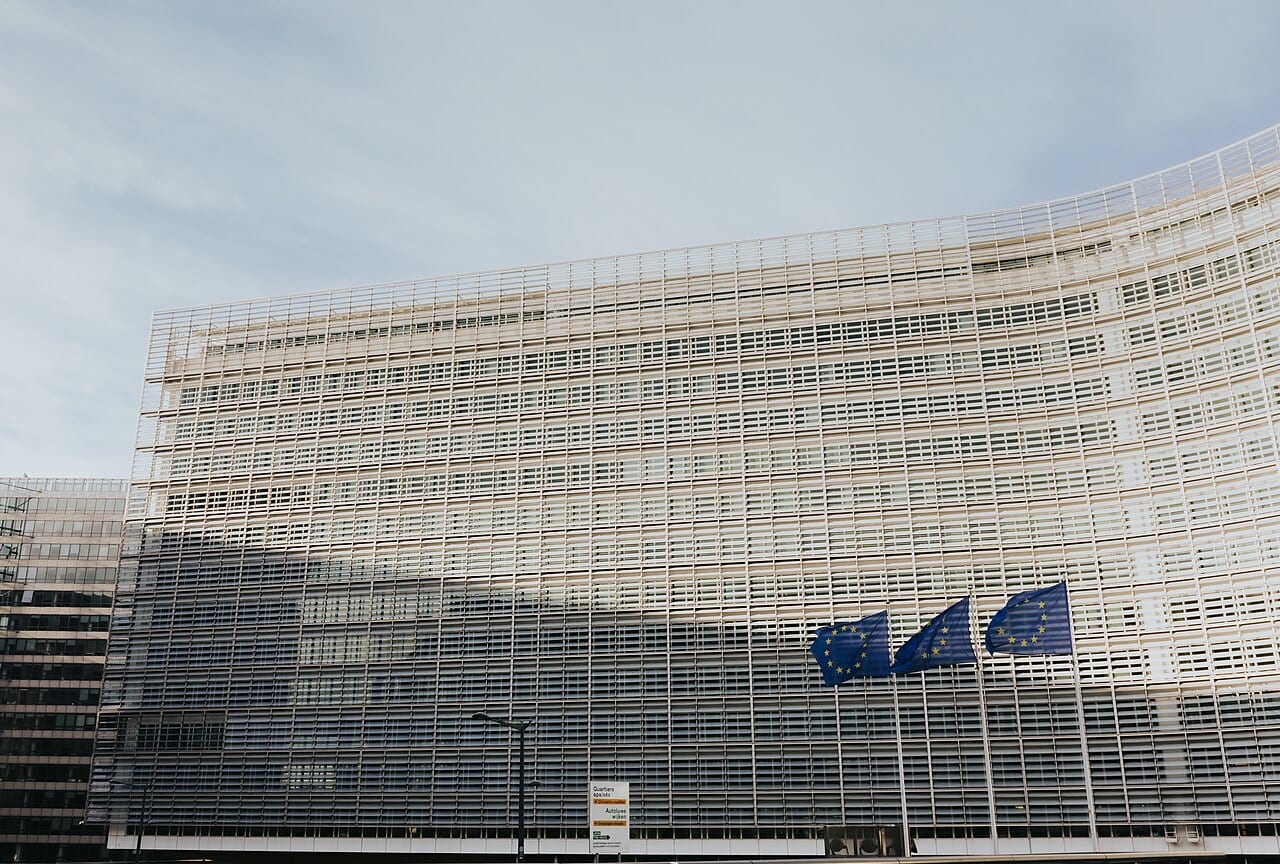
California passed a matching law the same year Beijing's rule reached its first birthday. Assembly Bill 853 turned operative the same day as Europe's rule, Aug. 2, 2026. It charges a company $5,000 for every breach, collected through the state's attorney general8.
Add up each regulator's own public rounds. China's count reads 3. The EU's and California's each read 0, four months into their own rule.

China's Regulator Already Reports 3 AI-Label Enforcement Rounds
Public enforcement rounds each regulator has reported under its own AI-content-labeling rule, through Nov. 26, 2026
The tall bar counts China's 3 reported rounds, in the 14 months since its rule began. The two short bars show the EU and California at 0, each only 4 months into their own rule.
China's rule has run about 14 months since it took effect; the EU's and California's have run about 4, so the gap may narrow as their own rules age.
Sources: Cyberspace Administration of China [2]; Cyberspace Administration of China [3]; Cyberspace Administration of China [4]; Cases Media [9]. Chart by Ryan Elliott Dennis.
The numbers behind this chart
| Item | Value |
|---|---|
| China | 3 |
| European Union | 0 |
| California | 0 |
A review of Europe's first sixty days under Article 50 came out in October. It found information requests sent to AI companies, one firm's own report, and fines tied to the new rule reading 0 so far9. California's version carries the same kind of civil penalty, enforced the same way. The law has barely run long enough to produce a test case8.
The Case For and Against
Zhang Linghan helped write China's AI rules. The China University of Political Science and Law counts her as a professor. She argued in March 2025 that labeling had already won the argument worldwide. "The institutional value of a labeling system has already become an international consensus," she wrote, pointing to similar steps already underway at the United Nations, in Singapore and inside Europe's own law10.
Li Ya reads the same record and sees a weaker curb. She is a partner at Beijing's Zhongwen Law Firm. "Rule-breaking merchants can open new accounts at will and face almost no cost for infringement," she told China Daily Global11.
Douyin's own deputy president, Li Liang, offered a reason platforms police themselves anyway. Unlabeled fakes using a real person's face, he said, "seriously undermines the credibility of creators, merchants, and the platform in the eyes of consumers, and runs counter to our long-term interests"11.
Both readings fit the same three rounds. Volume rose every time, from an anonymous batch to a named giant to a campaign counted in the millions. The repeat visits also show the first two rounds left gaps the third one still had to close.
What to Do
Check whether any product your company sells touches a Chinese user, even through a reseller. China's rule reaches "where services are provided to users within China," which pulls in outside distributors as well as domestic firms1. A tool that makes images, video or text needs two tags before that output reaches a Chinese screen.
One is visible. The other hides in the file.
Build the same two-layer label now if you serve Europe or California. Article 50 and AB 853 both ask for a visible mark plus a machine-readable one, the pattern China already enforces. Waiting for your own regulator's first case wastes the lead time China's year of rounds just handed every other market.
Expect enforcement to arrive in batches that keep growing. China's regulator ran three rounds, each one naming more companies than the last. A compliance plan built only around the first warning letter may find the company named in the batch that follows.
By the Numbers
- Sept. 1, 2025: the date China's labeling rule took effect, after four agencies signed it into force1.
- Three: the public enforcement rounds China's regulator has run against the rule so far234.
- 5.61 million: pieces of content regulators reported removing in the September 2026 round alone4.
- $5,000: the civil penalty California charges per breach under its own version of the rule8.
- Eleven months: roughly how much sooner China's rule took effect than the EU's and California's versions17.
- €15 million: the top fine the EU can levy on a company that misleads its own AI regulator9.
What to Watch
California's attorney general or an EU market authority could still answer Li Ya's point first. Watch China's next round too. Does it still catch repeat names? A returning offender would say three rounds left the job unfinished.
Sources
- Cyberspace Administration of China, "人工智能生成合成内容标识办法 (Measures for the Labeling of AI-Generated Synthetic Content)," March 14, 2025, https://www.cac.gov.cn/2025-03/14/c_1743654684782215.htm
- Cyberspace Administration of China, "网信部门依法集中查处一批存在人工智能生成合成内容标识违法违规问题的移动互联网应用程序," Nov. 25, 2025, https://www.cac.gov.cn/2025-11/25/c_1765795550841819.htm
- Cyberspace Administration of China, "网信部门依法查处"剪映"App等生成合成内容标识违法问题网站平台," April 28, 2026, https://www.cac.gov.cn/2026-04/28/c_1779119736411711.htm
- Cyberspace Administration of China, "中央网信办深入开展"清朗·整治AI应用乱象"专项行动第二阶段工作," Sept. 2, 2026, https://www.cac.gov.cn/2026-09/02/c_1790099041364574.htm
- CGTN, "China enforces new rules on labeling AI-generated content," Sept. 1, 2025, https://news.cgtn.com/news/2025-09-01/China-enforces-new-rules-on-labeling-AI-generated-content-1Gj1GWXQeJi/p.html
- Caixin Global staff, "China Enforces AI Content Labeling Rules to Curb Misuse," Caixin Global, Sept. 3, 2025, https://www.caixinglobal.com/2025-09-03/china-enforces-ai-content-labeling-rules-to-curb-misuse-102358308.html
- European Commission, "Transparency obligations under Article 50 of the AI Act," Digital Strategy, Aug. 2, 2026, https://digital-strategy.ec.europa.eu/en/faqs/transparency-obligations-under-article-50-ai-act
- Institute for AI Policy and Strategy, "California AB 853 (California AI Transparency Act)," Agora, Oct. 13, 2026, https://agora.eto.tech/instrument/5006
- Cases Media staff, "The EU AI Act Enforcement Is Live: What the First 60 Days Tell Us," Cases Media, Oct. 6, 2026, https://cases.media/en/article/the-eu-ai-act-enforcement-is-live-what-the-first-60-days-tell-us
- Zhang Linghan, "Professor Zhang Linghan: China's AI-generated content labeling leads international practices," GeopoliTechs, March 17, 2025, https://www.geopolitechs.org/p/professor-zhang-linghan-chinas-ai
- China Daily Global staff, "AI deepfakes spur calls for more control," China Daily Global, Nov. 12, 2026, https://global.chinadaily.com.cn/a/202511/12/WS6913d7aba310fc20369a4892.html
- Yicai 第一财经, post on X, Feb. 13, 2026, https://x.com/yicaichina/status/2022233443610869880