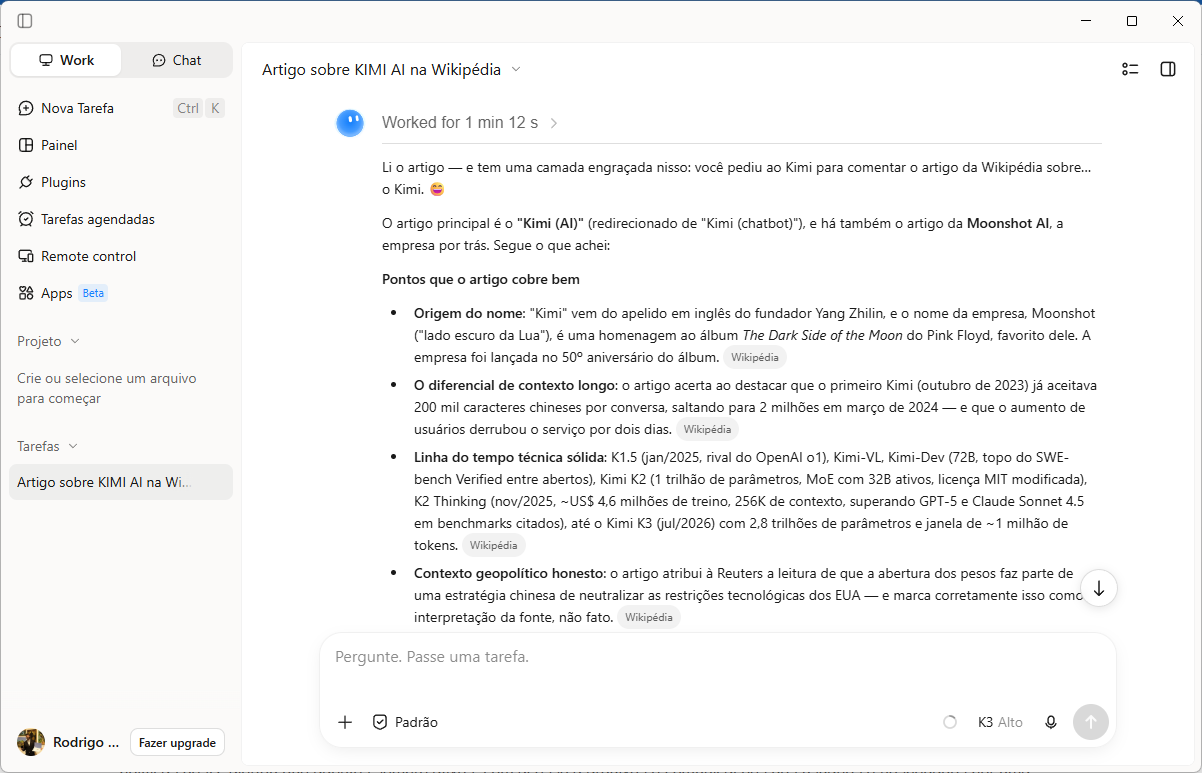
Moonshot AI gave away its biggest model this week1. The Chinese lab builds Kimi, a chatbot and coding assistant used across China and beyond. It posted the full weights for the new release on Hugging Face. Anyone can download them for free.
The model holds 2.8 trillion parameters, the numbers it learned during training1. Only a small share of them answer any single prompt. Moonshot calls the release free. Its license tells a narrower story once a company starts earning real money from it3.
What Moonshot Actually Gave Away
Moonshot built the model, Kimi K3.1 Pro, as a mixture of experts1. That design splits the network into many smaller parts. Each part learns a different kind of task. A single prompt wakes up only the parts it needs, leaving most of the network idle on any one answer.
Kimi K3.1 Pro Switches on Just 4 Percent of Its Parameters
Active parameters per answer against the model's full size, in billions
Source: Hugging Face [1]. Chart by Kelly Dennis.
The numbers behind this chart
| Item | Value |
|---|---|
| Active per answer | 104 |
| Whole | 2,800 |
The model carries a wide context window3. It can hold a long contract, or most of a company's codebase, in one sitting. Tokens are the small pieces of text a model reads and writes. This one holds close to a million of them at once.
Running it yourself still takes real hardware. One builder, on the Hacker News thread about the release, said an in-house server paid for itself within weeks2. The savings came against a steep monthly bill from Claude. Most readers will reach the model through a hosted provider, at least for now, instead of their own machine.
The Founders Behind the Giveaway
Yang Zhilin runs Moonshot as chief executive5. He co-founded the lab in March 2023. Two Tsinghua University classmates joined him, Zhou Xinyu and Wu Yuxin. The three had played in a band together before any of them built an AI company.
A computer science Ph.D. from Carnegie Mellon University followed in 20196. His doctoral committee included Ruslan Salakhutdinov and William Cohen. Salakhutdinov later led AI research at Apple, and Cohen is now a principal scientist at Google DeepMind. Both stayed in machine learning.

Moonshot reached a $35 billion valuation after a funding round that closed July 30, 20265. A lab worth that much just let any company keep a permanent copy of its best model. That beats only renting access to it through an app, the usual way an AI product reaches a paying customer.
The Free Ride Has a Meter on It
A real catch sits here. Moonshot's license permits free use, modification, redistribution and commercial use of the model, with two conditions attached3. A company whose combined revenue tops $20 million a year must sign a separate agreement with Moonshot first. Only then can it keep selling access built on the model.
Scale triggers the second condition. A product with a very large user base must display the model's name on screen too3. The same threshold applies to monthly revenue. Moonshot's own products, the partners it certifies, and any internal use skip both rules.
Math like that favors some teams more than others. That structure favors a small team testing an idea over a company already making real money from one. A startup earning well under the revenue line can build on the model free. That holds right up until the day it crosses that line.
The Score That Made Headlines Already Slipped
Simon Willison is an independent developer who built the data tool Datasette7. He tested the model through Moonshot's API the week it launched, before the open weights existed. The timing mattered.
Artificial Analysis is a group that scores AI models on its own tests. It placed the new release fourth among every model it tracks that week9. "This is the first time a (soon-to-be) open weight model has scored this highly against the frontier," Willison wrote on his site7.
Nathan Lambert, who writes the newsletter Interconnects, watched the same launch. "The Kimi team makes very clear statements about cyber risks and trying to pace the frontier of open-weight cyber capabilities and moderate it with respect to the closed frontier," Lambert wrote on X8.
Nathan Lambert@natolambertKimi K3.1 is announced as 3.1 Pro. The benchmark scores look to be clearly the strongest current open weight model, if the weights are released as they claim by November 4th. They are very impressive scores.
The Kimi team makes very clear statements about cyber risks and trying… pic.twitter.com/8vDJlql7gf

That score has since moved. Artificial Analysis rebuilt its Intelligence Index with a new set of evaluations between the two checks4. The rebuilt index now ranks the model well below where it stood at launch.
Kimi K3.1 Pro's Independent Score Falls 9 Points After Launch Week
Artificial Analysis Intelligence Index, 0 to 100, higher is better: the Oct. 23 preview score against the Nov. 5 open-weight score
The blue dot is the score Artificial Analysis gave the model when it previewed through an API; the magenta dot is what the same index gives the open weights today; the rod is the 9-point gap.
Artificial Analysis rebuilt its Intelligence Index with nine new evaluations between the two scores, so a harder test explains part of the drop, apart from the model itself.
Sources: Artificial Analysis [4]; X (Artificial Analysis, @ArtificialAnlys) [9]. Chart by Kelly Dennis.
The numbers behind this chart
| Item | Oct. 23 preview score | Nov. 5 open-weight score |
|---|---|---|
| Kimi K3.1 Pro | 55 | 46 |
The Open Source Initiative questions the word Moonshot reaches for. It writes the rules the software world uses for open source, and applies them to every weights-only release, the new model included10.
"Open Weights alone fall short of this because they do not provide the underlying training process, code, or comprehensive data details required for full-fledged use, study, modification, and sharing," the Open Source Initiative wrote10. Moonshot published the weights behind its model. It kept the training data and the training code to itself.
What to do
Test the model through a hosted provider before buying hardware of your own. Moonshot's own pricing beats renting a comparable server for most teams4.
Read your own growth plan against the license before you build a paid product on top of the model. The revenue threshold sounds distant today. A team that grows fast can still cross it within a year3. Plan for that day.
Wait for a second independent lab to test the open weight files4. Hold off trusting one benchmark number alone, Moonshot's launch chart or Artificial Analysis's first look included.
By the numbers
- 2.8 trillion (2,800 billion): total parameters in Kimi K3.1 Pro, of which 104 billion answer any one prompt1.
- 1,048,576 tokens: the model's context window, near a million words3.
- $20 million: the yearly revenue a company can earn before Moonshot requires a separate license3.
- 55 to 46: Kimi K3.1 Pro's Artificial Analysis Intelligence Index score, from its October preview to today's open-weight test94.
- $35 billion: Moonshot's valuation after its July 30 funding round5.
What to watch
Revenue is the real test. Watch whether any company actually crosses the line and signs Moonshot's separate deal3. That would show the free license cutting into real revenue, past download counts alone. Watch Artificial Analysis and other labs for the model's next score, since anyone can run the open weights apart from Moonshot's hosted version4.
Sources
- "moonshotai/Kimi-K3.1-Pro," Hugging Face, Nov. 4, 2026, https://huggingface.co/moonshotai/Kimi-K3.1-Pro
- "Kimi K3.1 Pro model weights are out," Hacker News, Nov. 4, 2026, https://news.ycombinator.com/item?id=50366999
- "Moonshot AI Releases Full 1.56TB Weights of Kimi K3.1 Pro for Free, Permits Commercial Use With Conditions," BigGo Finance, Nov. 5, 2026, https://finance.biggo.com/news/ea4290b1-7f72-4d50-9509-0240ed1a5abe
- "Kimi K3.1 Pro - Intelligence, Performance & Price Analysis," Artificial Analysis, Nov. 5, 2026, https://artificialanalysis.ai/models/kimi-k3-1-pro
- "Moonshot AI," Wikipedia, accessed Nov. 5, 2026, https://en.wikipedia.org/wiki/Moonshot_AI
- "Yang Zhilin," Wikipedia, accessed Nov. 5, 2026, https://en.wikipedia.org/wiki/Yang_Zhilin
- Simon Willison, "Kimi K3.1 Pro," Simon Willison's Weblog, Oct. 23, 2026, https://simonwillison.net/2026/Oct/23/kimi-k31-pro/
- Nathan Lambert, post on X, Oct. 23, 2026, https://x.com/natolambert/status/2113682066374062528
- Artificial Analysis, post on X, Oct. 23, 2026, https://x.com/ArtificialAnlys/status/2113688083145314416
- "Open Weights: not quite what you've been told," Open Source Initiative, accessed Nov. 5, 2026, https://opensource.org/ai/open-weights