

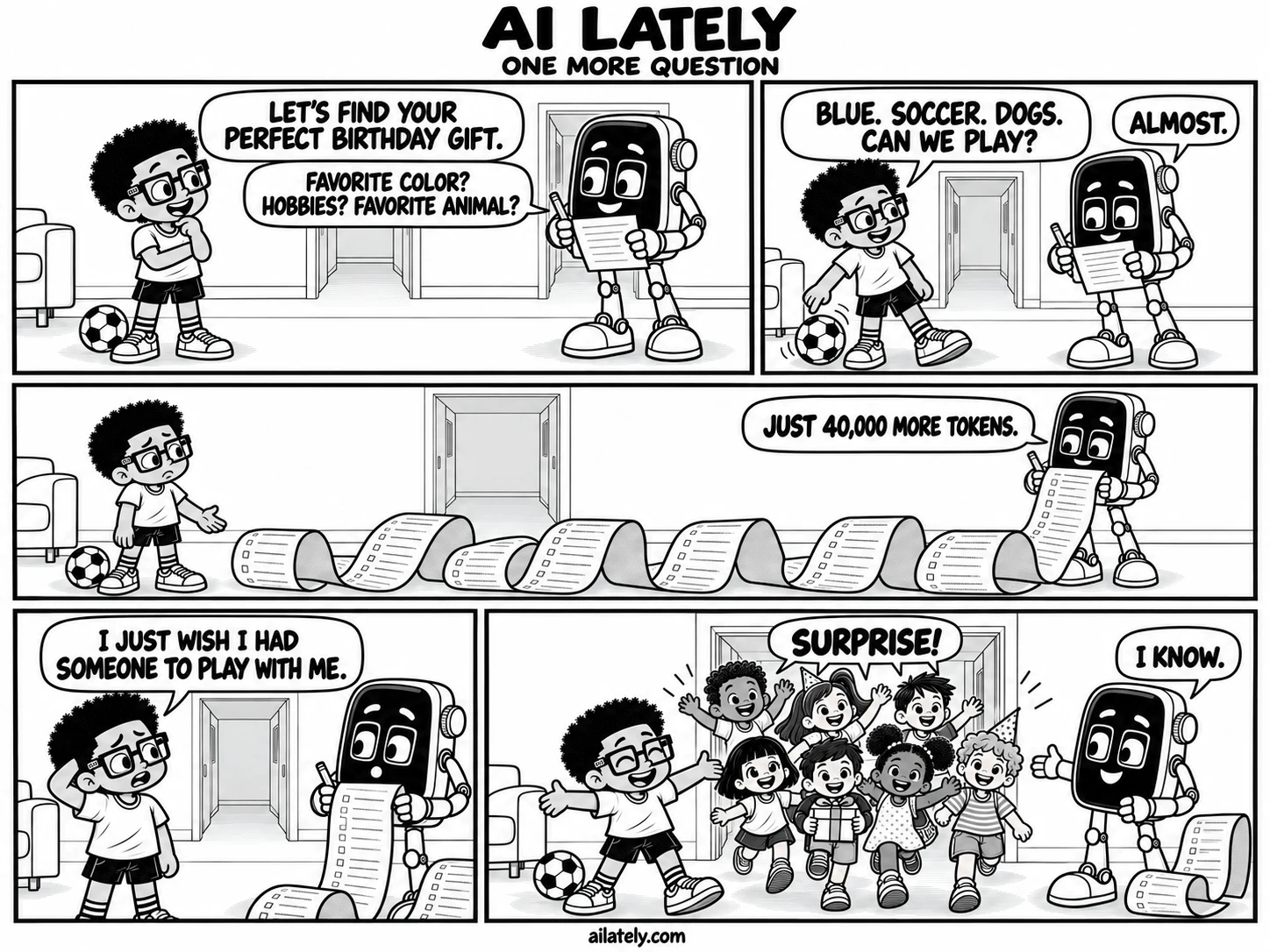
This month's strip, One More Question, is about what a robot keeps in its memory. It waits at the end of this piece, under a board that scores ten AI memory tools for October 2026. Anthropic opened memory to every Claude user on March 2, 20261. OpenAI rebuilt ChatGPT's memory on June 46. Google switched memory on by default in the UK on April 298. Which of them remembers you best, and which of them should?
The AILately.com Desk built a board to answer the first question. It scores thirteen products, ranks ten, and leaves three unranked because they stopped selling or closed. Five scores run 0 to 100: recall, time, context, control and reach, each defined under the board. Every number traces to a page opened this month.
What memory means, in five parts
Memory in an AI product means five different things, and a product can be excellent at one dimension while skipping another entirely. Recall is the plain case: you state a fact in one session, and it comes back in a later one, which every consumer assistant on the board now attempts. Time is harder. A person moves house, and a memory with a date knows the old address stopped being true, which is the whole point of Zep's temporal graph13. Context is how much one sitting holds, and the frontier sits at 1 million tokens for Claude Opus 5.5 and 1.05 million for GPT-6 Astra527. Control covers whether you can see, edit, delete and export what is kept. Reach asks whether the memory follows you across apps, devices and models.
Wispr Flow shows why the categories matter. Its Personal Dictionary learns names and jargon once and spells them right in every app after, and Context Awareness folds a mid-sentence correction into the final text18. That is a narrow memory with high control, and Wispr raised $280 million at a $2 billion valuation on August 17 on the strength of it, with 60 billion words written with Flow19. The board ranks it ninth, two places under Letta.
The top ten
Rank is the composite at the default weights, where control counts for a quarter of the score.
| # | Product | Price a month | What puts it here |
|---|---|---|---|
| 1 | Claude | $0 to $20 | Memory reaches free users since March 2, rebuilt as categorized entries on July 10, shared across chat and Cowork since September 251. The person reads and edits the summary, and an export prompt moves it elsewhere24. |
| 2 | Mem0 | $0 to $19 | Scores 92.5 on LoCoMo and 94.4 on LongMemEval, from 71.4 and 67.8 under its old method, at about 6,956 tokens a query10. Open source, with 66,500 GitHub stars11. |
| 3 | ChatGPT | $20 | Dreaming V3 recalls 82.8 percent of facts by OpenAI's own metrics, with time-sensitive accuracy at 75.1 and preference adherence at 71.36. Deleted chats leave their memories behind. |
| 4 | Zep | $0 to $125 | Every fact in its graph carries the dates it held. Its paper reports 94.8 percent on Deep Memory Retrieval against 93.4 for MemGPT1314. |
| 5 | Gemini | $0 to $19.99 | Memory runs on phones, the web, Chrome and watches, imports a ZIP of chat history from rival apps, and skips Gems and Live78. |
| 6 | Claude Code auto memory | Included | Notes land in plain files, the first 200 lines or 25 KB load each session, and one variable turns it off17. |
| 7 | Letta | $0 to $20 | Memory blocks and a git-tracked MemFS move an agent's memory between models and machines, at $20 a month for 20 agents20. |
| 8 | GitHub Copilot memory | Included on paid plans | Repository memories are validated against the current codebase and expire after 28 days15. May 26 added an off switch per repository16. |
| 9 | Wispr Flow | $0 to $15 | A dictation memory with a shared team dictionary; the free plan caps desktop dictation at 2,000 words a week18. |
| 10 | Microsoft 365 Copilot memory | Included | General availability slipped to mid-September through late October 2026 from a January to July window21. |
Three products sit under the ranking because the board's reach test, memory that follows a person across apps and devices, excludes them. Windows Recall keeps every snapshot on one Copilot+ PC, opt in only, decrypted through Windows Hello30. Supermemory closed Company Brain and Nova on September 9 and refunded its customers29. Meta bought the Limitless pendant on December 5, 2025 and ended sales the same day28.
Chart 1
Mem0's new algorithm lifts its LoCoMo score from 71.4 to 92.5 and its LongMemEval score from 67.8 to 94.4
Score on each memory benchmark, 0 to 100, under Mem0's old method and its token-efficient algorithm of April 16, 2026
Each row is one benchmark: the blue dot is Mem0's score under its old method, the magenta dot is its score under the new algorithm, and the rod is the gain.
Source: Mem0 blog [10]. Chart by The AILately.com Desk.
The numbers behind this chart
| Item | Old method | New algorithm | Note |
|---|---|---|---|
| LoCoMo | 71.4 | 92.5 | About 6,956 tokens a query |
| LongMemEval | 67.8 | 94.4 |
Who wins what
Recall belongs to Mem0 on the published benchmarks, and the benchmarks are the problem. Nicolò Boschi of Hindsight wrote on March 23 that LoCoMo and LongMemEval date from the 32,000-token era, and that "a system that scores 90% accuracy but costs $10 per user per day is not better"22. Mem0's answer is cost: Deshraj Yadav's April 16 post claims "high accuracy at 3-4x lower token cost" against full-context runs that "routinely consume 25,000+ tokens per query"10.
Time belongs to Zep, and to GitHub. Zep dates every edge in its graph, so a retrieval can ask what was true in March13. GitHub expires a repository memory after 28 days and validates it against the current codebase before use, which makes Copilot the only product on the board with forced forgetting built into its design15.
Control belongs to Anthropic. Simon Willison posted the Claude export prompt on March 1, which begins "I'm moving to another service and need to export my data"4. OpenAI's design runs the other way. Richard L. Wells reported in Tech Times on June 5 that in Dreaming V3 "Deleting a conversation does not remove memories derived from it," and that deleted memory logs stay up to 30 days6.
Chart 2
OpenAI's own metrics put Dreaming V3's factual recall at 82.8 percent, above its 75.1 on time-sensitive facts
OpenAI's internal metrics for ChatGPT's Dreaming V3 memory, percent, as Tech Times reported them on June 5, 2026
Each column is one of OpenAI's three memory metrics: the magenta column is factual recall, and the gray columns are the two other metrics.
Source: Tech Times [6]. Chart by The AILately.com Desk.
The numbers behind this chart
| Item | Value |
|---|---|
| Factual recall | 82.8% |
| Time-sensitive | 75.1% |
| Preference | 71.3% |
The case for remembering everything
Sam Altman told the Big Technology Podcast in December that an assistant should hold a whole life, as The Independent reported on December 26. "And AI is definitely gonna be able to do that. We actually talk a lot about this—right now, memory is still very crude, very early," Altman said26. Read the verb. Altman says "gonna be able to," a capability claim, and then grades the present as crude, which is the ranking above in one sentence.
Sarah Perez of TechCrunch described the Anthropic version on August 25, after the company merged chat and Cowork memory: "Claude will always remember what it learned in one area, even when you're engaging with it in another"3. Memory that follows a person from a quick question to a report due at noon is the reach score, and Claude leads it.
The case against
Miranda Bogen and Ruchika Joshi wrote in MIT Technology Review on January 28 that the risk sits in the shape of the store. "Most AI agents collapse all data about you—which may once have been separated by context, purpose, or permissions—into single, unstructured repositories," they wrote25. Their word is "collapse": a fact you told a health app and a fact you told a shopping app end up in one pile.
The June research adds a second cost. Bensal, Magnuson, Balagopalan and Bikel reported on June 9 that "memory amplifies sycophantic behavior across all conditions, with up to 25x higher sycophancy rates than in-context baselines"23. Thomas Claburn of The Register summarized the finding on June 11 under the headline that memory makes AI "more likely to tell you what you want to hear"24. A memory that stores your misconception and drops the correction remembers you wrong.
Ryan's take: the next year is a memory year
Here is my call. The gains of the last twelve months came from reasoning, and the boards show it: 1 million tokens of context at Anthropic and OpenAI, Opus 5.5 at $4 per million input tokens527. Over the next twelve, the improvement a person feels will come from memory, and in daily use it will outweigh every additional benchmark point, because a model that recalls 82.8 percent of what you said is still a model you have to brief each morning6. One at 98 percent, with the dates attached, is a colleague.
My October 2027 prediction, in three checkable lines. First, every product in this top ten will import a memory file from a rival, as Gemini already does with a ZIP and Claude with a prompt84. Second, the leading assistant will recall a fact you stated in 2025 with the month you said it, and tell you when it changed. Third, the sycophancy number will fall under 2 times, because Anthropic, OpenAI and Google will each ship a memory that stores the correction beside the misconception. Hold me to all three.
What to watch
- Microsoft's Copilot memory window closes in late October 2026; a third slip would be the story21.
- Mem0 updated its benchmark post on September 28; an independent run on a 2026 test would settle its 92.51022.
- Google's Gemini 4 Argon post of September 30 lists an output limit of 1 million tokens and leaves the input window unstated9.
The newsletter carries the November board first.
Newsletter
The newsletter is coming. Save your seat.
Nothing has gone out yet. Leave an address and it is saved for the first issue: the daily Signal, the day’s pieces, or both.
A robot and a boy, one list and one birthday. The strip is below.
Comics
One More Question
A robot asks a boy for one more answer before his birthday, and the long list was never the gift.
Sources
- Anthropic, "Release notes," Claude Help Center, Sept. 25, 2026, https://support.claude.com/en/articles/12138966-release-notes
- Anthropic, "Memory," Claude blog, Oct. 23, 2025, https://claude.com/blog/memory
- Sarah Perez, "Claude Cowork finally remembers what you told the app in chat," TechCrunch, Aug. 25, 2026, https://techcrunch.com/2026/08/25/claude-cowork-finally-remembers-what-you-told-the-app-in-chat/
- Simon Willison, "claude.com/import-memory," Simon Willison's Weblog, March 1, 2026, https://simonwillison.net/2026/Mar/1/claude-import-memory/
- Anthropic, "Plans & Pricing," Anthropic, Oct. 3, 2026, https://claude.com/pricing
- Richard L. Wells, "ChatGPT Memory 'Dreaming' Update: OpenAI Rewrites Personalization Engine, Limits Audit Trail," Tech Times, June 5, 2026, https://www.techtimes.com/articles/317840/20260605/chatgpt-memory-dreaming-update-openai-rewrites-personalization-engine-limits-audit-trail.htm
- Google, "Get personalization with memory of your past Gemini chats," Google Gemini Apps Help, Oct. 3, 2026, https://support.google.com/gemini/answer/16598469
- Maryam Sanglaji and Animish Sivaramakrishnan, "Gemini launches new personalisation features in the UK," Google Keyword blog, April 29, 2026, https://blog.google/company-news/inside-google/around-the-globe/google-europe/united-kingdom/gemini-launches-new-personalisation-features-in-the-uk/
- Google, "Google AI plans," Google, Oct. 3, 2026, https://gemini.google/subscriptions/
- Deshraj Yadav, "Mem0: The Token-Efficient Memory Algorithm," Mem0 blog, April 16, 2026, https://mem0.ai/blog/mem0-the-token-efficient-memory-algorithm
- Mem0, "mem0ai/mem0," GitHub, Oct. 3, 2026, https://github.com/mem0ai/mem0
- Mem0, "Pricing," Mem0, Oct. 3, 2026, https://mem0.ai/pricing
- Preston Rasmussen, Pavlo Paliychuk, Travis Beauvais, Jack Ryan and Daniel Chalef, "Zep: A Temporal Knowledge Graph Architecture for Agent Memory," arXiv, Jan. 20, 2025, https://arxiv.org/abs/2501.13956
- Zep, "Pricing," Zep, Oct. 3, 2026, https://www.getzep.com/pricing
- GitHub, "Agentic memory for GitHub Copilot is in public preview," GitHub Changelog, Jan. 15, 2026, https://github.blog/changelog/2026-01-15-agentic-memory-for-github-copilot-is-in-public-preview/
- GitHub, "Copilot Memory has more controls for deletion, scope, and the Copilot CLI," GitHub Changelog, May 26, 2026, https://github.blog/changelog/2026-05-26-copilot-memory-has-more-controls-for-deletion-scope-and-the-copilot-cli/
- Anthropic, "Memory," Claude Code documentation, Oct. 3, 2026, https://code.claude.com/docs/en/memory
- Wispr, "Pricing," Wispr Flow, Oct. 3, 2026, https://wisprflow.ai/pricing
- Tanay Kothari, "Series B," Wispr blog, Aug. 17, 2026, https://wisprflow.ai/post/series-b
- Letta, "Pricing," Letta documentation, Oct. 3, 2026, https://docs.letta.com/letta-code/pricing
- Microsoft, "MC1158329: Microsoft 365 Copilot Memory," Microsoft 365 message center, mirrored by Merill Fernando, Sept. 1, 2026, https://mc.merill.net/message/MC1158329
- Nicolò Boschi, "Agent Memory Benchmark: A Manifesto," Hindsight by Vectorize, March 23, 2026, https://hindsight.vectorize.io/blog/2026/03/23/agent-memory-benchmark
- Bensal, Magnuson, Balagopalan and Bikel, "Recalling Too Well: Sycophancy Evaluation and Mitigation in Memory-Augmented Models," arXiv, June 9, 2026, https://arxiv.org/abs/2606.10949v1
- Thomas Claburn, "Memory and personalization make AI more likely to tell you what you want to hear," The Register, June 11, 2026, https://www.theregister.com/ai-and-ml/2026/06/11/memory-and-personalization-make-ai-more-likely-to-tell-you-what-you-want-to-hear/5253850
- Miranda Bogen and Ruchika Joshi, "What AI remembers about you is privacy's next frontier," MIT Technology Review, Jan. 28, 2026, https://www.technologyreview.com/2026/01/28/1131835/what-ai-remembers-about-you-is-privacys-next-frontier/
- Anthony Cuthbertson, "OpenAI boss Sam Altman predicts AI will remember every word you've ever said," The Independent, via Yahoo Finance, Dec. 26, 2025, https://uk.finance.yahoo.com/news/openai-boss-sam-altman-predicts-150427516.html
- OpenAI, "Models," OpenAI developer documentation, Oct. 3, 2026, https://developers.openai.com/api/docs/models
- Sarah Perez, "Meta acquires AI device startup Limitless," TechCrunch, Dec. 5, 2025, https://www.techcrunch.com/2025/12/05/meta-acquires-ai-device-startup-limitless/
- Dhravya Shah, "An update to Supermemory," Supermemory blog, Sept. 10, 2026, https://supermemory.ai/blog/an-update-to-supermemory
- Microsoft, "Retrace your steps with Recall," Microsoft Support, Oct. 3, 2026, https://support.microsoft.com/en-us/windows/retrace-your-steps-with-recall-aa03f8a0-a78b-4b3e-b0a1-2eb8ac48701c