Google released a new model on Wednesday. The company calls it Gemini 4 Neon. It lists the model at $3 per million input tokens and $15 per million output tokens1. Tokens are the chunks of text a model reads and writes.
Gemini 4 Carbon costs less right now. It is the older, more capable model Neon has to match. Google cut its price to $2 and $10 per million tokens through Nov. 303. Neon's own launch post leaves that discount out.
Four Models, Seven Weeks
Neon is Google's fourth Gemini 4 model since October. Hydrogen, Carbon and Argon shipped first, each tuned for a different mix of speed and depth2.
Artificial Analysis tracks that pace for a living. "Google continues to accelerate its release cadence with Gemini 4 Neon, delivering a small Intelligence gain over Gemini 4 Carbon at a 17% lower Cost per Task," the firm wrote the day Neon launched2.
Neon already replaces one of its three predecessors. Inside the Gemini app, it takes over Argon's spot in the Deeper analysis menu, for subscribers on the Pro and Ultra plans6. Developers reach Neon elsewhere too, through Google AI Studio, Android Studio and Gemini for Business, from the same Wednesday1.
The Price Tag Contradicts the Promise
Simon Willison reviews model prices the day they change. He caught Neon's launch within hours.

"I wrote recently about how confusing the pricing for the Gemini 4 series was - Neon has somehow made this even worse," Willison wrote3.
His numbers show why. Hydrogen runs $1.50 and $7.50 per million tokens. Carbon's list price sits at $4 and $20, but its Nov. 30 discount cuts that exactly in half. Neon lists at $3 and $15, landing between Carbon's two prices on every measure3.
Carbon's Nov. 30 discount prices it under Neon's $3 rate
Dollars per million tokens, Gemini 4 Carbon's list and promotional price, through Nov. 30, 2026
Each row is one token type: the gray dot is Carbon's regular list price, the magenta dot is Carbon's price through Nov. 30, and the rod is the gap the discount opens.
Neon's own launch price runs $3 per million input tokens and $15 per million output tokens, landing between Carbon's sale price and its list price on both measures.
Sources: Google [1]; Simon Willison's Weblog [3]. Chart by Kelly Dennis.
The numbers behind this chart
| Item | Carbon's list price | Carbon's price through Nov. 30 |
|---|---|---|
| Input tokens | $4 | $2 |
| Output tokens | $20 | $10 |
What a Dollar Actually Buys
Price per token tells a buyer only part of the story. Artificial Analysis measured what each model actually spends to finish a task, tokens included.
Neon, pushed to its top setting, scored 61 on the firm's Intelligence Index. The index is a composite score the firm runs across dozens of tasks, from writing code to reading a spreadsheet. That task cost $6.44. Carbon scored 60 at its own top setting, for $7.76, measured at Carbon's full list price2.
Halve that $7.76 the way Carbon's own discount halves its token price, and the same task would cost about $3.88. This figure is Ai Lately's own math. Artificial Analysis priced Carbon at list rate alone23. If the math holds, the discount flips the cost advantage back to Carbon.
A discount may drop Carbon's cost per task to $3.88, under Neon's $6.44
Average dollar cost to finish one Artificial Analysis Intelligence Index task, Nov. 18, 2026; lower is better
Each bar is one price, lower is better: Carbon's full list cost in gray, Neon's listed cost in blue, and Carbon's cost under its own discount in magenta, estimated from the price cut Google has posted.
Ai Lately estimated the discounted Carbon bar: it assumes the Nov. 30 discount cuts Carbon's cost per task by the 50 percent it cuts Carbon's token price.
Sources: Artificial Analysis [2]; Simon Willison's Weblog [3]. Chart by Kelly Dennis.
The numbers behind this chart
| Item | Value |
|---|---|
| Carbon, list price | $7.76 |
| Neon, top setting | $6.44 |
| Carbon, launch discount (estimate) | $3.88 |
Who Can Use It, and Where
Access depends on which door you use. Paying API customers reach Neon now, through AI Studio, Android Studio and Gemini for Business1. Pro and Ultra subscribers get it inside the Gemini app and inside Antigravity5. Antigravity is Google's tool for agents that write and test code across many files at once.
That tool can also split the work between two models. "Orchestrator uses Neon for upfront planning, architecture, and complex reasoning while handing off routine code edits, package updates, and test runs to Hydrogen," Google wrote in its own Antigravity post5. Google says that pairing can cut cost per task 32 percent below running Carbon alone1.
GitHub shipped Neon into Copilot the same week. The model reaches Copilot's Pro+, Max, Business and Enterprise plans, inside Visual Studio Code, JetBrains IDEs, Xcode and GitHub's own apps4. Free, student and plain Pro tiers skip it for now. Business and Enterprise admins can block it through a model policy if they choose.
The Case for Calling It Efficient
Koray Kavukcuoglu runs AI research at Google DeepMind, and he wrote Neon's launch post himself. He placed Neon between its two siblings.
"While Carbon tackles your hardest, long-horizon projects and Hydrogen handles fast everyday execution, Neon balances depth and efficiency," Kavukcuoglu wrote1.
koray kavukcuoglu@koraykvToday we’re introducing Gemini 4 Neon — bringing frontier-level intelligence with fast end-to-end task completion across complex software engineering, knowledge work, and science workflows.
We focused on making Neon better to work with: much improved steerability (#2 on Agent… pic.twitter.com/DJVlW08DDK
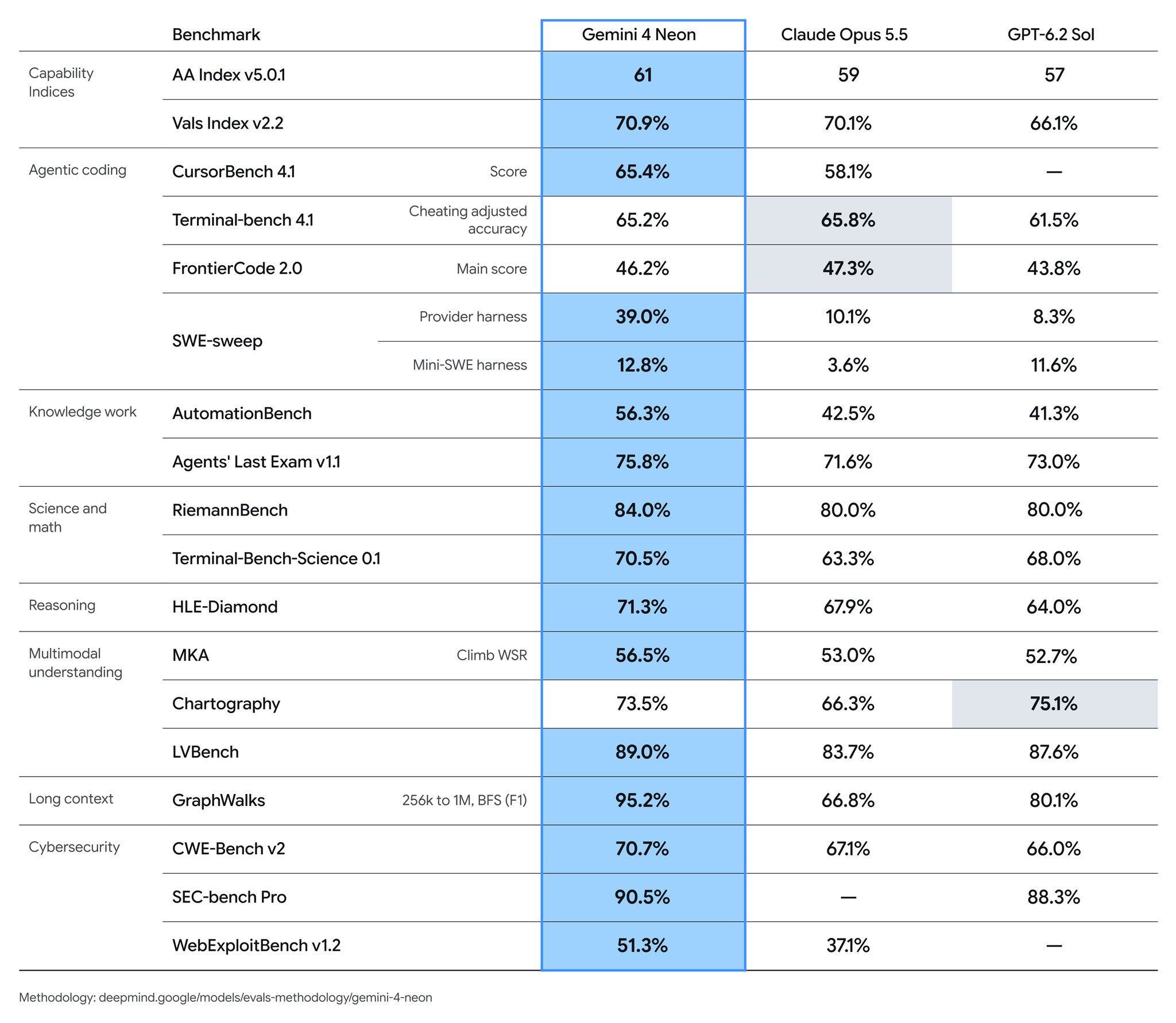
That claim holds at list price. It strains once Carbon's discount enters the math. A team billed by the token pays less running discounted Carbon than running Neon this month. Google itself still ranks Carbon a point behind Neon on its own benchmark23.
Willison's complaint rests on the receipt alone. Three models carry three prices right now, and the newest one costs the most of the three.
What to do
Run your own job through Neon and Carbon before you move a budget. Compare the dollar cost of a finished task, the number Artificial Analysis tracks, against the rate printed on Google's price page2.
Check your own door before you promise a team the switch. An API account, a Gemini app subscription and a Copilot seat each unlock Neon on different terms14.
Mark Dec. 1 on your calendar. Carbon's discount ends that day, and the price gap driving this story closes with it3.
By the numbers
- Neon's launch price: $3 and $15 per million input and output tokens, starting Nov. 181.
- Carbon's discount price: $2 and $10 per million tokens through Nov. 30, half its $4 and $20 list rate3.
- $6.44: Neon's average cost to finish one task scored 61 on Artificial Analysis's Intelligence Index2.
- $7.76: Carbon's average cost for the same kind of task at its own top setting and full list price2.
- Fourth model: Neon is Google's fourth Gemini 4 release since October, after Hydrogen, Carbon and Argon2.
- 1 million tokens: the size of Neon's context window, matching Carbon's and Hydrogen's1.
- Four plans: the Copilot tiers that carry Neon today, Pro+, Max, Business and Enterprise4.
What to watch
Watch Dec. 1, when Carbon's discount lapses and the per-token math flips back toward Google's own framing3. See whether Artificial Analysis publishes a fresh cost figure once Carbon trades at full price again2. Watch whether Google narrows this lineup instead of growing it. A fifth model inside two months would test how many prices one buyer can track.
Sources
- Koray Kavukcuoglu, "Introducing Gemini 4 Neon," Google, Nov. 18, 2026, https://blog.google/innovation-and-ai/models-and-research/gemini-models/introducing-gemini-4-neon/
- Artificial Analysis, "Google continues to accelerate its release cadence with Gemini 4 Neon," Artificial Analysis, Nov. 18, 2026, https://artificialanalysis.ai/articles/gemini-4-neon-intelligence-gain
- Simon Willison, "Release: llm-gemini 0.38," Simon Willison's Weblog, Nov. 18, 2026, https://simonwillison.net/2026/Nov/18/llm-gemini/
- GitHub, "Gemini 4 Neon in GitHub Copilot," GitHub Changelog, Nov. 18, 2026, https://github.blog/changelog/2026-11-18-gemini-4-neon-in-github-copilot/
- Google Antigravity, "Gemini 4 Neon in Google Antigravity," Google Antigravity, Nov. 18, 2026, https://antigravity.google/blog/gemini-4-neon-in-google-antigravity/
- TheNextWeb, "Google's Gemini 4 Neon ranks third in AI tests, replacing Argon in Gemini," TheNextWeb, Nov. 18, 2026, https://thenextweb.com/news/gemini-4-neon-google-third-intelligence-index-replaces-argon