Deezer tracked the moment this summer. AI-made tracks passed half of everything arriving on the service each day in June, the company said July 213. Nearly 90,000 fully AI-made songs landed daily that month.
Most listeners miss the difference anyway. A blind test Ipsos ran for Deezer found only 3% of 9,000 listeners picked the AI track correctly2. Five checkable signs can do what the ear alone misses.
The Tag on the Track
A tag on the track itself is the surest sign of all. Four major services now print one there.
Deezer flags any song its detector calls fully AI-made, a practice running since 20251. YouTube Music added three labels on Oct. 14. A track gets Fully Gen AI, Partly Gen AI, or a tag confirming a person made it7.
Apple told its label partners on Aug. 20 that AI use now triggers a mandatory tag. The tag, Made With AI, applies once AI made a material part of a track8. Tidal gives a fully AI track its own badge and stopped paying royalties on one from July 159.
Tony Gervino, Tidal's editor-in-chief, named the policy's target. Listeners are "inundated with music that is created completely AI-generated and impersonating existing artists purely for financial gain," he said9.
Spotify runs a quieter version. Its credits tab can carry an AI disclosure a distributor filled in7. Amazon Music keeps every track unmarked.
6 of 7 major streaming services now label some AI music
Major music streaming platforms with an AI disclosure or detection label in place, November 2026
Each cube is one of the seven platforms this piece checked. Magenta cubes already label some AI music. The gray cube is Amazon Music, which keeps every track unmarked.
Sources: Deezer Newsroom [1]; Deezer Newsroom [2]; Deezer Newsroom [3]; TechCrunch [7]; Engadget [8]; Yahoo Entertainment [9]. Chart by Ryan Elliott Dennis.
The numbers behind this chart
| Item | Value |
|---|---|
| Labels some AI music | 6 |
| Amazon Music, unmarked | 1 |
| Whole | 7 |
Six of the seven services this piece checked mark some AI music somewhere a listener can see. Only Amazon Music, among the seven, skips it.
A Detector Names the Model
This second sign needs one extra step. Deezer's own detector, free to any listener, scans a playlist and names which generator likely made each track2.
The tool works by finding signatures generative models leave behind in the audio. Those signatures usually sit too faint for a human ear2. Deezer says it catches Suno and Udio tracks this way. The company claims 99.8% accuracy, missing about two AI tracks in every 1,000.
Alexis Lanternier, Deezer's chief executive, points to demand behind the tool. "A vast majority of people want to know if AI music is being recommended to them and our data show that nearly half of the users joining Deezer from another platform have AI tracks in their playlists," he said when the free detector launched in June2.

This detector reads a whole mix, past just a vocal line. A producer's own gear leaves its signature in that same mix, and that signature matters for the next two signs.
The Voice Gives It Away
Two signs live in the sound itself, and the voice goes first.
AI vocals often sound smoother than a real singer's. A real voice slips, breathes at odd spots, or bends a note off pitch. An AI voice rarely does11.
Engadget's review of the tells found something sharper. AI vocals tend to hold one emotional register through a whole verse, rarely lifting or dropping with the lyric11. A phrase held too long on one breath reads the same tell. The same tell shows up when a breath lands in the wrong spot.

Rhythm Too Perfect to Be Real
The second sound sign sits in the rhythm.
Real drummers drift. Human timing wanders around the beat by design, and musicians call that drift groove11. AI-made tracks often snap to the grid instead, with every hit landing in the same place every time.
Structure repeats too. Engadget found AI songs reuse the same chord moves and skip the bridge a human writer would add for contrast11.
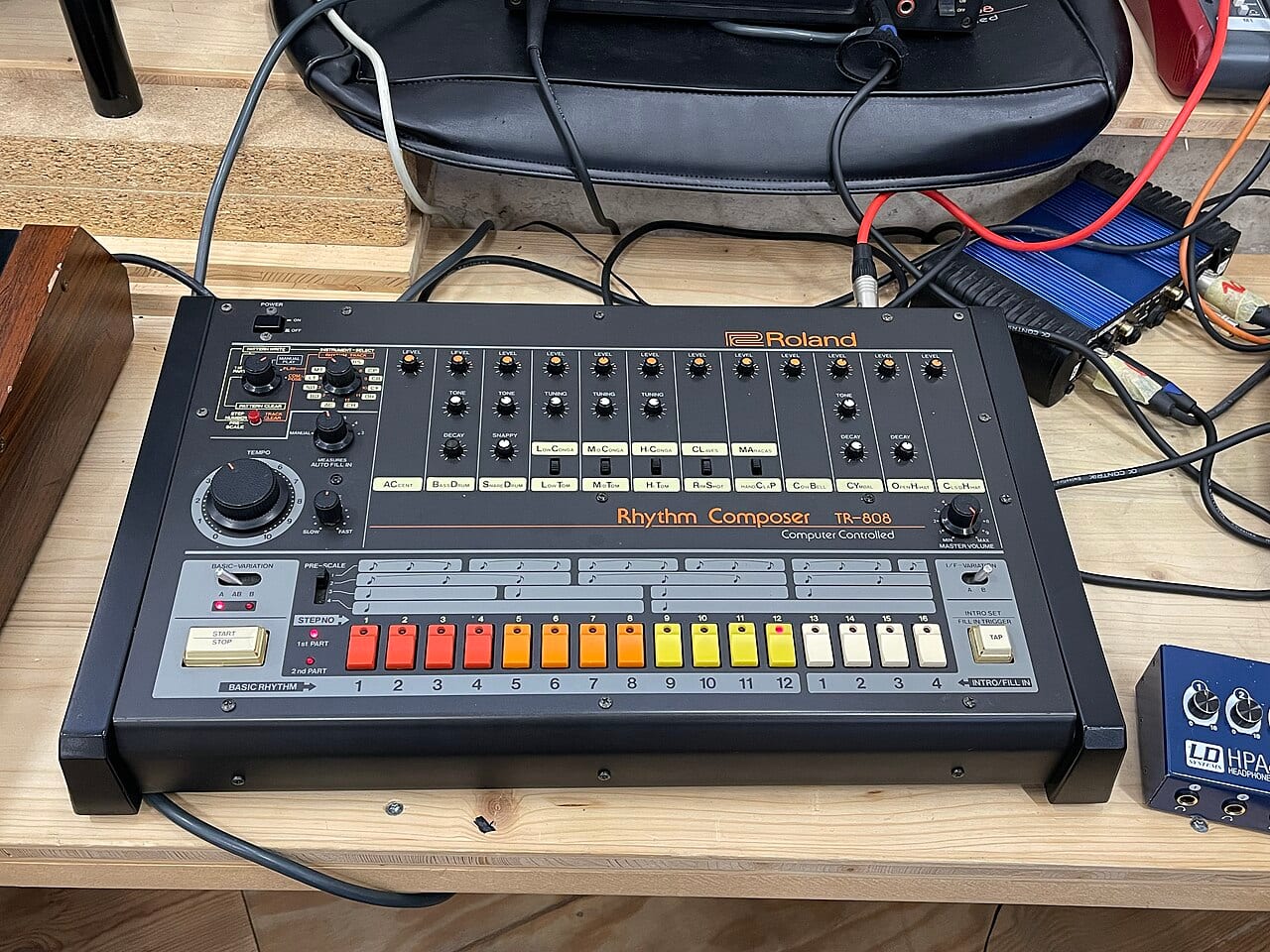
A listener who notices a song too steady to sway to has found a real tell. That tell still fits better alongside the others than on its own.
The Stream Count Outruns the Fan Base
A fifth sign lives in the money more than the music.
Fraud rings use AI tracks to farm plays. Generating hundreds of songs costs little next to recording them. Up to 85% of streams on Deezer's AI-made tracks were fraudulent in 2025, against 8% across its whole catalog1.
A catalog of hundreds of tracks is one part of the tell outside Deezer's own data. Streams far past that catalog's social following make up the other part. Labels and distributors already watch for it. Deezer has licensed its detector to Sacem, the French rights group representing more than 300,000 creators, since January 202610.
Why the Ear Still Gets Fooled
Deezer's confidence runs high. Lanternier points to the detector his own engineers built. It has flagged every upload since January 20253.
A peer-reviewed test disagrees, at least for the hardest cases. Researchers led by David López-Ayala built a 40-hour archive of real television recordings. They ran two trained detectors against it5.
Clean, isolated tracks scored 99.2% either way5. Real broadcast recordings told a different story. There, a standard detector fell to 18.6%. Training a detector on broadcast audio only lifted that to 47.2%, still far under the clean score.
A detector's score falls from 99.2 to as low as 18.6 on real broadcast audio
F1 score (higher is better) for two CNN-based AI-music detectors, by test condition, an August 2026 study
Each pair of columns is one test condition. The blue column is a detector trained on clean music, the magenta column is a version trained on broadcast-style audio, and both fall as the audio gets closer to a real television mix.
The clean row uses isolated studio audio, so only the real broadcast row reflects an actual television mix.
Source: arXiv [5]. Chart by Ryan Elliott Dennis.
The numbers behind this chart
| Item | Trained on clean music | Trained on broadcast audio |
|---|---|---|
| Clean audio | 99.2% | 99.2% |
| Real broadcast | 18.6% | 47.2% |
André Grafert found the same gap from the artist's side. The Hamburg musician released a 23-track covers album in June, made note by note on hardware synthesizers and his own vocals4. SubmitHub, the detector a reviewer leaned on most, flagged all 23 tracks as possibly AI-made. Two archival 1980s originals got misattributed too, to named AI tools that postdate them by decades.

"Suddenly, every independent musician and every young, up-and-coming band comes under pressure to justify themselves as soon as a track is professionally produced in a modern and clean way," Grafert said4.
Ines Weidemann, who ran the test for International Artist Marketing, warns the stakes go past embarrassment. A false flag can freeze an account, hold back a release, or stop a royalty payment before a human reviews it4.
A separate team tested nine watermarking systems built to prove where a track came from. They ran 109 attack configurations against them, drawn from 22 kinds of distortion6. Every one of the nine fell to at least one attack.
What to do
Check the tag before the ear. A platform's own label beats a guess every time1789. Run a suspicious track through Deezer's free detector when a tag is absent. Treat the result as one data point in a larger picture2.
Listen for the breath and the bridge. One tell proves little, but three or four pointing the same way build a case even a careful fan can trust11.
Favor an artist with a touring history or a long back catalog when the choice is close. That history is the one sign a detector score, or a stream count, rarely fakes14.
By the numbers
- 97%: share of 9,000 surveyed listeners who missed the AI track in Deezer and Ipsos's blind test2.
- 90,000: AI-made tracks arriving on Deezer each day in June, pushing AI past half of daily uploads for the first time3.
- 99.8%: Deezer claims this accuracy for its free detector, missing about two AI tracks per 1,0002.
- 18.6%: the score a standard detector managed on real broadcast recordings, down from 99.2% on clean audio5.
- 23: handmade tracks on André Grafert's covers album that every detector he tried flagged as AI-made4.
- 6 of 7: major streaming services that now mark some AI music, with Amazon Music the exception1789.
What to watch
Apple left the mandatory tag's start date open. Watch for it before the year ends8. A second broadcast-monitoring study would show whether more real-world training keeps closing the gap López-Ayala's team found5. Grafert's new EP, built to make the false-positive case directly, is worth a replay once a platform responds to it4.
Sources
- Jesper Wendel, "Deezer: AI-generated tracks now represent 44% of all new uploaded music," Deezer Newsroom, April 20, 2026, https://newsroom-deezer.com/2026/04/ai-generated-tracks-represent-44-of-new-uploaded-music/
- Maribel Khouwes, "Deezer launches AI music detector for playlists on all major streaming platforms," Deezer Newsroom, June 11, 2026, https://newsroom-deezer.com/2026/06/check-ai-generated-music-in-playlists-with-deezer-detector/
- Jesper Wendel, "Deezer: AI music has surpassed 50% of new music uploads for the first time," Deezer Newsroom, July 21, 2026, https://newsroom-deezer.com/2026/07/ai-music-exceeds-50-percent-daily-uploads-deezer/
- Ashley King, "More AI Detector False Positives Emerge In Rapid Succession: Do Indie Musicians Have a Serious Problem Here?," Digital Music News, Nov. 4, 2026, https://www.digitalmusicnews.com/2026/11/04/ai-detector-false-positives/
- David López-Ayala, Fernando García de la Cruz, Pablo Zinemanas, Emilio Molina and Martín Rocamora, "Assessing AI-generated music detection in real-world broadcast monitoring," arXiv, Aug. 7, 2026, https://arxiv.org/abs/2608.07359
- Yizhu Wen, Ashwin Innuganti, Aaron Bien Ramos, Hanqing Guo and Qiben Yan, "SoK: How Robust is Audio Watermarking in Generative AI models?," arXiv, March 24, 2025, https://arxiv.org/abs/2503.19176
- Lauren Forristal, "YouTube Music launches new labels as AI-generated music floods streaming platforms," TechCrunch, Oct. 14, 2026, https://techcrunch.com/2026/10/14/youtube-music-launches-new-labels-as-ai-generated-music-floods-streaming-platforms/
- Anna Washenko, "Apple Music will reportedly label any AI-made tracks later this year," Engadget, Aug. 20, 2026, https://www.engadget.com/2241260/apple-music-will-reportedly-label-any-ai-made-tracks-later-this-year/
- Trace William Cowen, "Tidal Has New Rules for AI-Generated Music: What About Other Platforms?," Yahoo Entertainment, July 5, 2026, https://www.yahoo.com/entertainment/music/articles/tidal-rules-ai-generated-music-145848600.html
- Lauren Forristal, "Deezer makes it easier for rival platforms to take a stance against AI-generated music," TechCrunch, Jan. 29, 2026, https://techcrunch.com/2026/01/29/deezer-makes-it-easier-for-rival-platforms-to-take-a-stance-against-ai-generated-music
- Jack Peachey, "AI music can be difficult to detect, but there are some telltale signs," Engadget, Nov. 8, 2026, https://www.engadget.com/2308062/ai-music-difficult-to-detect-telltale-signs/