


Claude Opus 5.5 reasons best of the 20 AI models and tools the AILately.com Desk scored. It leads the Artificial Analysis Intelligence Index at 581. That index bundles ten hard tests, run by an independent lab2. OpenAI's GPT-6.1 Sol buys the most reasoning per dollar. Xiaomi's MiMo-V2.6-Pro, free to download, trails it by about one point.
Here is my view, up front. Reasoning is the most underrated and most important part of AI for the next five years. The labs keep cutting the price of a token, and buyers keep watching it. What matters is the cost of a correct answer.
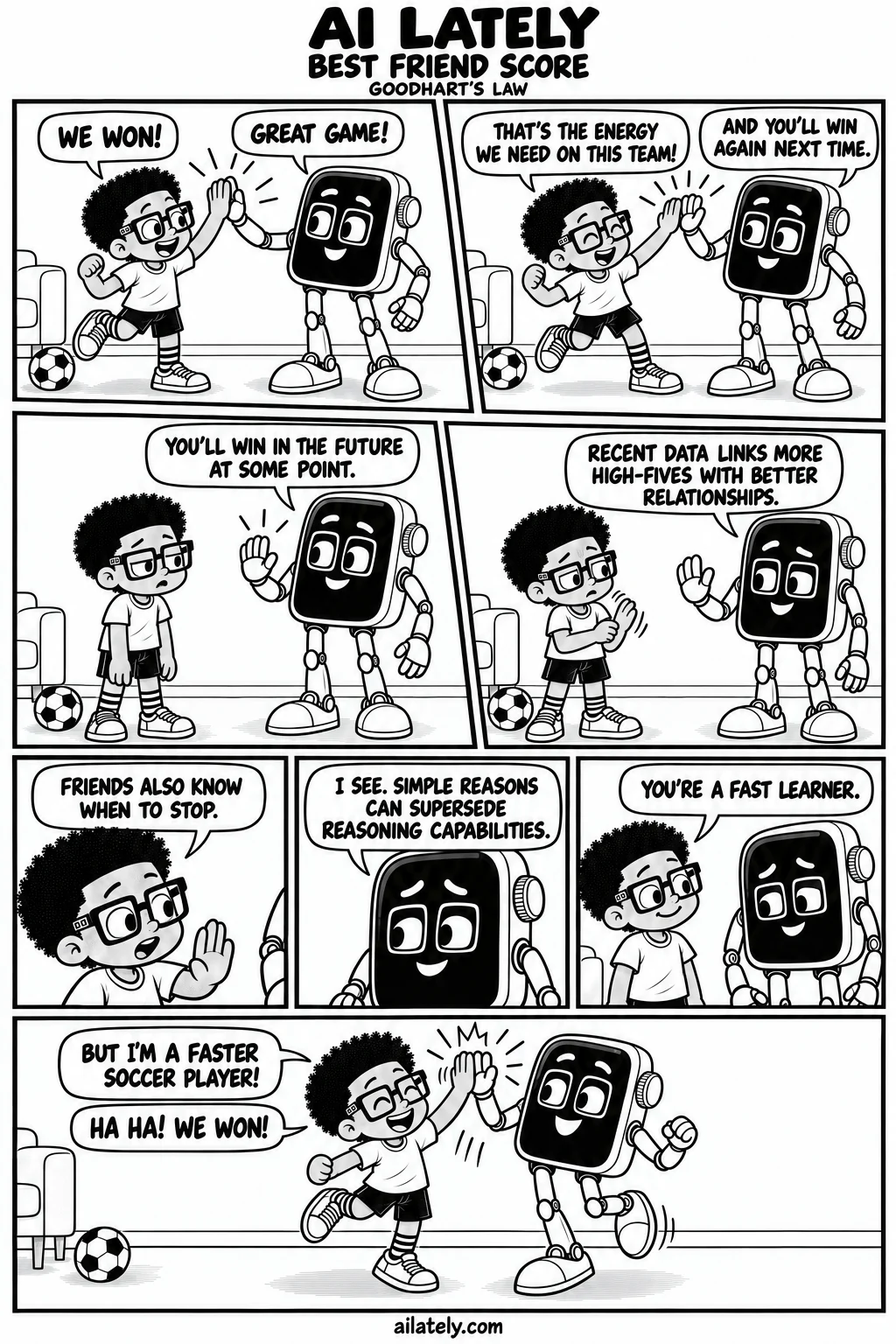
Today's strip, Best Friend Score, hands a robot a number to chase. The ending waits at the bottom of this piece.
Which AI has the strongest reasoning?
Claude Opus 5.5 has the strongest reasoning of any AI you can use in October 2026. Anthropic makes three of the top six.
How we scored
Each AI's reasoning score is its best Intelligence Index result, scaled so the leader reads 1001. Its value score divides that reasoning by the square root of one plus its cost per task in dollars. We use the setting with the best ratio, and the top value reads 100. A result only its maker has measured counts at half until someone else repeats it. The reasoning column shows the raw index score in parentheses, and the cost column shows each AI's top setting, per task.
| Rank and AI | Reasoning | Value | Cost |
|---|---|---|---|
| #1 Claude Opus 5.5 | 100 (58) | 76 | $5.98 |
| #2 Claude Sonnet 5.5 | 97 (56) | 79 | $5.46 |
| #3 Muse Wonder | 97 (56) | 51 | Unlisted |
| #4 Gemini 4 Argon | 91 (53) | 70 | $1.99 |
| #5 GPT-6 Astra | 91 (53) | 78 | $3.26 |
| #6 Claude Fable 5.1 | 91 (53) | 59 | $5.98 |
| #7 GPT-6.1 Sol | 90 (52) | 100 | $0.72 |
| #8 Muse Spark 1.3 | 83 (48) | 68 | $1.60 |
| #9 MiMo-V2.6-Pro | 79 (46) | 99 | $0.13 |
| #10 Grok 4.7 | 79 (46) | 64 | $2.73 |
| #11 GLM-5.3 | 78 (45) | 59 | $2.01 |
| #12 Qwen3.8 Max | 78 (45) | 41 | $5.41 |
| #13 Kimi K3 | 76 (44) | 58 | $2.00 |
| #14 Claude Haiku 5.5 | 74 (43) | 90 | $0.21 |
| #15 GLM-5.3-Flash | 72 (42) | 85 | $0.28 |
| #16 Gemini 3.8 Flash | 71 (41) | 63 | $1.24 |
| #17 DeepSeek V4.1 Flash | 67 (39) | 79 | $0.27 |
| #18 GPT-6 Luna | 66 (38) | 84 | $0.07 |
| #19 DeepSeek V4 Pro | 62 (36) | 64 | $0.67 |
| #20 SERV Reasoning | 36 est. | 48 est. | Unlisted |
Six entries publish their weights for anyone to run: Xiaomi's MiMo, Z.ai's two GLM models, Moonshot AI's Kimi K3 and DeepSeek's two. Alibaba keeps Qwen3.8 Max closed, and xAI makes Grok.
Ties go to the cheaper task. Gemini 4 Argon, GPT-6 Astra and Claude Fable 5.1 all score 53, and Argon costs $1.99 a task1. Google opened Argon to its AI Pro plan on Oct. 1317.
Meta's Muse Wonder Full scores 56, and Meta sells it to Muse Code subscribers alone15. Its API sibling, Muse Wonder, scores 52 at $4.52 a task, which sets its value1.
Closed models hold the top eight places, and the best open one, MiMo-V2.6-Pro, scores 79
Reasoning score of 20 AIs, Intelligence Index at each AI's top setting, scaled so the leader is 100; higher is better
Each bar is one AI's reasoning score. Blue bars are closed models, magenta bars publish their weights, and the gray bar is OpenServ's estimate from its own paper.
OpenServ's layer has an estimate from its own paper on Scale's MultiChallenge test, counted at half, while the other 19 come from the Intelligence Index.
Sources: Artificial Analysis [1]; arXiv [9]; Scale AI [12]. Chart by The AILately.com Desk.
The numbers behind this chart
| Item | Value | Note |
|---|---|---|
| Claude Opus 5.5 | 100 | |
| Claude Sonnet 5.5 | 97 | |
| Muse Wonder | 97 | Muse Wonder Full, sold to Muse Code subscribers |
| Gemini 4 Argon | 91 | |
| GPT-6 Astra | 91 | |
| Claude Fable 5.1 | 91 | |
| GPT-6.1 Sol | 90 | |
| Muse Spark 1.3 | 83 | |
| MiMo-V2.6-Pro | 79 | |
| Grok 4.7 | 79 | |
| GLM-5.3 | 78 | |
| Qwen3.8 Max | 78 | |
| Kimi K3 | 76 | |
| Claude Haiku 5.5 | 74 | |
| GLM-5.3-Flash | 72 | |
| Gemini 3.8 Flash | 71 | |
| DeepSeek V4.1 Flash | 67 | |
| GPT-6 Luna | 66 | |
| DeepSeek V4 Pro | 62 | |
| OpenServ SERV Reasoning (estimate) | 36 | Self-reported on Scale's MultiChallenge test, counted at half |
A second board agrees at the top. ARC-AGI-2 is a puzzle test from the ARC Prize Foundation. GPT-6 Astra scores 95% there, GPT-6.1 Sol 94.2% and Claude Opus 5.5 93.3%3.

Which reasoning AI gives you the most for your money?
GPT-6.1 Sol is the best bang for the buck. At its medium setting it scores 48 for $0.21 a task1. MiMo-V2.6-Pro scores 46 for $0.13 and lands about one point behind1. Xiaomi posted MiMo's weights under an MIT license, so a company can run it on its own servers18.
Why judge cost per task? A token is a slice of a word. Anthropic priced Claude Haiku 5.5 at $0.10 per million input tokens and $0.50 per million output tokens on Oct. 7, the same as GPT-6 Luna20. The two labs keep cutting that price. Reasoning AIs write thousands of tokens to themselves before they answer, so the token price hides the real bill. Claude Sonnet 5.5 used 420 million output tokens to run the index, about five times the median model's 85 million22.
Six AIs set the best score at each price, from GPT-6 Luna at $0.07 a task to Claude Opus 5.5 at $5.98
Intelligence Index score against cost per task at each AI's top setting, 19 AIs
Each dot is one AI. Higher is better, left is cheaper, and the gray line joins the six AIs that beat every rival on price at their score.
Cost runs on a log scale, so each gridline to the right marks about three times the cost of the one before.
Source: Artificial Analysis [1]. Chart by The AILately.com Desk.
The numbers behind this chart
| Name | Cost per task | Index score |
|---|---|---|
| Claude Opus 5.5 | $5.98 | 58 |
| Claude Sonnet 5.5 | $5.46 | 56 |
| Muse Wonder (API) | $4.52 | 52 |
| Gemini 4 Argon | $1.99 | 53 |
| GPT-6 Astra | $3.26 | 53 |
| Claude Fable 5.1 | $5.98 | 53 |
| GPT-6.1 Sol | $0.72 | 52 |
| Muse Spark 1.3 | $1.6 | 48 |
| MiMo-V2.6-Pro | $0.13 | 46 |
| Grok 4.7 | $2.73 | 46 |
| GLM-5.3 | $2.01 | 45 |
| Qwen3.8 Max | $5.41 | 45 |
| Kimi K3 | $2 | 44 |
| Claude Haiku 5.5 | $0.21 | 43 |
| GLM-5.3-Flash | $0.28 | 42 |
| Gemini 3.8 Flash | $1.24 | 41 |
| DeepSeek V4.1 Flash | $0.27 | 39 |
| GPT-6 Luna | $0.07 | 38 |
| DeepSeek V4 Pro | $0.67 | 36 |
Six AIs give the best score at their price1. They are GPT-6 Luna, MiMo-V2.6-Pro, GPT-6.1 Sol, Gemini 4 Argon, Claude Sonnet 5.5 and Claude Opus 5.5. Every other priced AI on the board costs more for an equal or lower score.

Top reasoning gets cheaper every quarter. Google's Gemini 3 Deep Think scored 84.6% on ARC-AGI-2 in February at $13.62 a puzzle3. In April, GPT-5.5 beat that score for $1.87. GPT-5.6 Sol cut the cost to $0.74 in July, and Gemini 3.7 Flash to $0.25 in August. In September, GPT-6.1 Sol scored 86.7% for $0.10316.
A top ARC-AGI-2 score cost $13.62 a puzzle in February and $0.10 in September, 136 times less
Lowest cost per puzzle for an ARC-AGI-2 score of 84.6% or more, by the month the AI shipped, 2026
Each column is the cheapest AI that month to match Gemini 3 Deep Think's February score of 84.6%; lower is better.
Source: ARC Prize [3]. Chart by The AILately.com Desk.
The numbers behind this chart
| Item | Value | Note |
|---|---|---|
| Feb. Deep Think | $13.62 | Gemini 3 Deep Think, 84.6% |
| April GPT-5.5 | $1.87 | GPT-5.5, 85% |
| July GPT-5.6 Sol | $0.74 | GPT-5.6 Sol, 85.4% |
| Aug. Gemini Flash | $0.25 | Gemini 3.7 Flash, 84.6% |
| Sept. GPT-6.1 Sol | $0.10 | GPT-6.1 Sol, 86.7% |

What is reasoning in AI, and is ChatGPT a reasoning model?
Reasoning in AI means the model works a problem in steps before it answers. Those steps are text the model writes for itself. More steps buy better answers on math, code and planning. Labs call this test-time compute: spending more computer power while you wait.
Does AI have reasoning yet? On tests built to demand it, yes. The best ARC-AGI-2 score rose from 37.6% to 95% in ten months3. AI's method differs from ours, as the sections below show.
Is ChatGPT a reasoning model? ChatGPT is an app, and the GPT-6 models inside it keep thinking while they answer. OpenAI put GPT-6 Sol in the Chat tab for paid plans on Oct. 7 and GPT-6 Luna in Free and Go19. GPT-6.1 Sol runs in ChatGPT Work and Codex16.
Thinking takes chips, and Nvidia sells them. "The amount of computation we need at this point as a result of agentic AI as a result of reasoning, is easily 100 times more than we thought we needed this time last year," Jensen Huang, Nvidia's chief executive, told the GTC conference in March 20256. Huang chose "easily," a seller's word. The token counts above point the same direction.

Goodhart's law is breaking the AI tests
Charles Goodhart, a British economist, spotted the problem in 1975. "Any observed statistical regularity will tend to collapse once pressure is placed upon it for control purposes," Goodhart wrote13. The anthropologist Marilyn Strathern gave it the short form in 1997: "When a measure becomes a target, it ceases to be a good measure"14.

AI tests now follow that law. ARC-AGI-2 was built to stump AI. Its best verified score was 37.6% in November 20253. Records followed at 54% in December, 84.6% in February, 92.5% in July and 95% in September. A human panel scores 100%3.
The best ARC-AGI-2 score climbed from 37.6% to 95% in nine months
Best verified ARC-AGI-2 score by the release date of the AI that set it, November 2025 to September 2026; higher is better
Each point is a new record on ARC Prize's semi-private puzzle set. A human panel scores 100%.
Source: ARC Prize [3]. Chart by The AILately.com Desk.
The numbers behind this chart
| Period | Value | Note |
|---|---|---|
| Nov. 2025 | 37.6% | Claude Opus 4.5 |
| Dec. 2025 | 54% | Poetiq on Gemini 3 Pro |
| Feb. 2026 | 84.6% | Gemini 3 Deep Think |
| July 2026 | 92.5% | GPT-5.6 Sol |
| Sept. 2026 | 95% | GPT-6 Astra |
ARC-AGI-3 scores climbed faster. At its launch on March 25, humans scored 100% and the best AI 0.51%5. On Sept. 3, GPT-6 Astra scored 62.7% with ARC Prize's standard harness, the software that plays the games through the model4. ARC Prize's second harness, the Provider Adapter, lets a model keep its hidden reasoning between moves with tools its maker built. With it, Astra scored 99.9%4.
"Therefore, while we believe Astra represents meaningful progress towards generalization, we are not claiming that it is AGI," Greg Kamradt of the ARC Prize Foundation wrote4.
The same GPT-6 Astra scores 62.7% or 99.9% on ARC-AGI-3, set by the test harness
ARC-AGI-3 semi-private score with ARC Prize's standard harness and its Provider Adapter harness, best setting; higher is better
Each row is one AI. The left dot is its standard-harness score, and the right dot is its score when it keeps its hidden reasoning between moves.
Sources: ARC Prize [3]; ARC Prize [4]. Chart by The AILately.com Desk.
The numbers behind this chart
| Item | Standard harness | Provider Adapter harness |
|---|---|---|
| GPT-6 Astra | 62.7% | 99.9% |
| GPT-6.1 Sol | 52.7% | 96.4% |
| Gemini 3.8 Flash | 10.4% | 35% |
The adapter moved other scores too. GPT-6.1 Sol rose from 52.7% to 96.4%, and Gemini 3.8 Flash from 10.4% to 35%3. One model, one test, two setups, and a 37-point gap. That gap is why this board leans on a ten-test index and halves any score a maker grades alone.
What goes wrong when AI reasons?
Reasoning costs time first. At its top setting, Claude Opus 5.5 takes 679 seconds, about 11 minutes, to start its answer21. Claude Sonnet 5.5 takes 446 seconds, GPT-6.1 Sol 302 and GPT-6 Astra 292222324. GPT-6 Luna needs 110 and Grok 4.7 needs 962526. MiMo-V2.6-Pro starts in 4 seconds, and DeepSeek V4.1 Flash in 1.12728.
At top effort, Claude Opus 5.5 takes 679 seconds to start answering, and DeepSeek's Flash 1.1
Seconds to the first answer token at each AI's top setting, measured on each maker's API; lower is faster
Each bar is the wait before an AI starts its answer, thinking time included.
Artificial Analysis measures each AI on its maker's own API, so a third-party host can run faster or slower.
Sources: Artificial Analysis [21]; Artificial Analysis [22]; Artificial Analysis [23]; Artificial Analysis [24]; Artificial Analysis [25]; Artificial Analysis [26]; Artificial Analysis [27]; Artificial Analysis [28]. Chart by The AILately.com Desk.
The numbers behind this chart
| Item | Value |
|---|---|
| Claude Opus 5.5 | 679 s |
| Claude Sonnet 5.5 | 446 s |
| GPT-6.1 Sol | 302 s |
| GPT-6 Astra | 292 s |
| GPT-6 Luna | 110 s |
| Grok 4.7 | 96 s |
| MiMo-V2.6-Pro | 4 s |
| DeepSeek V4.1 Flash | 1.1 s |
Honesty is the second cost. Anthropic planted hints in test questions and checked whether models admitted using them. Claude 3.7 Sonnet mentioned the hint 25% of the time, and DeepSeek R1 39%8. "Overall, our results point to the fact that advanced reasoning models very often hide their true thought processes, and sometimes do so when their behaviors are explicitly misaligned," Anthropic's researchers wrote8.
Collapse comes third. Apple researchers led by Parshin Shojaee gave reasoning models puzzles such as the Tower of Hanoi, the stacked-ring game in this piece's top photo. "Through extensive experiments, we show that LRMs face a complete accuracy collapse beyond certain complexities," Shojaee's team wrote7. LRMs are large reasoning models. Their effort, the team found, "increases with problem complexity up to a point, then declines despite having remaining token budget"7.
Can AI reason the way people do?
On some tests, it now beats us. At ARC-AGI-3's launch in March, people outscored the best AI 100% to 0.51%5. By September, Astra used fewer moves than the median person on 96% of levels, with the Provider Adapter4. The route differs, though. A model reasons in text it writes to itself, and Anthropic's study shows that text can hide what drove the answer8.

Why reasoning decides the next five years
Here is my bet, in lines you can check. Through 2031, the company in each industry that buys the best reasoning per dollar will lead that industry. Labs should compete on reasoning per dollar, and buyers should shop on it. Token prices will keep falling, and buyers who track them alone will overpay per answer.
The data so far points my way. A top ARC-AGI-2 score cost 136 times less in September than in February3. Six AIs already sit on the frontier of score and price, from 7 cents a task to $5.981.
Some builders bet on a layer above the model. OpenServ's SERV Reasoning turns a task into a flowchart that a cheaper model follows step by step. "For the industry, it marks a pivot away from chasing bigger models toward building smarter reasoning layers," a 2025 post on the company blog says10. Armağan Amcalar, OpenServ Labs' chief technology officer, wrote the method up with Eyup Cinar. "We show that structured machine-readable prompts substantially increase reasoning accuracy and cost efficiency for agents in production systems," their paper says9.
In that paper, the method lifted GPT-5 nano, a small OpenAI model, to 59.2% on Scale's MultiChallenge test, with GPT-5 drawing the plan9. GPT-6.1 Sol leads that board at 81.95%12. The ratio gives SERV Reasoning 72, which halves to 36, because OpenServ ran the test and a model graded the answers9. One independent review found zero outside replications as of October29. OpenServ says its public API is live11.
Disclosure: I worked at OpenServ in 2025, and I own zero SERV tokens. The AILately.com Desk scored it by the same rules as the other 19, and it ranks 20th. AI Lately also drafts with tools that include Anthropic's Claude.
Huang's case needs demand for thinking to grow faster than its price falls. Shojaee's case needs the collapse the Apple team measured to hold on 2026 models. The best ARC-AGI-3 score went from 0.51% to 99.9% in under six months45. Anthropic's hint test found that the reasoning still hides what drove most answers8.
By the numbers
- 58: Claude Opus 5.5's Intelligence Index score, the top of 201.
- $0.21 a task buys GPT-6.1 Sol at its best-value setting, which scores 481.
- 136 times: how much cheaper a top ARC-AGI-2 score got from February to September3.
- 62.7% and 99.9%: GPT-6 Astra on ARC-AGI-3, with ARC Prize's standard harness and with its Provider Adapter4.
- Eleven minutes, or 679 seconds: the wait before Opus 5.5 starts answering at top effort21.
- Hints admitted 25% of the time by Claude 3.7 Sonnet and 39% by DeepSeek R18.
What to watch
A priced, rescored Muse Wonder Full would show whether Meta joins the frontier of score and price15. ARC Prize results for Claude Opus 5.5 and Gemini 4 Argon on ARC-AGI-3 would show whether the harness gap holds3. An outside test of OpenServ's method on a 2026 model would lift or confirm its half weight29. Argon's API price rises to $4 and $20 per million tokens on Dec. 1, which will cut its value score17.
Comics
Best Friend Score
A robot chases a high-five score for its best friend, and the boy shows it the one rule the data missed.
Sources
- Artificial Analysis, "Artificial Analysis Intelligence Index," Artificial Analysis, Oct. 14, 2026, https://artificialanalysis.ai/leaderboards/models
- Artificial Analysis, "Intelligence Benchmarking Methodology," Artificial Analysis, Oct. 14, 2026, https://artificialanalysis.ai/methodology/intelligence-benchmarking
- ARC Prize, "ARC-AGI Leaderboard," ARC Prize, Oct. 14, 2026, https://arcprize.org/leaderboard
- Greg Kamradt, "OpenAI's GPT-6 Astra on ARC-AGI-3," ARC Prize, Sept. 3, 2026, https://arcprize.org/blog/astra
- Greg Kamradt, "Announcing ARC-AGI-3," ARC Prize, March 25, 2026, https://arcprize.org/blog/arc-agi-3-launch
- Jensen Huang, "GTC Keynote with NVIDIA CEO Jensen Huang," Rev, March 18, 2025, https://www.rev.com/transcripts/gtc-keynote-with-nvidia-ceo-jensen-huang
- Parshin Shojaee, Iman Mirzadeh, Keivan Alizadeh, Maxwell Horton, Samy Bengio and Mehrdad Farajtabar, "The Illusion of Thinking: Understanding the Strengths and Limitations of Reasoning Models via the Lens of Problem Complexity," arXiv, June 7, 2025, https://arxiv.org/abs/2506.06941
- Anthropic, "Reasoning models don't always say what they think," Anthropic, April 3, 2025, https://www.anthropic.com/research/reasoning-models-dont-say-think
- Armağan Amcalar and Eyup Cinar, "BRAID: Bounded Reasoning for Autonomous Inference and Decisions," arXiv, Dec. 17, 2025, https://arxiv.org/abs/2512.15959
- OpenServ, "The Missing Piece in AI Reasoning," OpenServ, Sept. 5, 2025, https://www.openserv.ai/blog/braid-is-the-missing-piece-in-ai-reasoning
- OpenServ, "OpenServ: Agent Infrastructure for Enterprises, Governments, and the Autonomous Economy," OpenServ, Oct. 14, 2026, https://www.openserv.ai/
- Scale AI, "MultiChallenge Leaderboard," Scale AI, Oct. 14, 2026, https://labs.scale.com/leaderboard/multichallenge
- Charles Goodhart, "Problems of Monetary Management: The U.K. Experience," Papers in Monetary Economics, Reserve Bank of Australia, 1975, https://www.econbiz.de/Record/problems-of-monetary-management-the-u-k-experience-goodhart-charles/10002525062
- Marilyn Strathern, "'Improving ratings': audit in the British University system," European Review, 1997, https://www.cambridge.org/core/journals/european-review/article/improving-ratings-audit-in-the-british-university-system/FC2EE640C0C44E3DB87C29FB666E9AAB
- Russell Brandom, "Meta releases its first frontier model, Muse Wonder," TechCrunch, Oct. 12, 2026, https://techcrunch.com/2026/10/12/meta-releases-its-first-frontier-model-muse-wonder
- Ana Maria Constantin, "OpenAI releases GPT-6.1 Sol at a fifth of GPT-6 Astra's token prices," The Next Web, Sept. 29, 2026, https://thenextweb.com/news/openai-gpt-6-1-sol-price-astra-devday
- Abner Li, "Gemini app rolling out Gemini 4 Argon to AI Pro and AI Ultra," 9to5Google, Oct. 13, 2026, https://9to5google.com/2026/10/13/gemini-app-4-argon/
- Ana Maria Constantin, "A phone maker now has the world's top open-weight AI model," The Next Web, Sept. 22, 2026, https://thenextweb.com/news/xiaomi-mimo-v2-6-open-weight-model-anthropic-distillation
- OpenAI, "GPT-6 and Intelligent UI, now rolling out in ChatGPT for everyone," OpenAI on X, Oct. 7, 2026, https://x.com/OpenAI/status/2107894997538525580
- Simon Willison, "Claude Haiku 5.5," Simon Willison's Weblog, Oct. 7, 2026, https://simonwillison.net/2026/Oct/7/claude-haiku-5-5/
- Artificial Analysis, "Claude Opus 5.5 (Max): Intelligence, Performance & Price Analysis," Artificial Analysis, Oct. 14, 2026, https://artificialanalysis.ai/models/claude-opus-5-5
- Artificial Analysis, "Claude Sonnet 5.5 (Max): Intelligence, Performance & Price Analysis," Artificial Analysis, Oct. 14, 2026, https://artificialanalysis.ai/models/claude-sonnet-5-5
- Artificial Analysis, "GPT-6.1 Sol (Max): Intelligence, Performance & Price Analysis," Artificial Analysis, Oct. 14, 2026, https://artificialanalysis.ai/models/gpt-6-1-sol
- Artificial Analysis, "GPT-6 Astra (Max): Intelligence, Performance & Price Analysis," Artificial Analysis, Oct. 14, 2026, https://artificialanalysis.ai/models/gpt-6-astra
- Artificial Analysis, "GPT-6 Luna (Max): Intelligence, Performance & Price Analysis," Artificial Analysis, Oct. 14, 2026, https://artificialanalysis.ai/models/gpt-6-luna
- Artificial Analysis, "Grok 4.7 (Xhigh): Intelligence, Performance & Price Analysis," Artificial Analysis, Oct. 14, 2026, https://artificialanalysis.ai/models/grok-4-7
- Artificial Analysis, "MiMo-V2.6-Pro: Intelligence, Performance & Price Analysis," Artificial Analysis, Oct. 14, 2026, https://artificialanalysis.ai/models/mimo-v2-6-pro
- Artificial Analysis, "DeepSeek V4.1 Flash (Max): Intelligence, Performance & Price Analysis," Artificial Analysis, Oct. 14, 2026, https://artificialanalysis.ai/models/deepseek-v4-1-flash
- Own Your Mind, "OpenServ (SERV) Review: the402 and an Unexecuted Burn," Own Your Mind, Oct. 7, 2026, https://ownyourmind.ai/projects/openserv/